
































Essential Defensible Claims Worksheet | Grade 10 English II

Paste this activity's link or code into your existing LMS (Google Classroom, Canvas, Teams, Schoology, Moodle, etc.).
Students can open and work on the activity right away, with no student login required.
You'll still be able to track student progress and results from your teacher account.
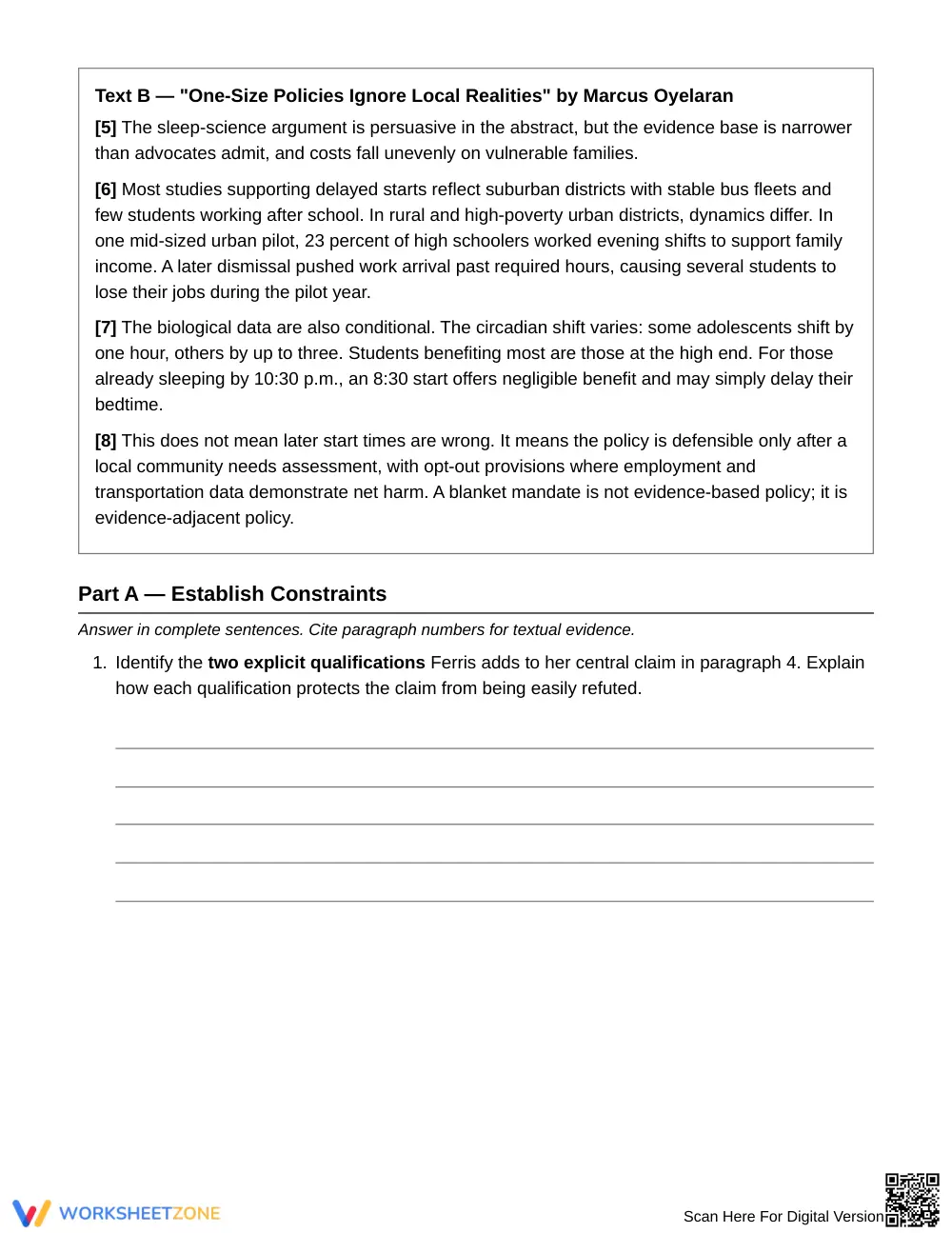
This Grade 10 English II worksheet trains students to reconstruct and defend nuanced textual arguments. Working with two paired informational texts on high school start times, learners evaluate argument validity, analyze logical constraints, and synthesize competing perspectives into precise, evidence-based qualified claims.
At a Glance
- Grade: 10 · Subject: English II
- Standard:
RI.9-10.8— Evaluate argument validity and evidence sufficiency in informational texts- Skill Focus: Reconstruct Defensible Claims
- Format: 5 pages · 8 problems · Answer key included · PDF
- Best For: Argument analysis and synthesis
- Time: 40–50 minutes
What's Inside
The 5-page printable resource features two paired point-counterpoint texts examining adolescent circadian biology alongside school scheduling logistics. Across 8 rigorous tasks, students engage with text-dependent analysis, multiple-choice reasoning evaluation, and open-ended claim revision prompts. A 2-page answer key provides exemplar responses.
Skill Progression
- Guided practice (Part A, 2 tasks): Students identify explicit claim qualifications and prerequisite policy conditions in the paired passages.
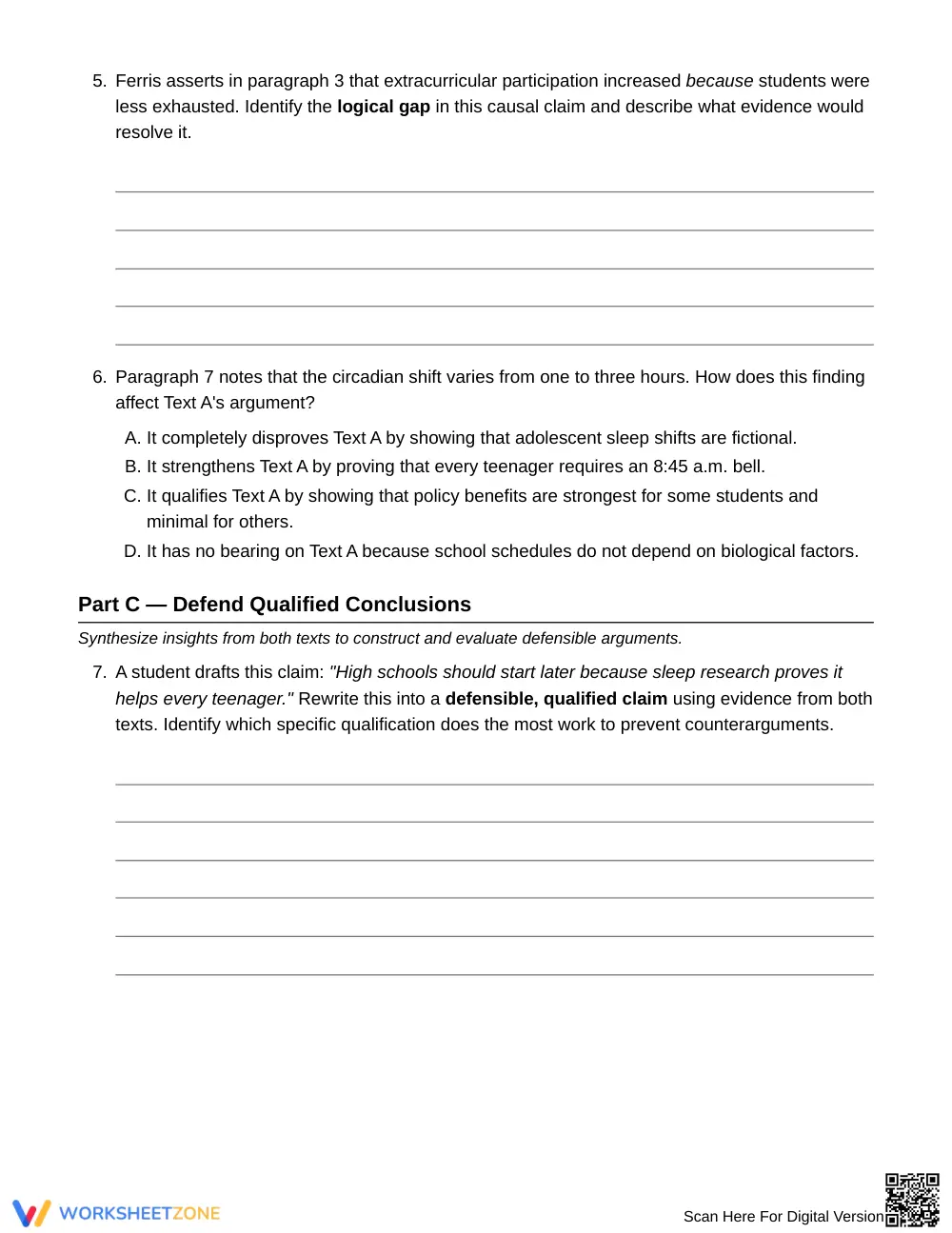
- Supported practice (Part B, 4 tasks): Students evaluate alternative assertions through multiple-choice questions and short responses addressing logical gaps.
- Independent practice (Part C, 2 tasks): Students synthesize opposing viewpoints to rewrite an overbroad claim into a defensible statement.
This structured progression follows a gradual-release model, moving students from identifying qualifiers to formulating balanced arguments.
Standards Alignment
This resource aligns with Common Core standard `RI.9-10.8`: Delineate and evaluate the argument and specific claims in a text, assessing whether the reasoning is valid and evidence is sufficient. Students evaluate the sufficiency of pilot study data and critique biological reasoning. Both standard codes can be copied directly into lesson plans, IEP goals, or district curriculum mapping tools.
How to Use It
Assign this worksheet during an argumentative writing unit after teaching claim qualification. Use Parts A and B during guided practice to check if students catch causal reasoning gaps in paragraph 3. Use Part C as a formative assessment of synthesis skills. Expect completion within 40 to 50 minutes.
Who It's For
This activity is designed for Grade 10 English students building argumentation and analytical skills. It provides clear structural scaffolds for developing writers while challenging advanced learners to evaluate conflicting evidence. Pair this worksheet with an anchor chart detailing argumentative qualifiers such as scope, conditions, and population boundaries.
According to research by Fisher & Frey (2014), robust argumentation instruction requires students to evaluate conflicting viewpoints and analyze how authors qualify their claims. Common Core standard `RI.9-10.8` requires Grade 10 learners to delineate and evaluate arguments in informational texts, assessing whether reasoning is valid and evidence is relevant and sufficient. This worksheet directly targets that standard through paired passages on school start times, guiding students through constraint identification, alternative testing, and claim reconstruction. By isolating logical fallacies and guiding students to rewrite an overgeneralized assertion into a defensible statement, this resource reinforces essential academic literacy. Teachers gain an efficient, standards-aligned tool to measure student capacity to weigh empirical evidence against practical logistical constraints. This focused practice prepares high school students for complex argumentative writing tasks and state reading assessments across secondary English curricula.


