




























Views
Downloads



Essential Convergent Boundaries Worksheet | Grade 8 Science

Paste this activity's link or code into your existing LMS (Google Classroom, Canvas, Teams, Schoology, Moodle, etc.).
Students can open and work on the activity right away, with no student login required.
You'll still be able to track student progress and results from your teacher account.
This Grade 8 plate tectonics worksheet directly addresses a persistent Earth science misconception: the false assumption that all convergent boundaries produce volcanoes. Through targeted error analysis, students evaluate synthetic plate data, identify flawed reasoning regarding subduction and crustal buoyancy, and write scientifically rigorous corrections detailing flux melting mechanisms.
At a Glance
- Grade: 8 · Subject: Science
- Standard: Plate Tectonics — Analyze crustal density and subduction dynamics to evaluate landform formation claims
- Skill Focus: Correct All-Convergent-Boundaries-Form-Volcanoes Claims
- Format: 5 pages · 8 problems · Answer key included · PDF
- Best For: Conceptual mastery and error analysis practice
- Time: 40–50 minutes
What's Inside
This five-page student packet features a comprehensive "Core Principles" reference box establishing crustal density metrics and flux melting criteria, followed by an annotated worked model repair. Students then tackle eight unique diagnostic tasks requiring scientific corrections of synthetic plate convergence data. A thorough three-page answer key provides complete sample diagnoses and model scientific explanations for immediate grading.
Skill Progression
- Guided practice: Students review the foundational reference text and the worked model repair of the Zagros Mountains collision, analyzing how continental buoyancy precludes subduction and volcanism.
- Supported practice (Problems 1–4): Learners diagnose four synthetic scenarios with explicit crustal densities and convergence rates, contrasting continental collisions with oceanic-continental subduction zones.
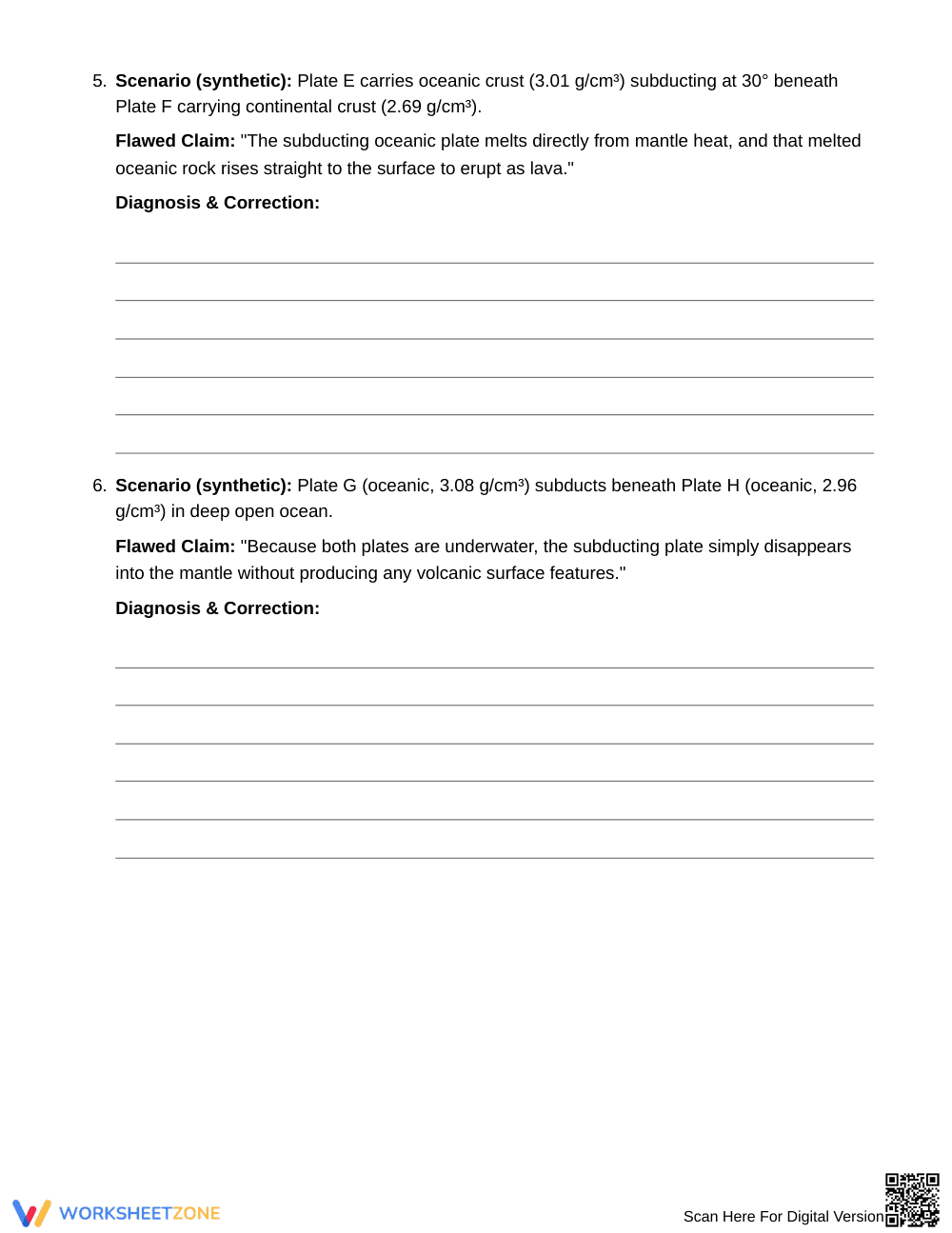
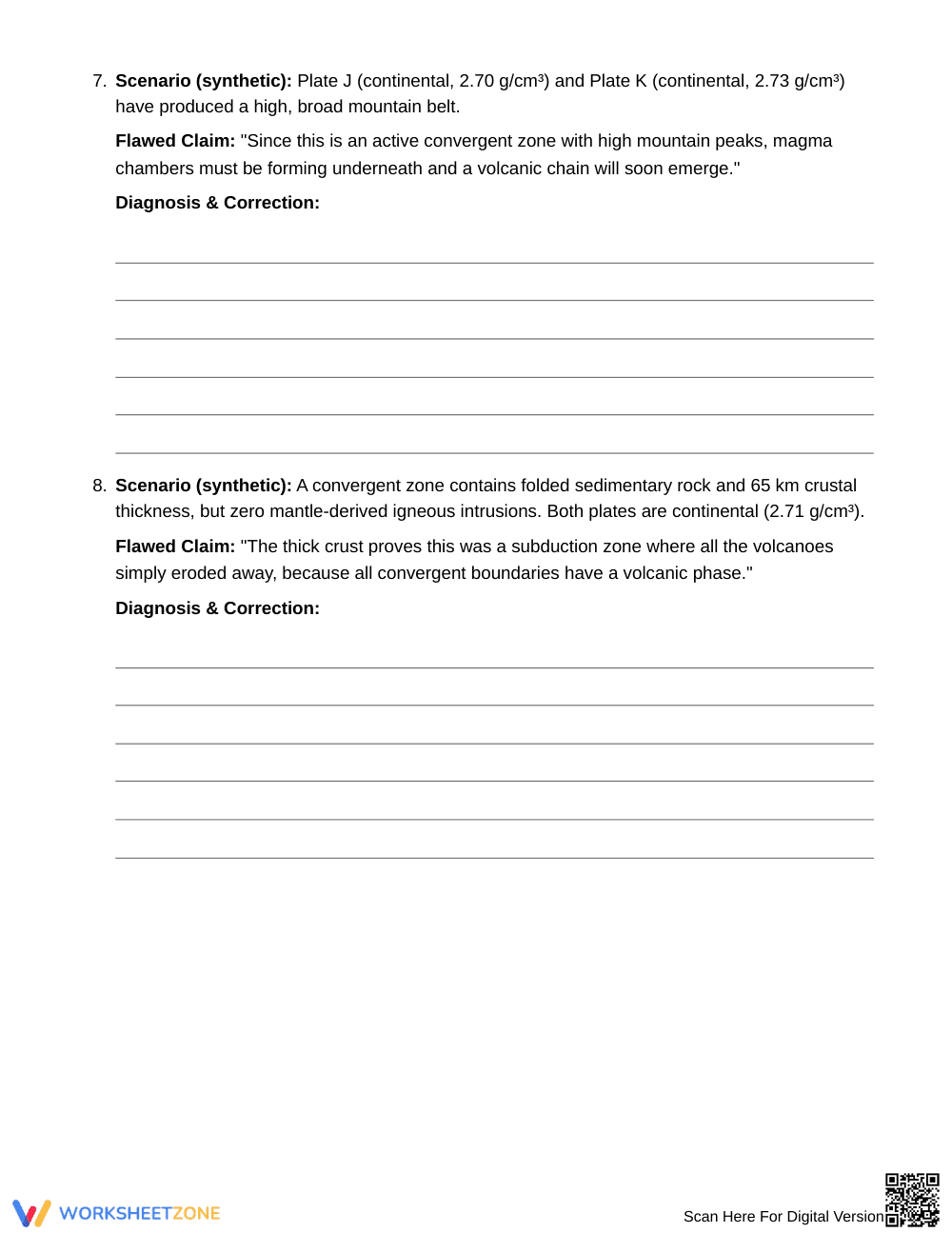
- Independent practice (Problems 5–8): Students analyze complex edge cases—including slab melt fallacies and thick crust misinterpretations—requiring full synthesis without inline hints.
This structured sequence reflects the gradual-release framework, moving students systematically from modeled diagnosis to independent scientific critique.
Standards Alignment
The curriculum aligns with middle school Earth and space science standards requiring students to develop and use models of Earth materials to explain cycling and geoscience processes. Learners evaluate how density differentials drive tectonic subduction or crustal crumpling. Standard alignments can be copied directly into lesson plans, IEP goals, or district curriculum mapping tools.
How to Use It
Deploy this packet after direct instruction on convergent boundaries to challenge surface-level pattern matching. As an active mid-unit formative check, assign Problems 1 through 4 during paired lab stations, circulating to observe whether students cite buoyancy values or default to simplistic motion rules. Alternatively, assign the final four scenarios as an end-of-unit summative evaluation. The complete activity takes approximately 40 to 50 minutes.
Who It's For
This resource targets eighth-grade science students who have memorized boundary definitions but struggle to explain causative mechanisms. The explicit density cues provide access for emerging scientists, while high-depth analytical repairs challenge advanced learners. Pair this worksheet directly with a physical foam-slab tectonic demonstration or an interactive subduction simulation.
Scientific misconception repair requires students to confront and systematically dismantle intuitive fallacies rather than simply restating correct definitions. According to Fisher & Frey (2014), structured error analysis provides essential cognitive scaffolding within the gradual-release of responsibility model, guiding learners from modeled teacher think-alouds toward autonomous conceptual evaluation. When Grade 8 students analyze why continental crust buoyancy prevents subduction, they do not merely memorize that continental-continental collisions produce non-volcanic mountain ranges; they actively evaluate density metrics and mechanical constraints. By identifying the absence of flux melting across synthetic data sets, learners transition from superficial keyword association to authentic causal reasoning. This rigorous eight-task protocol ensures students master plate interactions, cementing an empirical understanding of tectonic processes that directly supports long-term retention and higher-order diagnostic proficiency across all secondary Earth science coursework.


