




























Views
Downloads



Essential Consistent Units Worksheet | Grade 10 Geometry

Paste this activity's link or code into your existing LMS (Google Classroom, Canvas, Teams, Schoology, Moodle, etc.).
Students can open and work on the activity right away, with no student login required.
You'll still be able to track student progress and results from your teacher account.
This geometry worksheet equips tenth-grade students to reconcile mismatched measurement units before solving volume and surface area equations. Learners convert linear dimensions across metric and customary systems to model cylinders, cones, spheres, and composite solids, preventing calculation errors caused by inconsistent dimensional scales.
At a Glance
- Grade: 10 · Subject: Geometry
- Standard:
HSG-GMD.A.3— Apply volume formulas for cylinders, pyramids, cones, and spheres to solve multi-step problems.- Skill Focus: Calculate Measures with Consistent Units
- Format: 5 pages · 18 problems · Answer key included · PDF
- Best For: In-class geometric modeling practice and dimensional conversion review
- Time: 45–60 minutes
What's Inside
This 5-page worksheet includes 18 modeling problems organized across three progressive tiers, plus a complete 2-page answer key with full computational setups. A top reference header outlines volume formulas for cylinders, cones, and spheres alongside conversion factors for metric and customary units. Tasks range from basic linear alignment to real-world composite structures and rate calculations.
Skill Progression
- Guided practice (Part A, Problems 1–4): Foundation tasks require converting single linear dimensions before computing the volume or surface area of basic cylinders, cones, spheres, and pyramids.
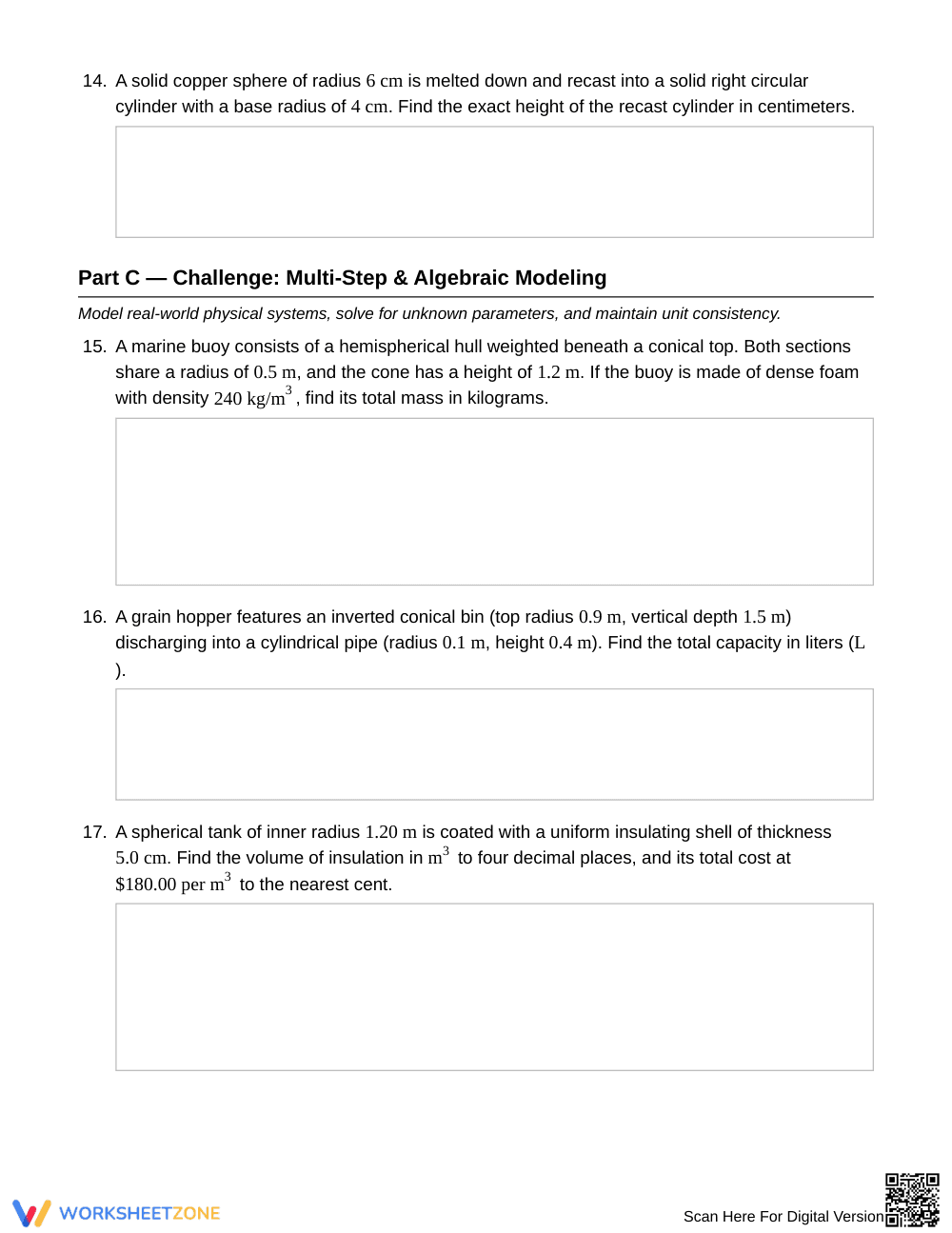
- Supported practice (Part B, Problems 5–14): Core items challenge students to partition composite solids, evaluate hollow cylinders, calculate sealant coverage, and convert cubic meters into liters.
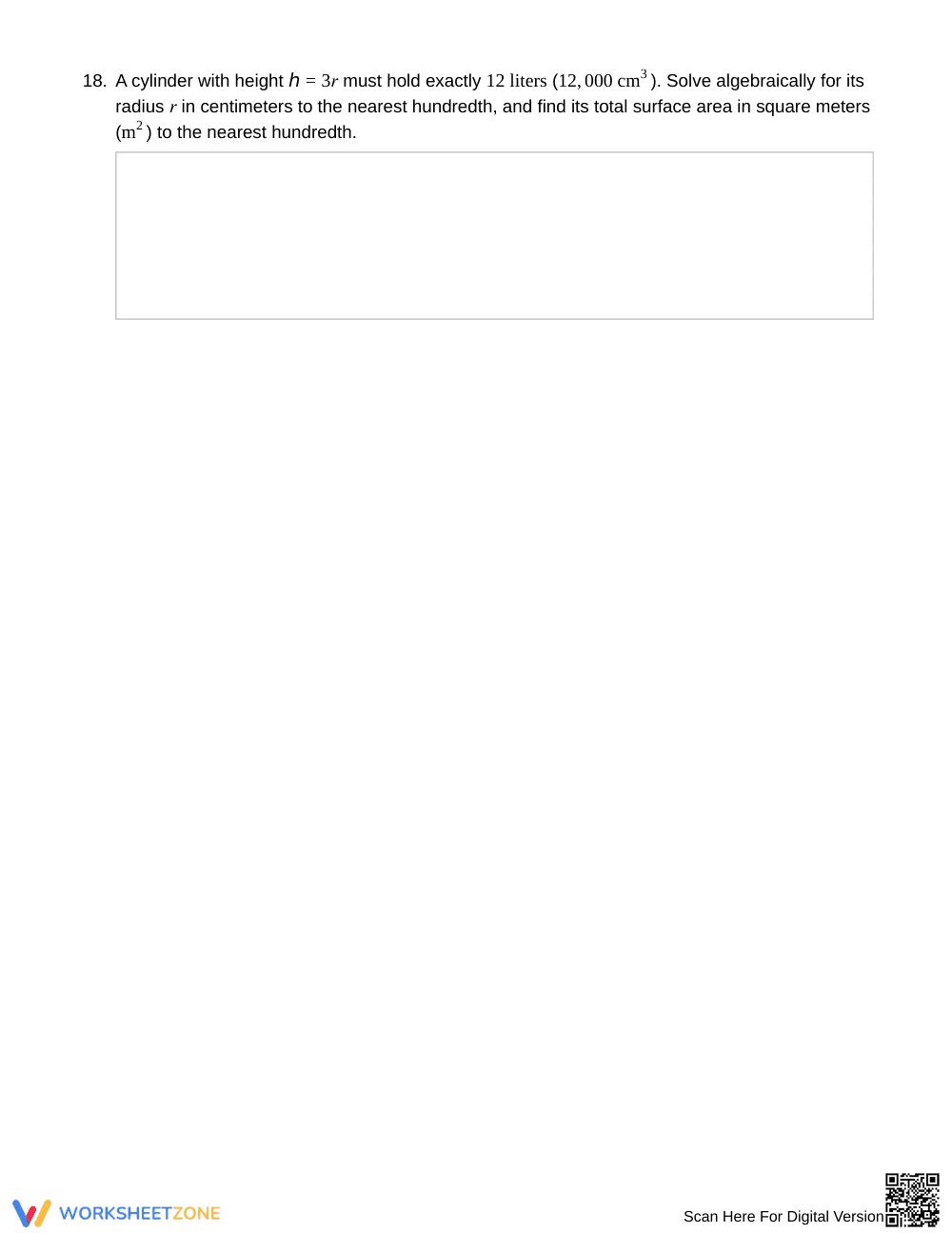
- Independent practice (Part C, Problems 15–18): Advanced modeling tasks require students to determine mass from material density, calculate shell insulation costs, and solve algebraically for missing dimensions.
This sequence follows a gradual-release model, moving students from guided alignment to independent multi-step geometric problem solving.
Standards Alignment
This worksheet aligns directly with `HSG-GMD.A.3`: Use volume formulas for cylinders, pyramids, cones, and spheres to solve problems. In addition, real-world modeling questions support standard HSG-MG.A.1 by applying geometric methods to physical objects. Both standard codes can be copied directly into lesson plans, IEP goals, or district curriculum mapping tools.
How to Use It
Assign Parts A and B during class following direct instruction on volume formulas, having students highlight mismatched units before computing. Use Part C as a formative assessment checkpoint to evaluate algebraic mastery. During practice, check whether students reconcile linear units before applying exponents. Expected completion time is 45 to 60 minutes.
Who It's For
This worksheet is designed for tenth-grade Geometry students learning spatial measurement and unit conversion. The formula header provides essential scaffolding for developing learners, while Part C extends honors students. Pair this activity with an anchor chart comparing cubic measurements to liquid volume.
Targeting standard HSG-GMD.A.3, this comprehensive Geometry resource develops student proficiency in calculating volume and surface area with consistent units across multi-step modeling scenarios. According to Fisher & Frey (2014), instructional frameworks that scaffold complex mathematical concepts through intentional gradual release foster substantial gains in student confidence and long-term analytical independence. By guiding high school learners through tiered practice—transitioning from isolated linear unit conversions to composite geometric solids and algebraic constraint problems—the worksheet actively prevents dimensional errors and builds enduring spatial reasoning. Students systematically reconcile mismatched units, dissect compound structures like silos and storage tanks, and evaluate real-world physical constraints including material density and fluid capacity. This rigorous progression ensures tenth-grade students acquire the structural modeling fluency and computational precision required for advanced high school STEM coursework, standards-based secondary mathematics assessments, and future engineering applications.


