































Essential Composite Solids Worksheet | Grade 10 Geometry

Paste this activity's link or code into your existing LMS (Google Classroom, Canvas, Teams, Schoology, Moodle, etc.).
Students can open and work on the activity right away, with no student login required.
You'll still be able to track student progress and results from your teacher account.
Mastering geometric decomposition allows students to analyze complex shapes with precision. This Grade 10 geometry worksheet guides learners through calculating the volume and exterior surface area of composite figures. Students break down cylinders, cones, pyramids, and hemispheres across 12 structured problems, building solid procedural fluency.
At a Glance
- Grade: 10 · Subject: Geometry
- Standard:
HSG-GMD.A.3— Use volume formulas for cylinders, pyramids, cones, and spheres to solve problems- Skill Focus: Decompose a Composite Solid
- Format: 5 pages · 12 problems · Answer key included · PDF
- Best For: Guided instruction and independent geometric modeling
- Time: 45–60 minutes
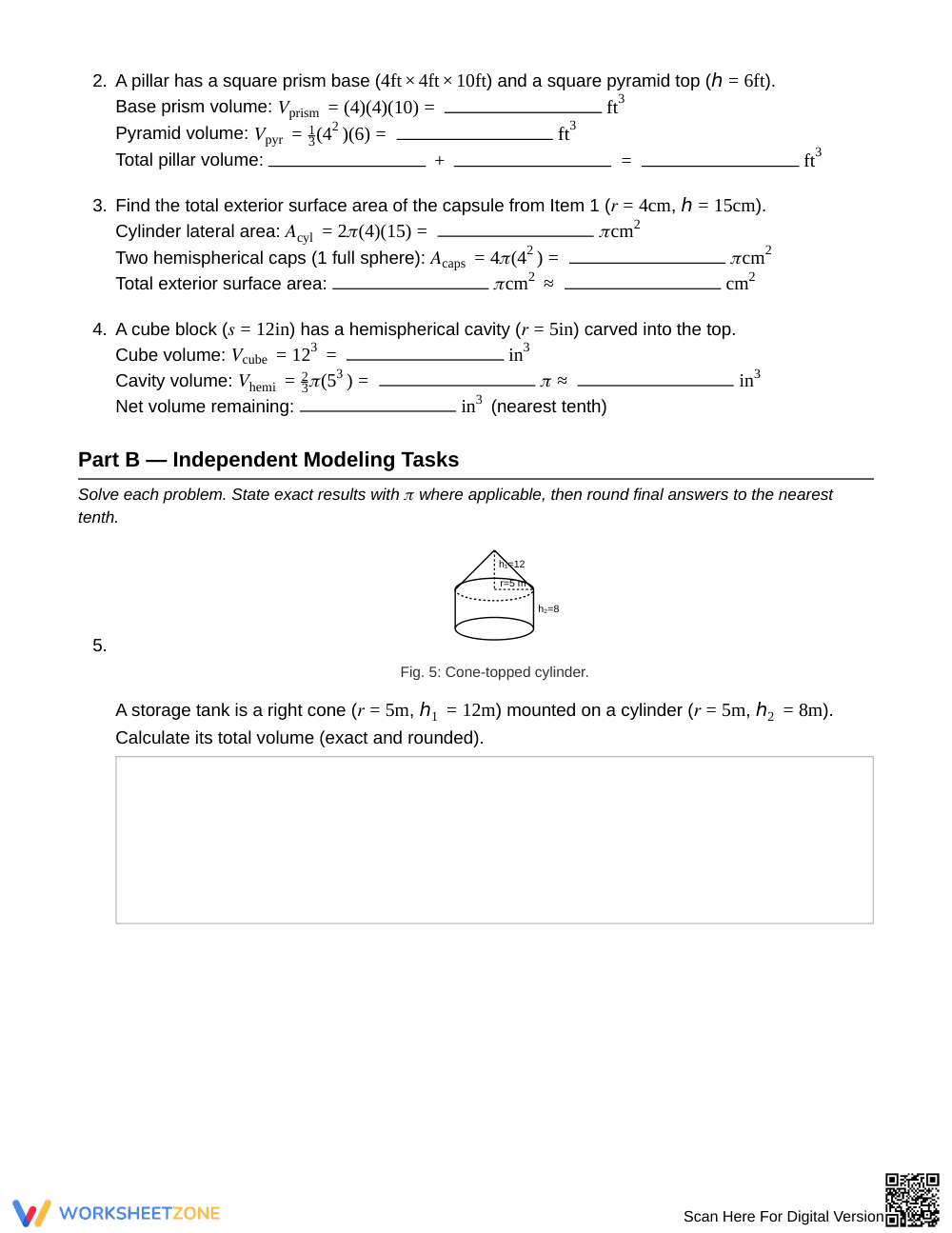
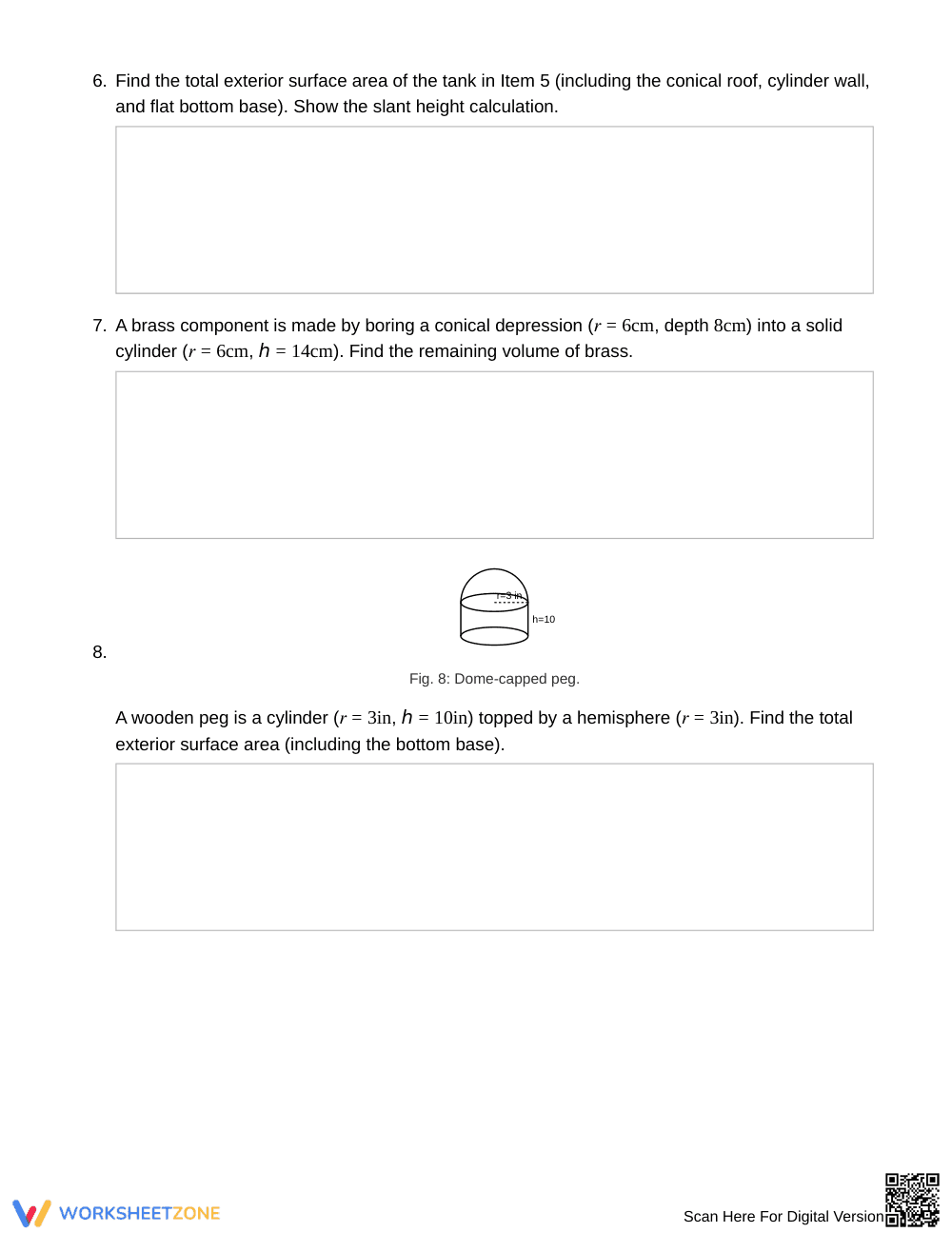
The 5-page printable document opens with a core formula reference chart and two worked models illustrating additive and subtractive solids. Students complete scaffolded fill-in calculations, multi-step engineering word problems, and conceptual error analysis prompts. A complete 2-page answer key provides step-by-step solutions showing exact values in terms of pi and rounded decimals.
Skill Progression
- Guided practice: Students review worked additive and subtractive examples alongside reference formulas before solving 4 missing-step problems with partially filled equations.
- Supported practice: Learners tackle 6 independent modeling tasks that require setting up multi-step volume and surface area equations without prompts.
- Independent practice: Students critique 2 error analysis scenarios to evaluate misconceptions regarding overlapping interior faces and formula coefficients.
This structure follows the gradual release of responsibility model, guiding students from supported computations to rigorous geometric evaluation.
Standards Alignment
This worksheet aligns with HSG-GMD.A.3: Use volume formulas for cylinders, pyramids, cones, and spheres to solve problems. It also supports standard HSG-MG.A.1 by applying geometric methods to model physical objects. Both standard codes can be copied directly into lesson plans, IEP goals, or district curriculum mapping tools.
How to Use It
Use this resource after introducing three-dimensional formulas as guided or independent practice. During class, monitor Part A to ensure students do not add internal contact boundaries into total surface area calculations. Most tenth-grade students will complete the 12 problems in 45 to 60 minutes.
Who It's For
This worksheet suits Grade 10 geometry students mastering spatial modeling. Provide physical manipulatives for students needing concrete visualization, and pair this resource with a three-dimensional net anchor chart or interactive geometric software demonstration.
According to research on scaffolded mathematics instruction by Fisher & Frey (2014), the gradual release of responsibility framework significantly enhances student retention and autonomy in multi-step spatial problem solving. This Grade 10 geometry worksheet operationalizes that instructional research through a deliberate three-tier progression aligned directly with standard HSG-GMD.A.3. To master decomposing composite solids, secondary learners must transition smoothly from recognizing isolated geometric formulas to evaluating complex, multi-stage physical representations. By providing fully worked reference models, scaffolded missing-step calculations, and targeted conceptual error analysis tasks, this resource helps high school students isolate exposed exterior boundaries from interior interfaces while calculating accurate net volume. Educators utilizing this 12-task learning progression provide high school learners with the focused cognitive scaffolding needed to independently tackle complex three-dimensional geometric modeling tasks, bridging basic procedural computation and advanced conceptual understanding across secondary mathematics classrooms.


