































Essential Cold War Word Search | Grades 8–9 Social Studies

Paste this activity's link or code into your existing LMS (Google Classroom, Canvas, Teams, Schoology, Moodle, etc.).
Students can open and work on the activity right away, with no student login required.
You'll still be able to track student progress and results from your teacher account.
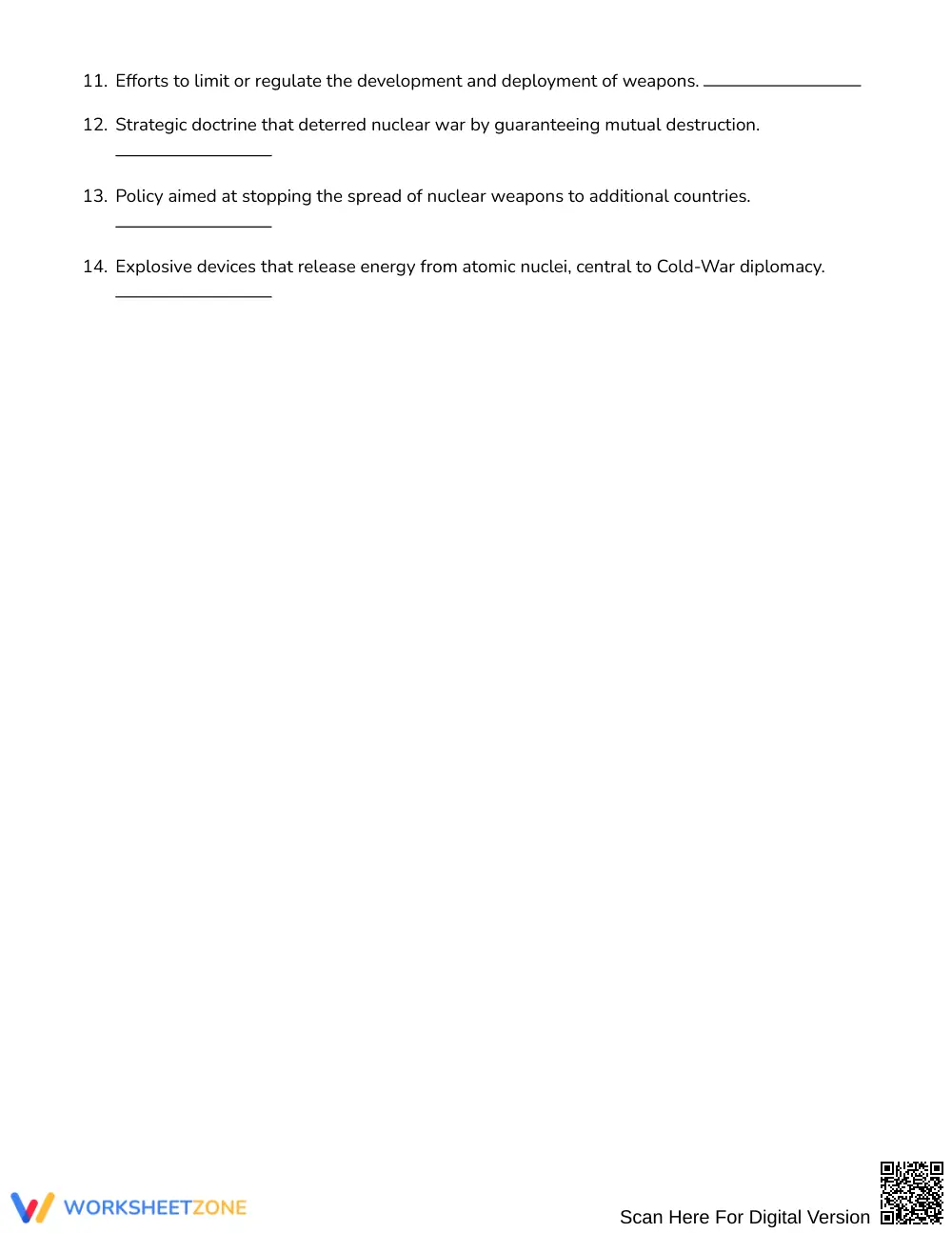
Students master essential Cold War nuclear diplomacy vocabulary by solving definition-based clues and locating hidden terms in this engaging word search. This 3-page activity reinforces concepts such as deterrence, containment, and nonproliferation. By connecting historical clues to key terminology, learners build background knowledge during 20th-century World History units.
At a Glance
- Grade: Grades 8–9 · Subject: Social Studies
- Standard: Not standards-assessed — vocabulary enrichment
- Skill Focus: Nuclear diplomacy vocabulary
- Format: 3 pages · 14 words · Answer key included · PDF
- Best For: Vocabulary enrichment and unit review
- Time: 20–30 minutes
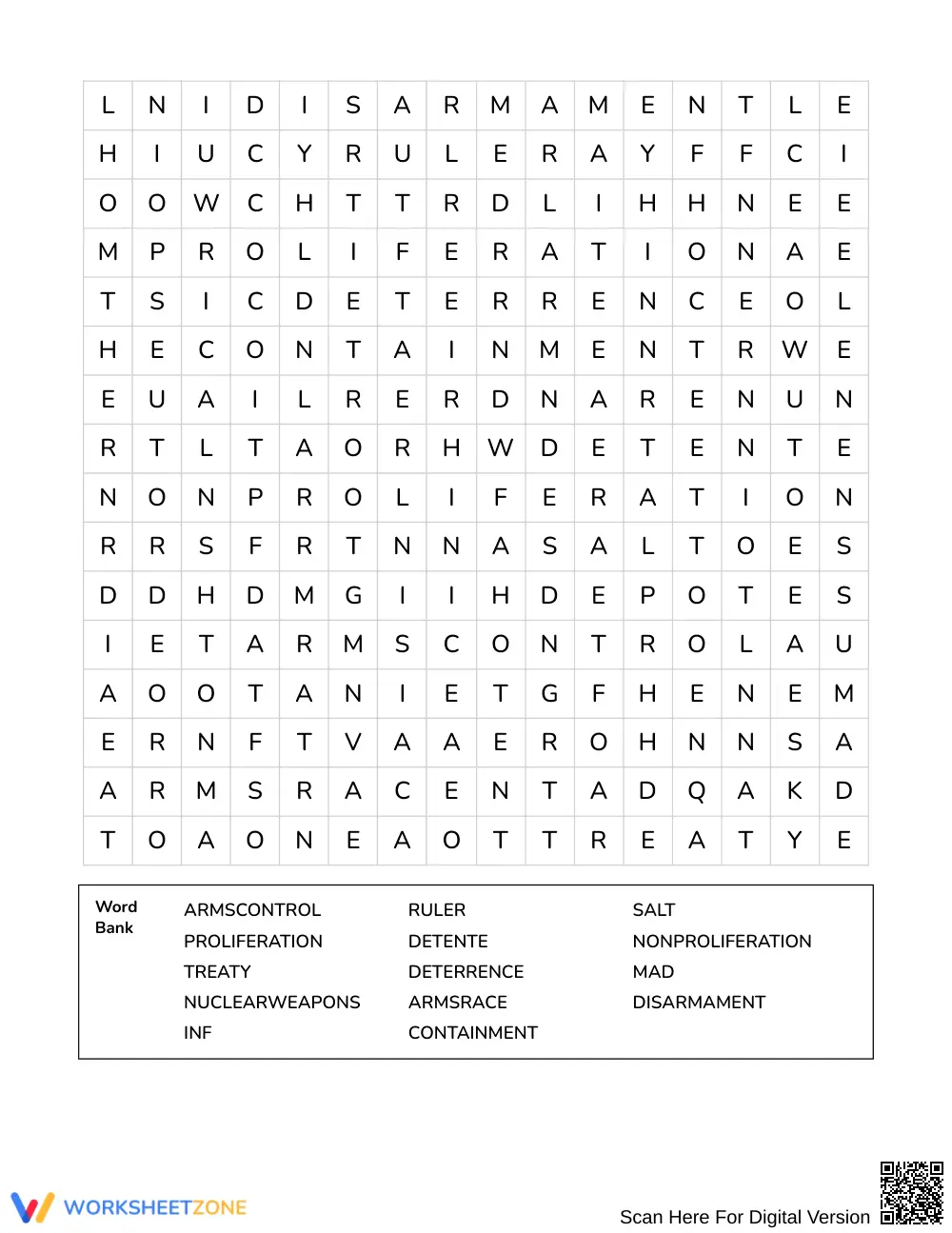
This printable 3-page activity features a 16 × 16 letter grid containing 14 words focused on Cold War international relations. Rather than simply scanning a basic list, students analyze historical clues to identify target vocabulary before finding terms. A complete 3-page answer key provides visual solution grids for rapid checking.
How the Puzzle Works
The puzzle embeds 14 terms within a 16 × 16 letter grid. Words run in four directions: northeast (NE), east (E), southeast (SE), and south (S). A shuffled word bank pairs with historical clues defining concepts like deterrence and containment. Students deduce each term from its clue before locating it in the letter matrix, requiring active conceptual recall.
Standards Alignment
This resource serves as vocabulary enrichment and is not aligned to a specific standard. It supports World History curricula by reinforcing core terminology essential for understanding Cold War geopolitical conflicts, treaties, and strategic doctrines.
How to Use It
Use this word search as an introductory hook before direct instruction or as independent review following a lesson on arms-control treaties. For formative assessment, observe whether students decipher clues independently or rely on the shuffled bank; struggling with terms like deterrence signals a need for reteaching. Students typically finish in 20 to 30 minutes.
Who It's For
This activity is designed for Grades 8–9 students in World History or Civics courses. It supports visual learners and students strengthening domain-specific vocabulary. Pair this puzzle with primary-source treaty excerpts or an anchor chart of superpower alliances to deepen comprehension.
Mastering nuclear diplomacy vocabulary equips secondary students to comprehend complex geopolitical relationships and historical treaties. According to Fisher & Frey (2014), intentional vocabulary acquisition that connects content-specific definitions with engaging retrieval tasks significantly enhances reading comprehension in secondary social studies classrooms. This Cold War word search reinforces 14 critical historical terms—including deterrence, containment, and nonproliferation—by requiring learners to analyze conceptual clues rather than relying on rote visual scanning. Combining definition analysis with spatial search strategies supports long-term memory retention and builds academic literacy across World History units. By contextualizing strategic doctrines such as mutually assured destruction alongside pivotal treaties like SALT and INF, the activity establishes a solid conceptual foundation for analyzing modern international relations. Educators can deploy this resource during unit introductions or review sessions to verify conceptual familiarity and strengthen historical literacy effectively.


