































Essential Codon Vocabulary Worksheet | Grades 8-12 Science

Paste this activity's link or code into your existing LMS (Google Classroom, Canvas, Teams, Schoology, Moodle, etc.).
Students can open and work on the activity right away, with no student login required.
You'll still be able to track student progress and results from your teacher account.
This comprehensive genetics worksheet equips secondary science students to define, decode, and analyze codons across protein synthesis. Learners evaluate base triplets, read a standard genetic code chart, and examine how specific mutations impact amino acid chains. Through structured tasks, students solidify foundational molecular biology concepts before tackling complex gene expression units.
At a Glance
- Grade: Grades 8–12 · Subject: Science
- Standard: Relate mRNA nucleotide triplets to amino acids and protein translation
- Skill Focus: Codon identification, vocabulary, chart interpretation, and mutation effects
- Format: 4 pages · 34 problems · Answer key included · PDF
- Best For: Introductory genetics and protein synthesis practice
- Time: 40–50 minutes
What's Inside
The four-page printable packet features 34 targeted problems organized into distinct thematic sections. Students explore nucleotide sequences through concise reference definitions, nonexample identification tables, matching exercises, and codon chart decoding. A complete 4-page answer key provides full explanations and worked solutions for efficient grading.
Skill Progression
- Guided Practice (Part A): Students examine rule definitions, match key terms (such as mRNA, anticodon, and ribosome), and classify 5 RNA sequences as codons or nonexamples with written justifications.
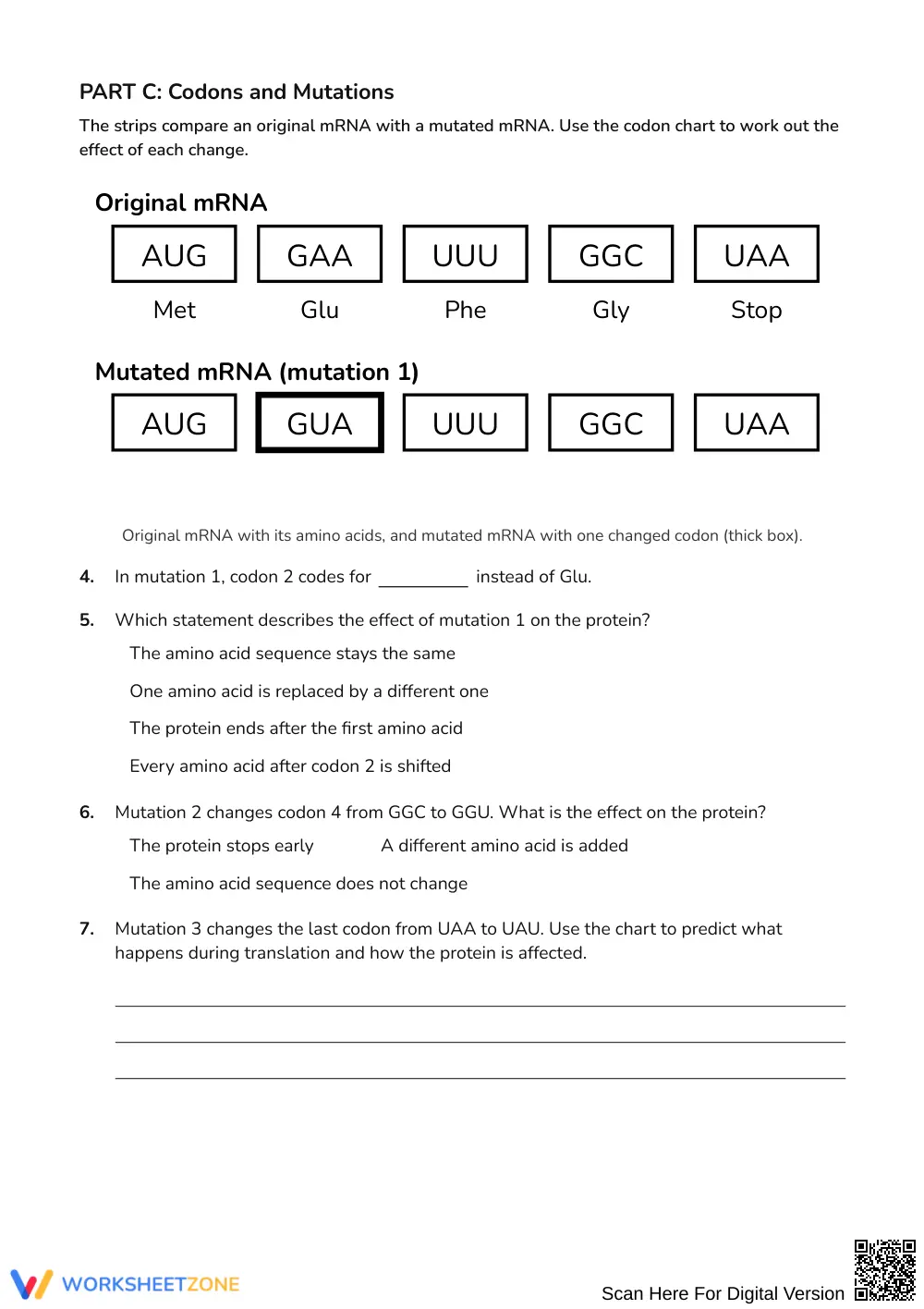
- Supported Practice (Parts B & C): Learners translate mRNA sequences using a 64-codon chart, distinguish stop codons, and analyze 3 targeted mutation scenarios to determine changes in amino acid sequences.
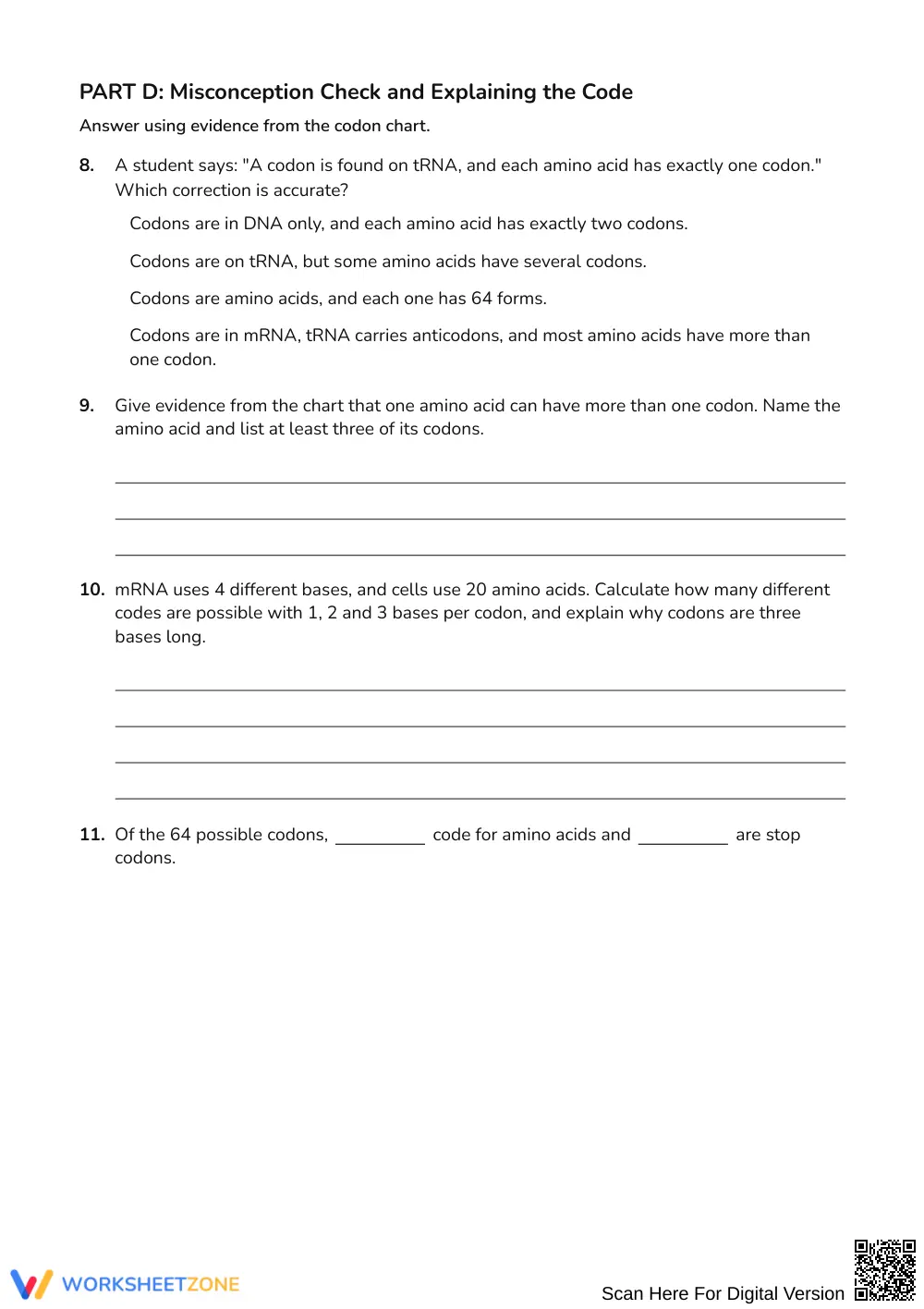
- Independent Practice (Part D): Students independently address common misconceptions, cite codon chart evidence for code redundancy, and calculate why 3-base triplets are required for 20 amino acids.
This sequence embodies a gradual-release model, moving from structured vocabulary acquisition to high-demand mathematical reasoning and analytical evaluation.
Standards Alignment
This resource aligns with high school life science standards that require students to construct explanations of how the structure of DNA determines the structure of proteins, which carry out the essential functions of life through systems of specialized cells. Students evaluate how sequences of nucleotide bases form codons that specify amino acids. These foundational learning goals can be copied directly into lesson plans, IEP goals, or district curriculum mapping tools.
How to Use It
Introduce this worksheet directly after initial direct instruction on transcription and the structure of mRNA. During class, monitor student responses in Part A as a formative checkpoint; students struggling to reject sequences containing thymine require quick review on RNA base-pairing rules. High school biology classes will typically complete the 34 tasks within 40 to 50 minutes of structured work.
Who It's For
This resource serves general high school biology students, introductory middle school life science learners, and AP Biology students needing targeted review. Pair this worksheet directly with an interactive translation animation or an mRNA decoding wheel chart for visual reinforcement.
According to Fisher & Frey (2014), systematic vocabulary acquisition paired with explicit nonexample analysis deepens conceptual retention during introductory molecular biology units. This 4-page instructional resource operationalizes that research framework by engaging students in 34 tasks that clarify codon structure, mRNA sequence boundaries, and triplet reading frames. Rather than memorizing terms in isolation, learners actively evaluate codon charts, differentiate tRNA anticodons from mRNA transcripts, and calculate the mathematical rationale behind 64 total triplet permutations for 20 biological amino acids. By exposing common misunderstandings through direct misconception checks, the resource ensures students build durable mental models of protein synthesis and point mutations, preparing them for advanced genetics coursework and standardized science assessments.


