


























Views
Downloads
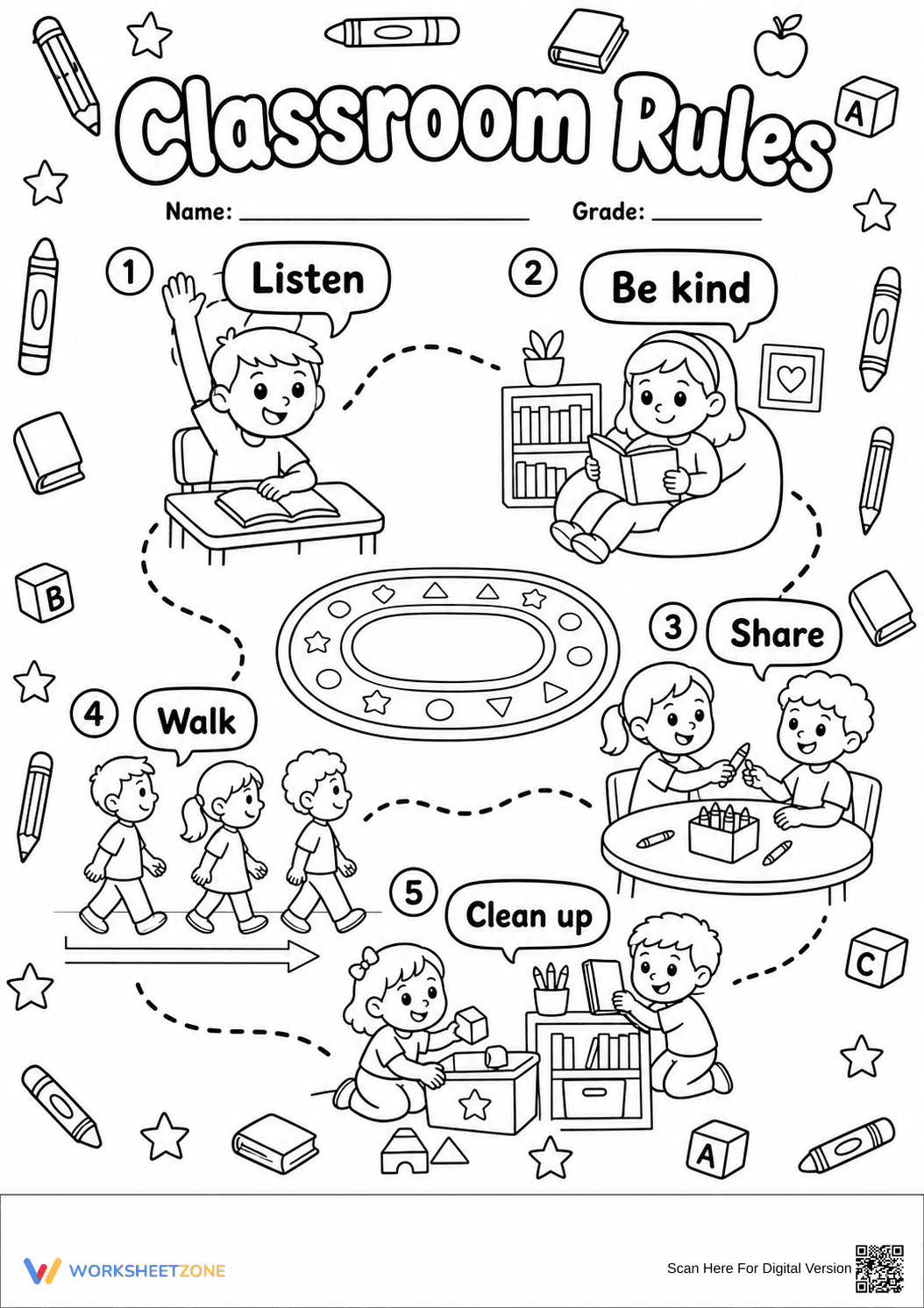

Essential Classroom Rules Coloring Page | Grade K-2
Paste this activity's link or code into your existing LMS (Google Classroom, Canvas, Teams, Schoology, Moodle, etc.).
Students can open and work on the activity right away, with no student login required.
You'll still be able to track student progress and results from your teacher account.
This Grade K-2 classroom rules worksheet helps young learners internalize behavioral expectations through creative coloring. By engaging with visual representations of positive actions, students build a foundation for a respectful learning environment. It simplifies complex social norms into five actionable steps that promote safety, kindness, and cooperation during the first week of school.
At a Glance
- Grade: K-2 · Subject: Social Studies
- Standard:
CCSS.ELA-LITERACY.SL.K.1— Follow agreed-upon rules for discussions and participating in classroom activities- Skill Focus: Behavioral expectations and social-emotional learning
- Format: 1 page · 5 tasks · No answer key required · PDF
- Best For: First week of school orientation
- Time: 15–20 minutes
What's Inside
This single-page PDF features high-quality line art depicting five core classroom expectations: listening, being kind, sharing, walking safely, and cleaning up. Each scene is numbered and labeled with a clear, bold speech bubble. The layout includes student name and grade fields at the top, surrounded by school-themed icons like pencils and books to encourage artistic expression and ownership of the page.
Zero-Prep Workflow
- Print: Select the single-page PDF and print enough copies for your cohort in under 30 seconds.
- Distribute: Hand out the sheets along with crayons or colored pencils during your morning meeting or orientation block.
- Review: Discuss each rule as students color, reinforcing the visual cues with verbal explanations for a total teacher prep time of under 2 minutes.
Standards Alignment
The primary standard addressed is `CCSS.ELA-LITERACY.SL.K.1`, which requires students to follow agreed-upon rules for discussions and participate in collaborative classroom activities. By identifying and coloring these specific behaviors, students demonstrate an initial understanding of the social framework required for academic success. Both standard codes can be copied directly into lesson plans, IEP goals, or district curriculum mapping tools.
How to Use It
Use this worksheet during the first day of school as a guided-practice activity. As you introduce each rule, have students find the corresponding number on the page and color that specific scene. It also serves as a formative-assessment tool; observe which students can identify the "Walk" or "Share" icons to gauge their comprehension of verbal instructions. Expected completion time ranges from 15 to 20 minutes depending on the grade level.
Who It's For
This resource is designed for Pre-K, Kindergarten, and First Grade students who are learning to navigate the school environment. It is particularly effective for English Language Learners (ELLs) who benefit from the strong visual support. Pair this worksheet with a classroom tour or a read-aloud book about school manners to reinforce the concepts through multiple modalities.
Research from Fisher & Frey (2014) emphasizes the importance of establishing clear behavioral expectations through visual and linguistic modeling to create a productive learning climate. This worksheet aligns with those findings by providing concrete, illustrated examples of CCSS.ELA-LITERACY.SL.K.1 in action. By engaging in the low-stakes task of coloring, students reduce anxiety while processing the social-emotional skills necessary for collaborative learning. According to the NAEP, early exposure to structured classroom norms is a significant predictor of long-term academic engagement and social competence. This resource provides a structured yet creative entry point for students to internalize these essential life skills. The use of thick outlines and simple labels supports fine motor development and early literacy, ensuring that the transition into the formal school environment is both positive and clearly defined for every learner in the room.


