





























Essential CER Chain Audit Worksheet | Grade 6 ELA
Paste this activity's link or code into your existing LMS (Google Classroom, Canvas, Teams, Schoology, Moodle, etc.).
Students can open and work on the activity right away, with no student login required.
You'll still be able to track student progress and results from your teacher account.
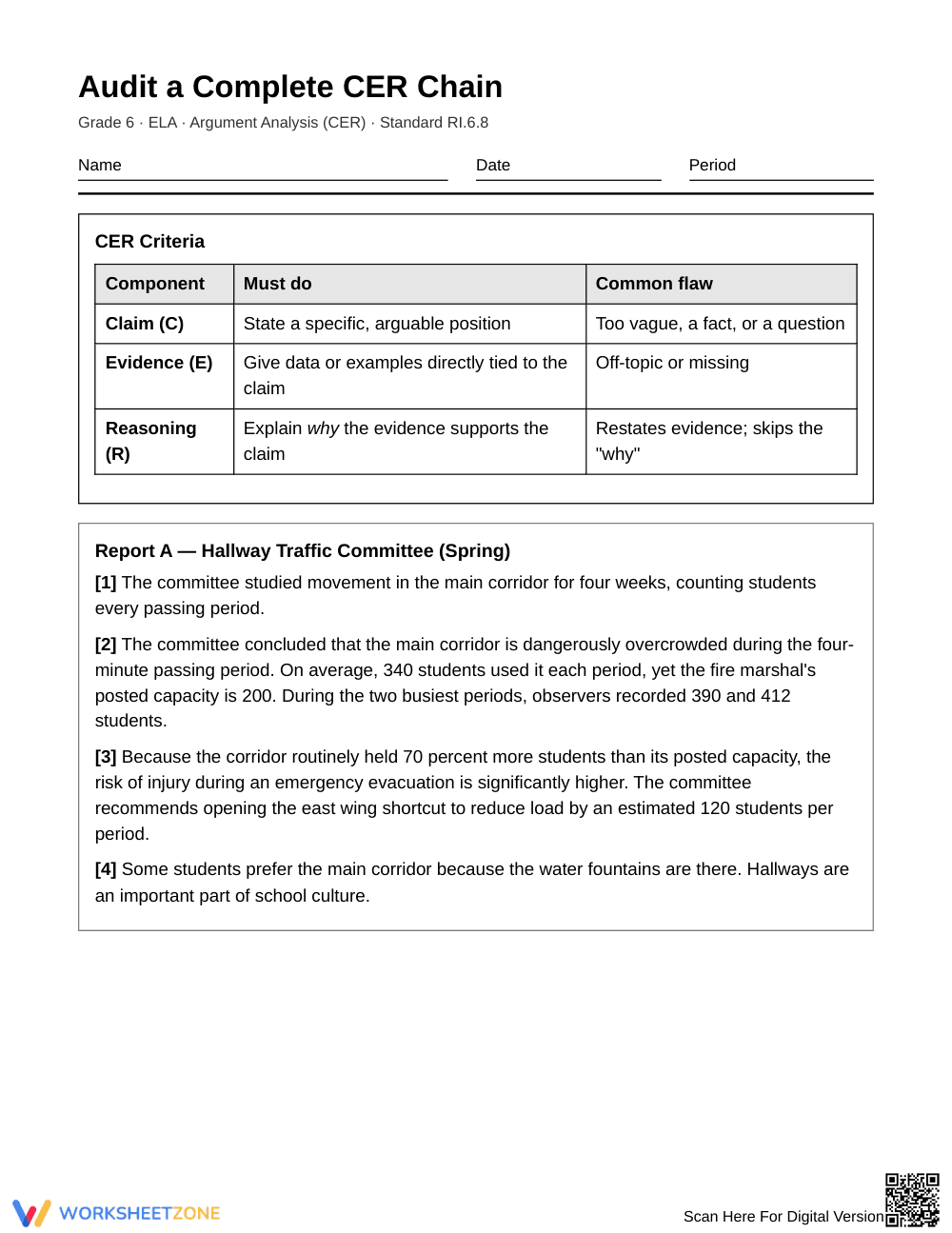
This Grade 6 ELA worksheet guides students to audit, repair, and evaluate Claim-Evidence-Reasoning (CER) arguments using comparative texts. Students analyze two hallway traffic proposals, identify logical fallacies, repair broken reasoning chains, and defend strong argumentative structures to master textual evidence evaluation.
At a Glance
- Grade: 6 · Subject: ELA
- Standard:
RI.6.8— Trace and evaluate arguments and specific claims in a text- Skill Focus: Audit a Complete CER Chain
- Format: 5 pages · 12 problems · Answer key included · PDF
- Best For: Argument analysis and CER practice
- Time: 40–50 minutes
What's Inside
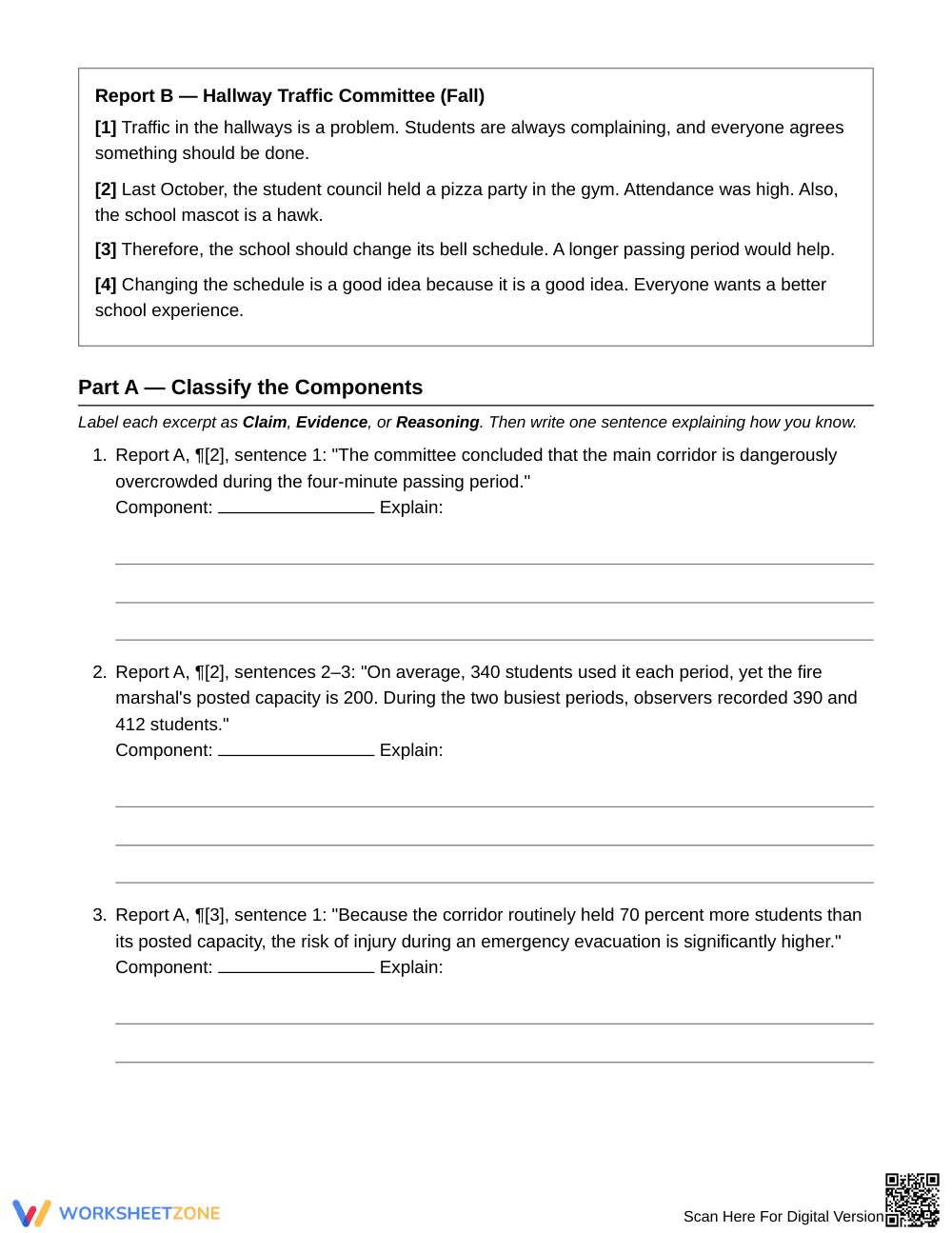
This 5-page worksheet features a CER criteria reference chart, two contrasting hallway traffic reports, and 12 analytical problems. Students classify argumentative components, rewrite flawed reasoning and irrelevant evidence, and justify the stronger report. A 4-page answer key provides complete model responses and explanations for all tasks.
Skill Progression
- Guided practice (Part A, 3 items): Students classify text excerpts as claims, evidence, or reasoning, explaining their choices with the criteria chart.
- Supported practice (Part B, 6 items): Students identify flaws like circular reasoning, then write corrected replacement sentences.
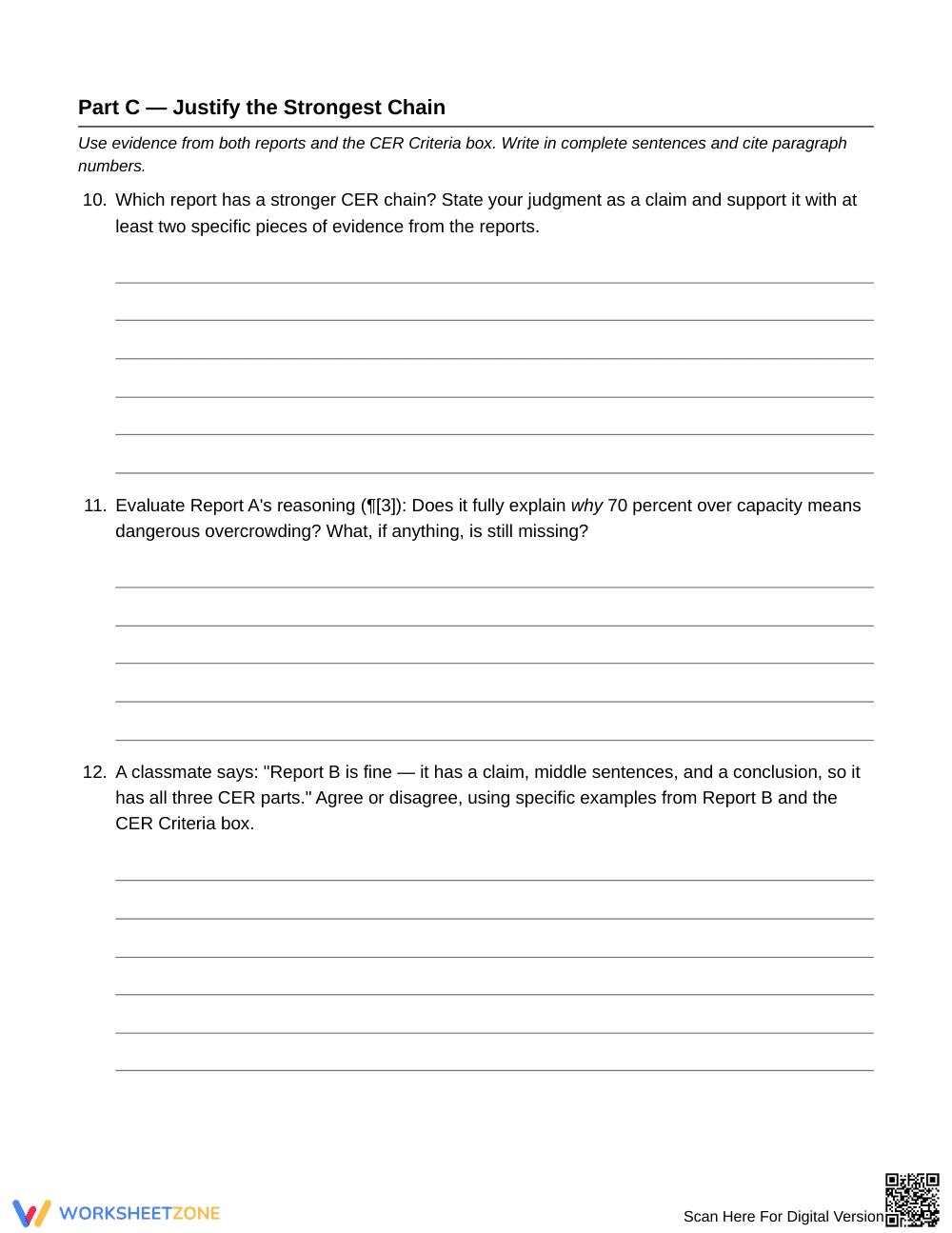
- Independent practice (Part C, 3 items): Students independently evaluate reasoning depth and defend the stronger report with text evidence.
This gradual-release structure moves students from component identification to independent argumentative critique.
Standards Alignment
This resource aligns to Common Core standard RI.6.8: Trace and evaluate the argument and specific claims in a text, distinguishing supported claims from unsupported assertions. It also reinforces argumentative writing foundations. Both standard codes can be copied directly into lesson plans, IEP goals, or district curriculum mapping tools.
How to Use It
Use this worksheet after direct instruction on CER elements or as a mid-unit formative assessment. During Part B, check whether students create valid quantitative reasoning or simply restate the claim. Expect students to complete the 12 problems in 40 to 50 minutes of instructional time.
Who It's For
This activity serves sixth-grade ELA students, developing writers who need structured argument practice, and intervention groups. Pair it with an argumentative anchor chart or a lesson on identifying faulty reasoning.
Explicit instruction in evaluating argument structures strengthens middle school reading comprehension and analytical writing. According to research synthesized by Fisher & Frey (2014) on the gradual release of responsibility, structured scaffolding allows learners to internalize complex cognitive tasks—such as evaluating claims, distinguishing relevant empirical evidence, and critiquing logical reasoning chains—before executing them independently. Aligned to standard RI.6.8, this resource provides sixth-grade students with targeted practice in detecting argumentative fallacies, identifying circular reasoning, and reconstructing flawed claims. By evaluating 12 structured tasks across two contrasting texts, students develop the discernment necessary to audit their own informational writing as well as complex published arguments. Grounding rhetorical analysis in concrete criteria charts and stepwise error correction ensures measurable gains in reading comprehension and text-based evaluation.


