




























Views
Downloads
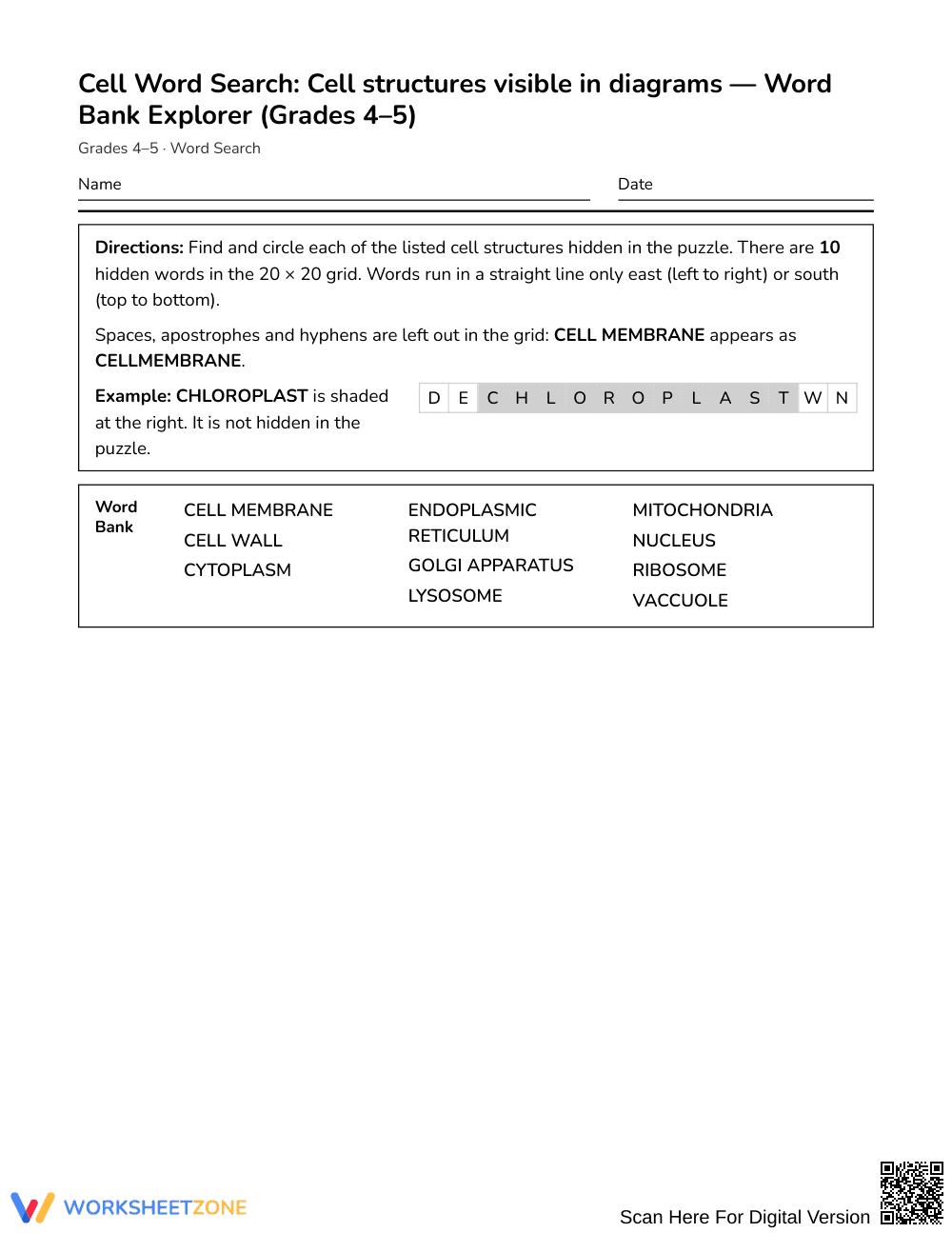


Essential Cell Structures Word Search | Grades 4–5 Science

Paste this activity's link or code into your existing LMS (Google Classroom, Canvas, Teams, Schoology, Moodle, etc.).
Students can open and work on the activity right away, with no student login required.
You'll still be able to track student progress and results from your teacher account.
This Grades 4–5 science word search reinforces foundational biology terminology by guiding students to locate key cell structures visible in cell diagrams. Learners identify 10 essential organelle terms within an engaging puzzle layout, building domain-specific vocabulary recognition and spelling accuracy to support subsequent diagram labeling and cell biology comprehension.
At a Glance
- Grade: Grades 4–5 · Subject: Science
- Standard: Not standards-assessed — vocabulary enrichment
- Skill Focus: Cell structures visible in diagrams
- Format: 2 pages · 10 words · Answer key included · PDF
- Best For: Science vocabulary reinforcement and early finishers
- Time: 15–25 minutes
The printable packet spans two pages designed for clean, immediate classroom implementation. It features 10 targeted vocabulary terms embedded within a structured letter grid, paired alongside an alphabetical word bank for straightforward tracking. A complete two-page answer key displays exact word placements, enabling quick grading or student-led self-checking during independent station work.
Puzzle Structure
This vocabulary search operates on a spacious 20 by 20 grid engineered specifically for upper elementary learners. Hidden words run strictly East (horizontal from left to right) and South (vertical from top to bottom), avoiding reverse or diagonal orientations that can frustrate developing readers. Students reference the alphabetical word bank containing core organelle names to track their discoveries systematically.
Curriculum Context
This science resource functions purely as vocabulary enrichment rather than a formal assessment of state or national performance standards. It provides foundational lexical familiarity with organelle terminology, preparing students to tackle future life science standards involving plant and animal cell structures.
How to Use It
Introduce this word search immediately after direct instruction on plant and animal cell diagrams. While students work, conduct a formative observation check by asking learners to point to an identified organelle on a shared cell diagram. Alternatively, assign the activity as a calm bell-ringer or independent center task. Expected completion time is 15 to 25 minutes.
Who It's For
This resource is tailored for upper elementary science learners in Grades 4–5 discovering cellular biology. The predictable East and South word orientations offer accessible practice for English learners and striving readers without sacrificing scientific rigor. Pair this puzzle with an illustrated plant and animal cell diagram anchor chart to bridge word recognition and visual identification.
Domain-specific vocabulary acquisition forms the backbone of elementary life science comprehension, particularly when students transition from macroscopic observations to microscopic cellular models. According to Fisher & Frey (2014), intentional word exposure through structured print activities reinforces lexical storage and orthographic processing, enabling students to retrieve technical scientific terminology with greater automaticity during subsequent inquiry tasks. By isolating 10 essential cell structures visible in diagrams within a predictable 20 by 20 grid, this vocabulary enrichment activity grounds upper elementary learners in accurate organelle spelling and recognition. Students consolidate names like nucleus, cytoplasm, and cell wall without the visual frustration of complex backwards or diagonal text paths. Consequently, this focused exposure bridges the gap between passive listening and active scientific literacy, ensuring learners possess the foundational lexical fluency necessary to explain organelle functions, analyze biological diagrams, and participate meaningfully in collaborative science discourse across upper elementary instructional units.


