































Essential Bread Varieties Word Search | Grades 7–8 ELA

Paste this activity's link or code into your existing LMS (Google Classroom, Canvas, Teams, Schoology, Moodle, etc.).
Students can open and work on the activity right away, with no student login required.
You'll still be able to track student progress and results from your teacher account.
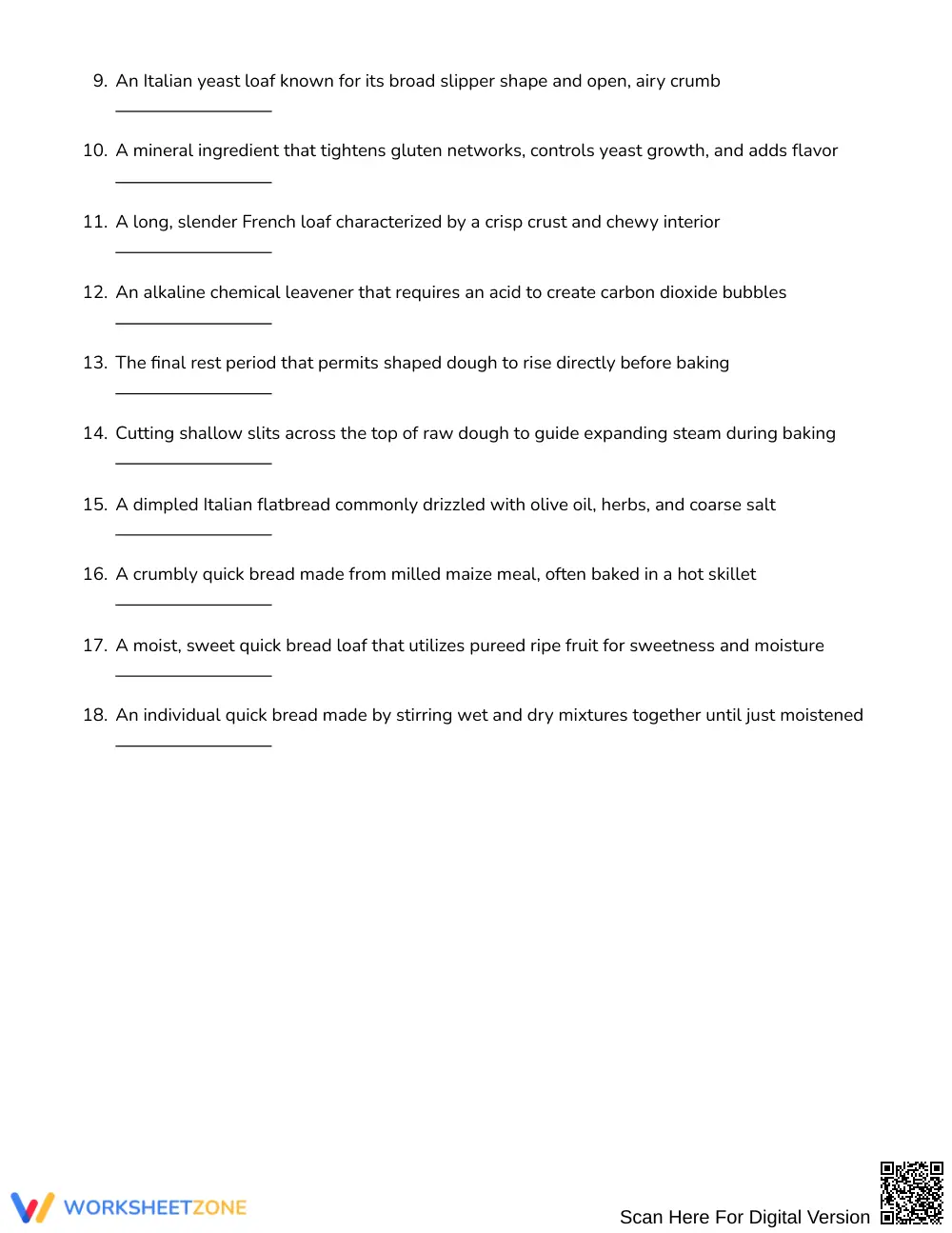
This Grades 7–8 bread vocabulary word search challenges students to reinforce culinary terms through definition matching and grid navigation. Students examine culinary clues to identify 18 essential terms spanning bread varieties, fundamental ingredients, and preparation techniques before locating them within the grid. The activity consolidates culinary vocabulary while promoting active cognitive recall and reading comprehension.
At a Glance
- Grade: Grades 7–8 · Subject: ELA
- Standard: Not standards-assessed — vocabulary enrichment
- Skill Focus: Bread varieties, ingredients, and preparation methods
- Format: 3 pages · 18 words · Answer key included · PDF
- Best For: Culinary vocabulary review and fast-finisher enrichment
- Time: 25–35 minutes
What's Inside
This resource spans 3 student-facing pages accompanied by a comprehensive 4-page answer key. The activity centers on an informational clue bank where each of the 18 target vocabulary terms is paired with a clear, descriptive definition. Students read technical explanations for leavening agents, dough structure, and baking varieties, using those prompts to verify their vocabulary knowledge before searching the letter matrix.
Puzzle Structure and Mechanics
The activity features an expansive 20 × 20 letter grid containing 18 hidden culinary vocabulary terms. Words run in all 8 compass directions: north, northeast, east, southeast, south, southwest, west, and northwest, including backward and diagonal placements. Rather than simply scanning a basic word bank, learners use rich culinary clues to determine target terms—such as brioche, fermentation, and gluten—before executing systematic visual searches across the matrix.
Standards Alignment
This resource is designed specifically as vocabulary enrichment and cumulative review; it is not aligned to an assessed Common Core standard. Instead, it supports cross-curricular literacy by deepening student exposure to technical, culinary, and scientific terminology. Integrating domain-specific language into language arts instruction reinforces context-clue analysis and morphological recognition without standard-specific testing constraints.
How to Use It
Deploy this word search during after-lesson independent practice or as a dynamic cumulative review station following a culinary arts or informational reading unit. Teachers can observe how effectively students use the clue definitions to confirm words before searching, noting which learners readily connect structural terms like gluten and kneading versus those requiring glossary support. Expected completion time is 25 to 35 minutes.
Who It's For
This activity is created for Grades 7–8 students in English Language Arts, family and consumer sciences, or career and technical education exploratory rotations. For differentiated support, emerging readers can highlight keyword associations within the clues before grid scanning, while advanced learners can compose original sentences explaining the culinary function of each identified term. It pairs naturally with an informational text on baking science or yeast fermentation.
According to Fisher & Frey (2014), intentional exposure to domain-specific vocabulary across interactive print tasks substantially deepens conceptual retention and lexical automaticity for middle school learners. This 18-word puzzle reinforces key culinary terminology through dual-stage cognitive engagement: students first analyze functional definitions of baking concepts, ingredients, and varieties, and then execute focused visual scanning across a 20 × 20 letter matrix. Transforming word recognition from rote matching into clue-driven retrieval prompts students to actively synthesize technical terminology including fermentation, gluten, and proofing within meaningful culinary contexts. The inclusion of backward, vertical, and diagonal orientations develops spatial tracking and sustained visual attention alongside domain-specific vocabulary mastery. Consequently, structured puzzle activities serve as valuable supplementary tools for reinforcing specialized cross-curricular texts, ensuring middle school students consolidate academic vocabulary efficiently while maintaining high cognitive interest across diverse classroom learning environments.


