































Essential Boyle's Law Worksheet | Grades 8–12 Science

Paste this activity's link or code into your existing LMS (Google Classroom, Canvas, Teams, Schoology, Moodle, etc.).
Students can open and work on the activity right away, with no student login required.
You'll still be able to track student progress and results from your teacher account.
Students master Boyle’s Law by modeling gas particles, interpreting pressure‑volume tables, and solving real‑world calculations. This worksheet guides them from conceptual diagrams to quantitative predictions, ensuring they can explain inverse relationships and apply the law in everyday scenarios with confidence.
At a Glance
- Grade: Grades 8–12 · Subject: Science
- Standard:
— Use the pressure‑volume relationship to solve authentic, real‑world problems involving gases- Skill Focus: Boyle’s Law modeling, quantitative calculations, and graph interpretation
- Format: 4 printable pages · 22 scaffolded problems · Answer key included · PDF ready
- Best For: Structured guided practice of gas laws in middle‑school science
- Time: Approximately 15–25 minutes for completion
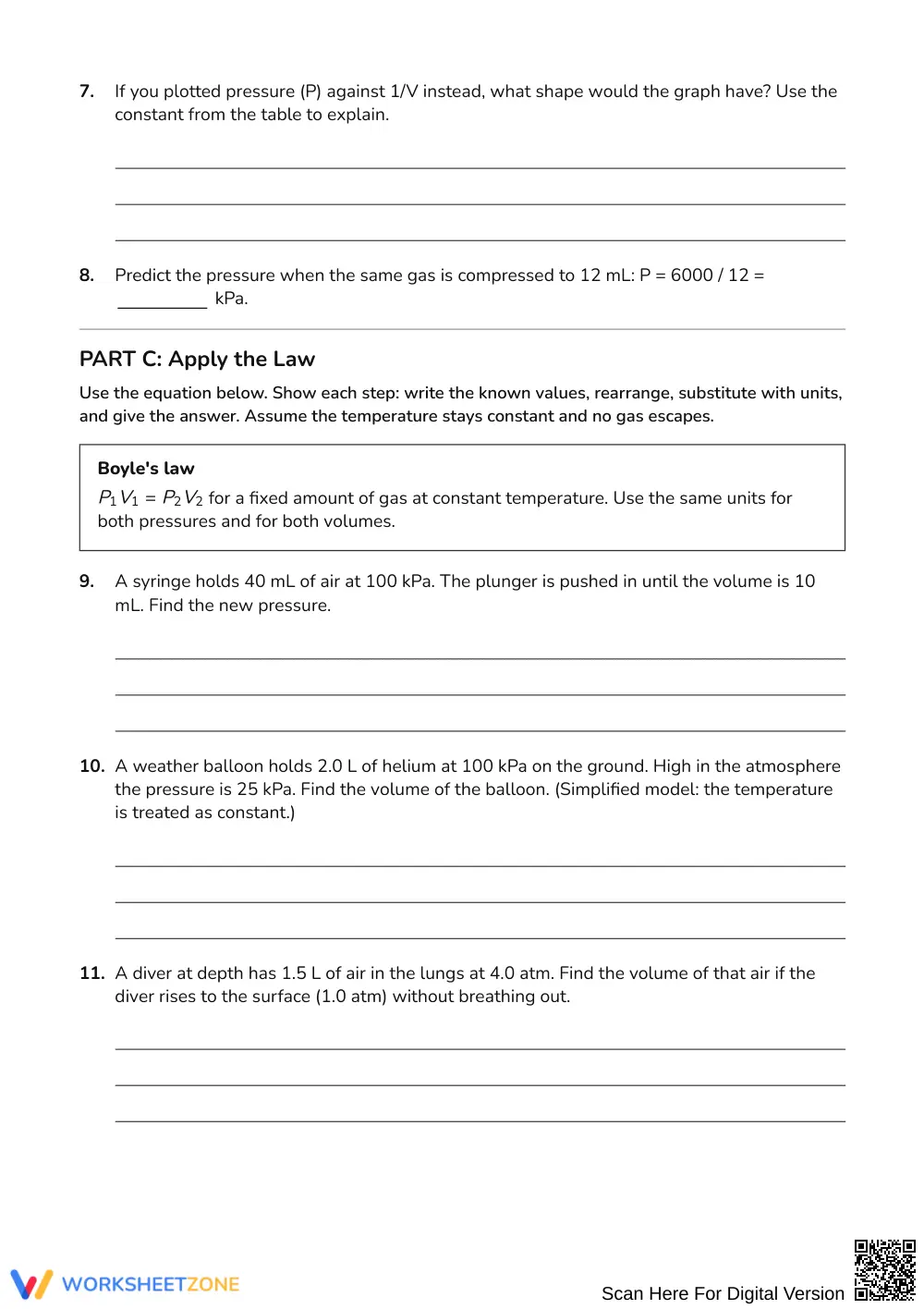
The worksheet spans four pages, offering 22 problems that move from particle‑model questions to data‑table calculations, graph analysis, and multi‑step algebraic applications. An answer key follows each section.
Skill Progression
- Guided practice (7 tasks): particle‑model multiple‑choice items with sentence frames.
- Supported practice (8 tasks): table‑completion and graph‑interpretation problems with a word bank.
- Independent practice (7 tasks): multi‑step calculations and written explanations requiring full reasoning.
Standards Alignment
`Boyle's Law (Pressure‑Volume Relationship)` – Students determine how pressure changes when volume changes at constant temperature, using P₁V₁ = P₂V₂. This aligns with the high‑school physical science standard on gas laws. Both standard references can be copied directly into lesson plans, IEP goals, or district curriculum mapping tools.
How to Use It
Use the worksheet as a pre‑lab activity to activate prior knowledge, then revisit during the lab for data analysis. Alternatively, assign it as independent practice after direct instruction; quickly scan responses to gauge mastery and note misconceptions for immediate feedback. Expected completion time is 15–25 minutes.
Who It's For
Designed for Grades 8‑12 science students, especially those mastering intermediate physical‑science concepts. The built‑in sentence frames and word bank support struggling learners, while the multi‑step calculations challenge advanced students. Pair it with a short video on gas particle motion or an anchor chart of the inverse relationship.
Research indicates that explicit visual modeling paired with guided practice significantly enhances students’ conceptual grasp of gas laws (Fisher & Frey, 2014). When learners manipulate particle diagrams, complete pressure‑volume tables, and interpret graphs, they build multiple representations that reinforce the inverse relationship. This worksheet integrates those evidence‑based strategies, offering scaffolded multiple‑choice items, word‑bank support, and open‑ended calculations that promote deeper reasoning. Studies also show that real‑world contexts, such as scuba diving or weather balloons, increase motivation and transfer of knowledge (Fisher & Frey, 2014). By providing immediate feedback through an answer key, teachers can quickly address misconceptions and adjust instruction. The design aligns with high‑school physical‑science standards and supports differentiated instruction, making it a reliable tool for reinforcing Boyle’s Law concepts and preparing students for laboratory investigations throughout the semester.


