




























Views
Downloads



Essential Box Material & Capacity Worksheet | Grade 6 Math

Paste this activity's link or code into your existing LMS (Google Classroom, Canvas, Teams, Schoology, Moodle, etc.).
Students can open and work on the activity right away, with no student login required.
You'll still be able to track student progress and results from your teacher account.
This Grade 6 math worksheet guides students to calculate the surface area and volume of right rectangular prisms through packaging design problems. Students evaluate material requirements, determine interior capacity, and analyze cost trade-offs. The resource builds geometric reasoning from net decomposition to packaging optimization.
At a Glance
- Grade: 6 · Subject: Math
- Standard: Calculate surface area and volume of right rectangular prisms in packaging contexts
- Skill Focus: Choose Material and Capacity for a Box
- Format: 5 pages · 10 problems · Answer key included · PDF
- Best For: Geometry packaging modeling, small-group practice, and application
- Time: 45–60 instructional minutes
What's Inside
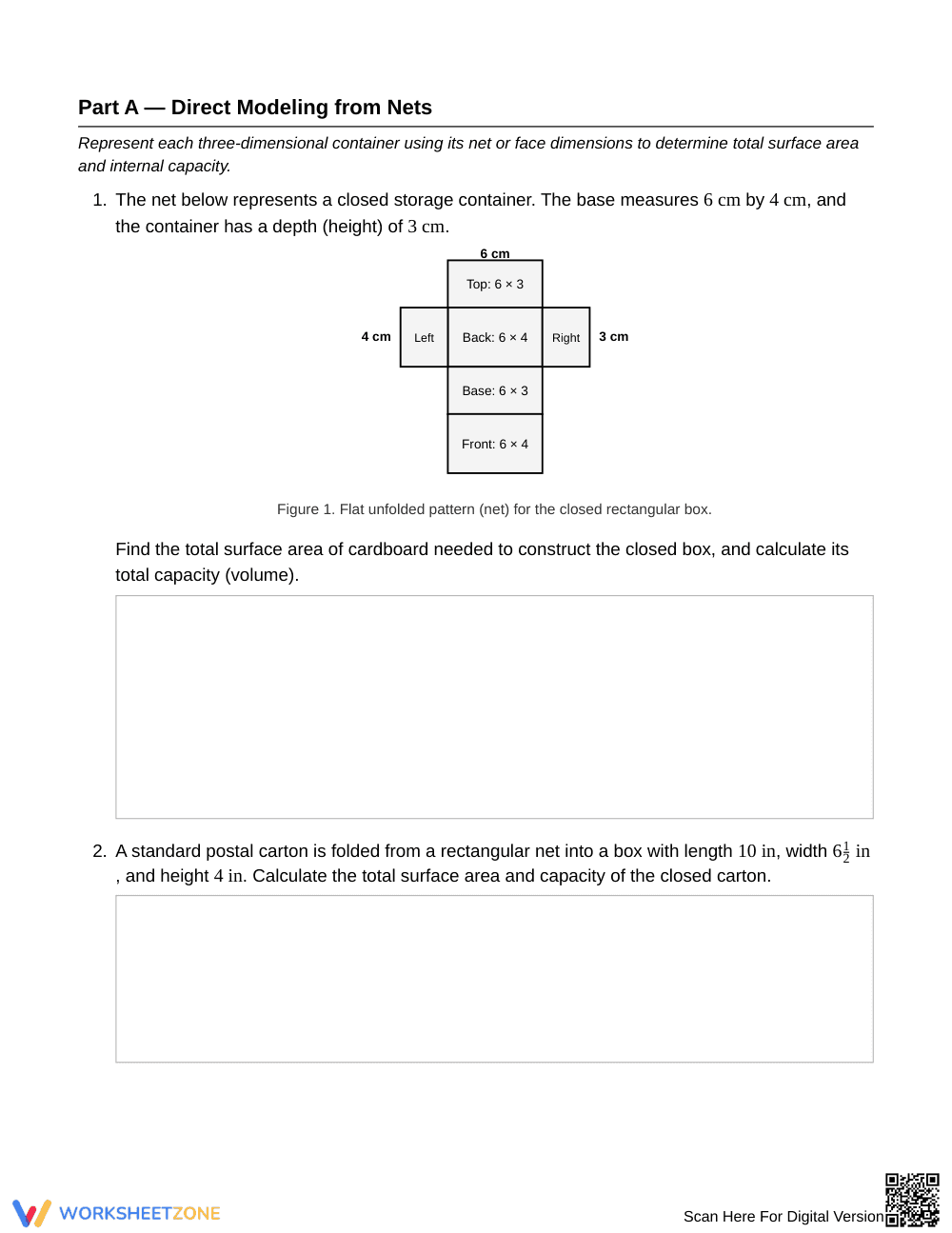
This 5-page worksheet provides 10 structured geometry problems and a 4-page answer key. The opening reference box reviews surface area and volume formulas alongside a three-step packaging cost model. Tasks include analyzing unfolded nets, calculating open-top containers, computing fractional dimensions, and evaluating competing box prototypes against real-world engineering constraints.
Skill Progression
- Guided practice: Problems 1–2 establish spatial foundations, using labeled nets and dimensions to calculate surface areas and internal volume with direct visual support.
- Supported practice: Problems 3–8 present multi-step challenges, including open-top wooden bins, fractional measurements, unit conversions, and unit cardboard costs.
- Independent practice: Problems 9–10 require students to evaluate alternative shipping containers and cereal boxes under strict cost, volume, and material constraints.
This sequence implements a gradual-release model, advancing learners from visual decomposition to independent engineering analysis.
Standards Alignment
This worksheet aligns with Grade 6 geometry standards for right rectangular prisms. Students represent three-dimensional figures using nets to find total surface area and apply volume formulas with fractional edge lengths in real-world contexts. Both standard codes can be copied directly into lesson plans, IEP goals, or district curriculum mapping tools.
How to Use It
Assign this activity following direct instruction on prism volume and net surface area. Use Parts A and B for collaborative partner practice during a 50-minute lesson. For formative assessment, check whether students omit the top lid when calculating material for open-top containers in Problems 3 and 8. The complete worksheet takes 45 to 60 minutes.
Who It's For
This worksheet supports Grade 6 math classrooms, advanced Grade 5 students, and introductory middle school STEM courses. Provide physical folding net manipulatives for students needing spatial scaffolding, or use Part C as an enrichment challenge. It pairs effectively with hands-on box dissection activities and 3D geometric modeling lessons.
According to Fisher & Frey (2014), structured gradual-release frameworks significantly strengthen mathematical competency by guiding students from scaffolded worked examples to autonomous problem solving. This Grade 6 geometry resource operationalizes that evidence-based model as students determine the surface area, cardboard costs, and storage capacity of rectangular packaging. Beginning with two-dimensional unfolded net models, learners systematically advance to multi-step real-world problems and constraint-based engineering evaluations. By comparing competing container prototypes against strict volume minimums and surface area thresholds, students connect geometric formulas to practical financial and industrial decision-making. Educational research indicates that embedding geometry in authentic packaging contexts improves conceptual retention of fractional volume and multi-surface calculations across diverse classroom settings. Consequently, this 5-page worksheet functions as a reliable instructional tool for mastering rectangular prism geometry, providing clear formative diagnostic evidence of each student's progress from visual net decomposition to independent spatial analysis.


