
































Essential Body System Worksheet | Grade 6‑10 Science

Paste this activity's link or code into your existing LMS (Google Classroom, Canvas, Teams, Schoology, Moodle, etc.).
Students can open and work on the activity right away, with no student login required.
You'll still be able to track student progress and results from your teacher account.
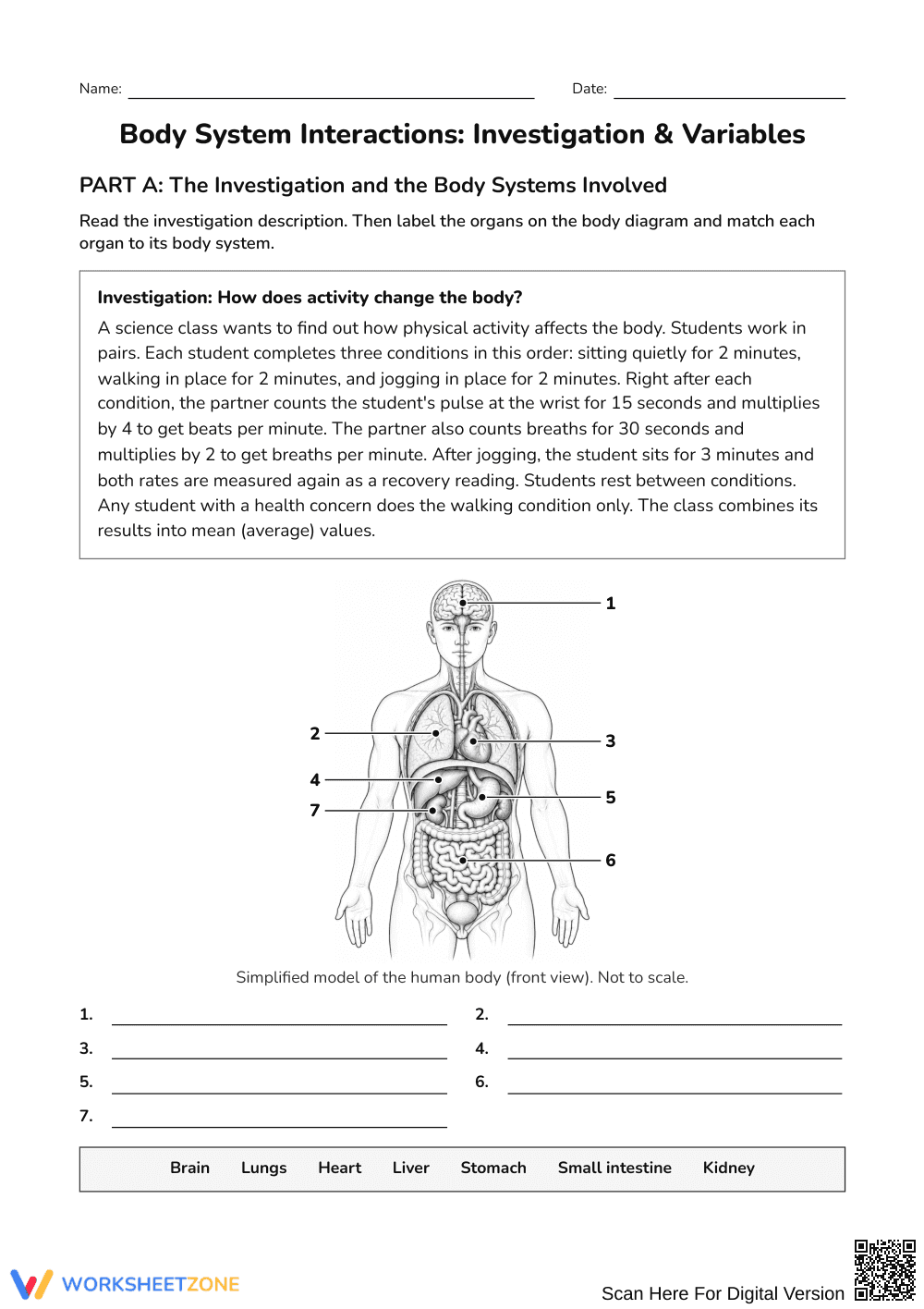
Students explore how different activity levels affect heart and breathing rates, using a hands‑on investigation to identify variables, make predictions, collect evidence, and draw conclusions about body system interactions. They label organs, match them to systems, and interpret class data to deepen their understanding of physiological responses.
At a Glance
- Grade: 6‑10 · Subject: Science
- Standard: — Investigate how activity influences pulse and breathing rates in the human body
- Skill Focus: Body System Interactions through investigation, including variable identification and evidence analysis
- Format: 4 pages · 31 problems · Answer key included · PDF
- Best For: Classroom labs, data‑analysis practice, and inquiry‑based lessons
- Time: 30‑45 minutes
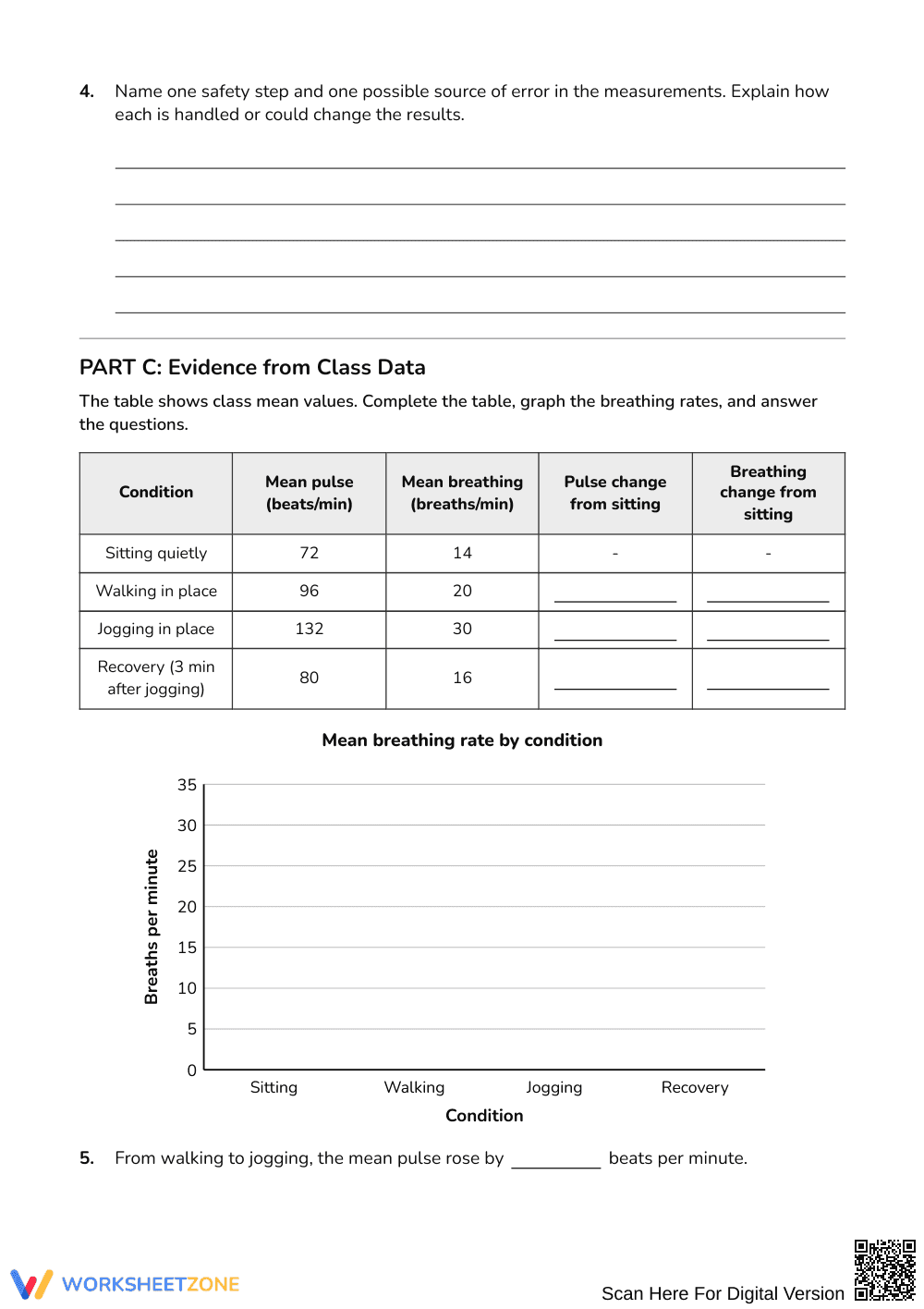
The worksheet spans four printable pages and offers 31 inquiry‑driven problems. Students begin by labeling a body diagram and matching organs to their systems, then complete a variable‑identification table, write a prediction with scientific reasoning, evaluate evidence, and analyze class data through tables and graphing tasks. An answer key on the back provides step‑by‑step solutions. Students can check each response against the key to self‑assess understanding and receive immediate feedback.
- Guided practice (10 problems): Students label organs and match them to systems using a provided diagram and word bank.
- Supported practice (12 problems): Students fill out the variable table, write predictions, and evaluate evidence with sentence frames and a worked example.
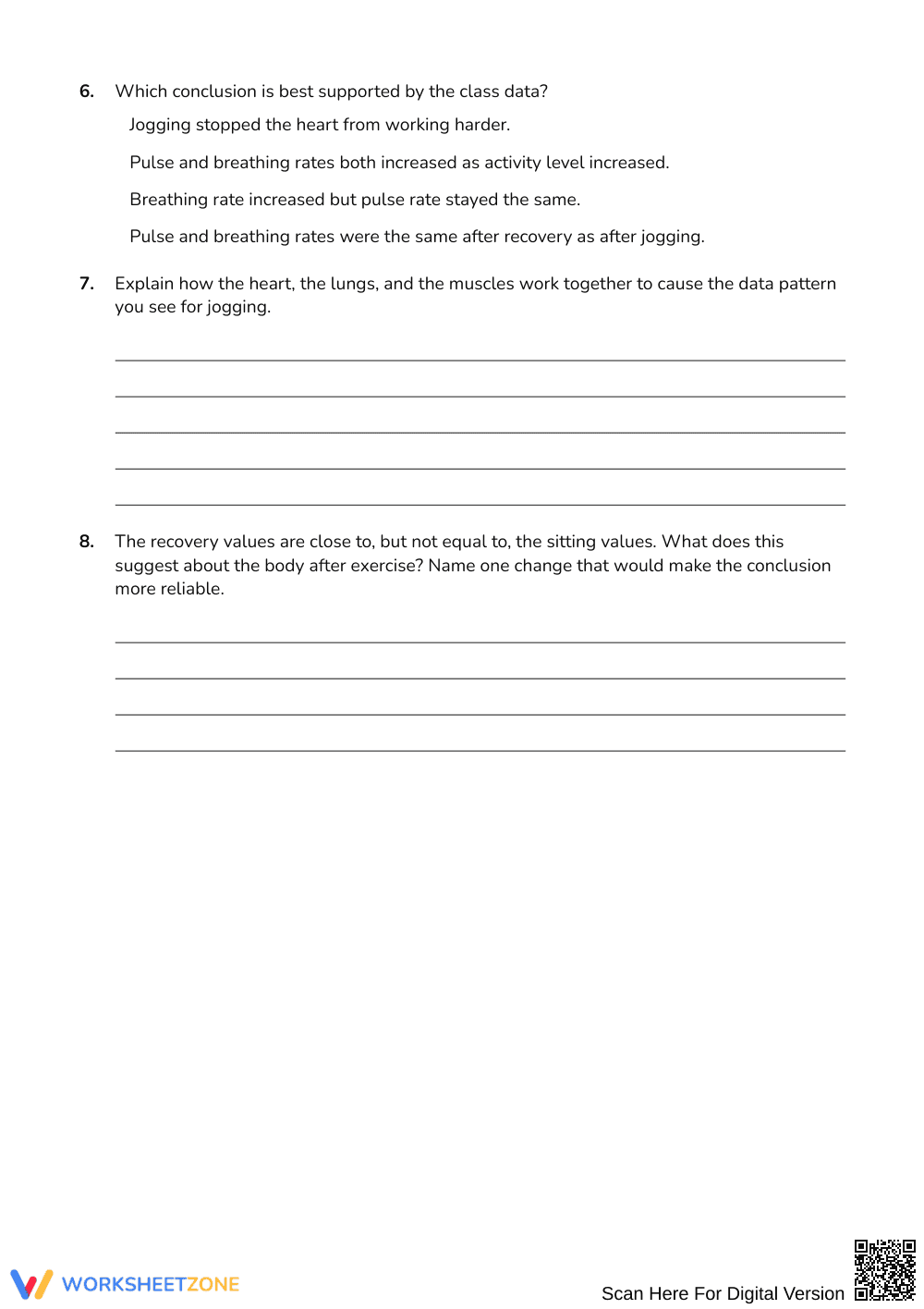
- Independent practice (9 problems): Students complete data‑analysis questions, graph the breathing rates, and write a physiological explanation without scaffolds.
The sequence follows the classic I Do, We Do, You Do gradual‑release model.
` ` This worksheet aligns with the investigation standard that requires students to examine how physical activity influences pulse and breathing rates, identify variables, formulate predictions, and interpret evidence. It also supports cross‑cutting concepts of cause and effect in life sciences. Both standard references can be copied directly into lesson plans, IEP goals, or curriculum maps.
Use the worksheet as a pre‑lab activity to activate prior knowledge before the class conducts the pulse‑and‑breathing investigation. Students work in pairs, completing the labeling and variable table while the teacher circulates to prompt scientific reasoning. After data collection, assign the worksheet for independent analysis, allowing you to observe each learner’s ability to draw evidence‑based conclusions. A quick exit ticket can capture their understanding in 5 minutes.
Designed for Grades 6‑10 science learners, this investigation supports students who need concrete visual aids as well as those ready for abstract data interpretation. Teachers can differentiate by providing the diagram with labels for struggling readers or by extending the graphing section for advanced students. Pair the worksheet with a Human Body Systems anchor chart or a short video on cardiovascular response for seamless integration.
The Body System Interactions worksheet meets the investigative standard that asks students to explore how activity changes pulse and breathing rates, identify independent and dependent variables, and draw evidence‑based conclusions. By guiding learners through labeling, prediction, data analysis, and explanation, the resource operationalizes the inquiry cycle emphasized in Fisher & Frey (2014), which reports that structured scientific investigations boost conceptual understanding and reasoning skills. The 31‑task sequence offers gradual scaffolding, enabling students to move from teacher‑modeled examples to autonomous interpretation of physiological data. With an answer key and clear rubrics, teachers can quickly assess mastery and provide targeted feedback. This printable, PDF‑ready worksheet is ready to assign, print, or download for immediate classroom use. Research shows that hands‑on investigations paired with visual organ diagrams improve students’ ability to connect system functions with measurable outcomes, fostering deeper retention of life‑science concepts.


