































Essential Blood Vessel Model Worksheet | Grade 6-10 Science

Paste this activity's link or code into your existing LMS (Google Classroom, Canvas, Teams, Schoology, Moodle, etc.).
Students can open and work on the activity right away, with no student login required.
You'll still be able to track student progress and results from your teacher account.
This blood vessel modeling worksheet guides students through structural and functional analysis of arteries, veins, and capillaries across 28 scaffolded questions. Students examine anatomical cross sections, trace pulmonary and systemic circulation pathways, and evaluate hemodynamic data to refine scientific models of the cardiovascular system.
At a Glance
- Grade: Grades 6–10 · Subject: Science
- Standard: Life Science — Develop and use models to describe blood vessel structure and circulation
- Skill Focus: Build or Revise a Model of Arteries and Veins
- Format: 4 pages · 28 problems · Answer key included · PDF
- Best For: Cardiovascular biology practice and model revision
- Time: 45–60 minutes
What's Inside
This 4-page worksheet features 28 scaffolded tasks organized into three distinct parts. Students examine anatomical vessel cross sections, complete a double circulation flow diagram, and analyze quantitative pressure and lumen diameter tables. A complete 4-page answer key provides labeled diagrams, model corrections, and thorough written response explanations.
Skill Progression
- Guided Practice (Part A, Tasks 1–10): Students label vessel layers—tunica externa, media, intima, and endothelium—using structural diagrams to connect thick muscular walls to high pressure and single-cell capillaries to rapid diffusion.
- Supported Practice (Part B, Tasks 11–20): Students complete a double circulation flow model, identifying systemic and pulmonary pathways while revising misconceptions about oxygenation and vessel direction.
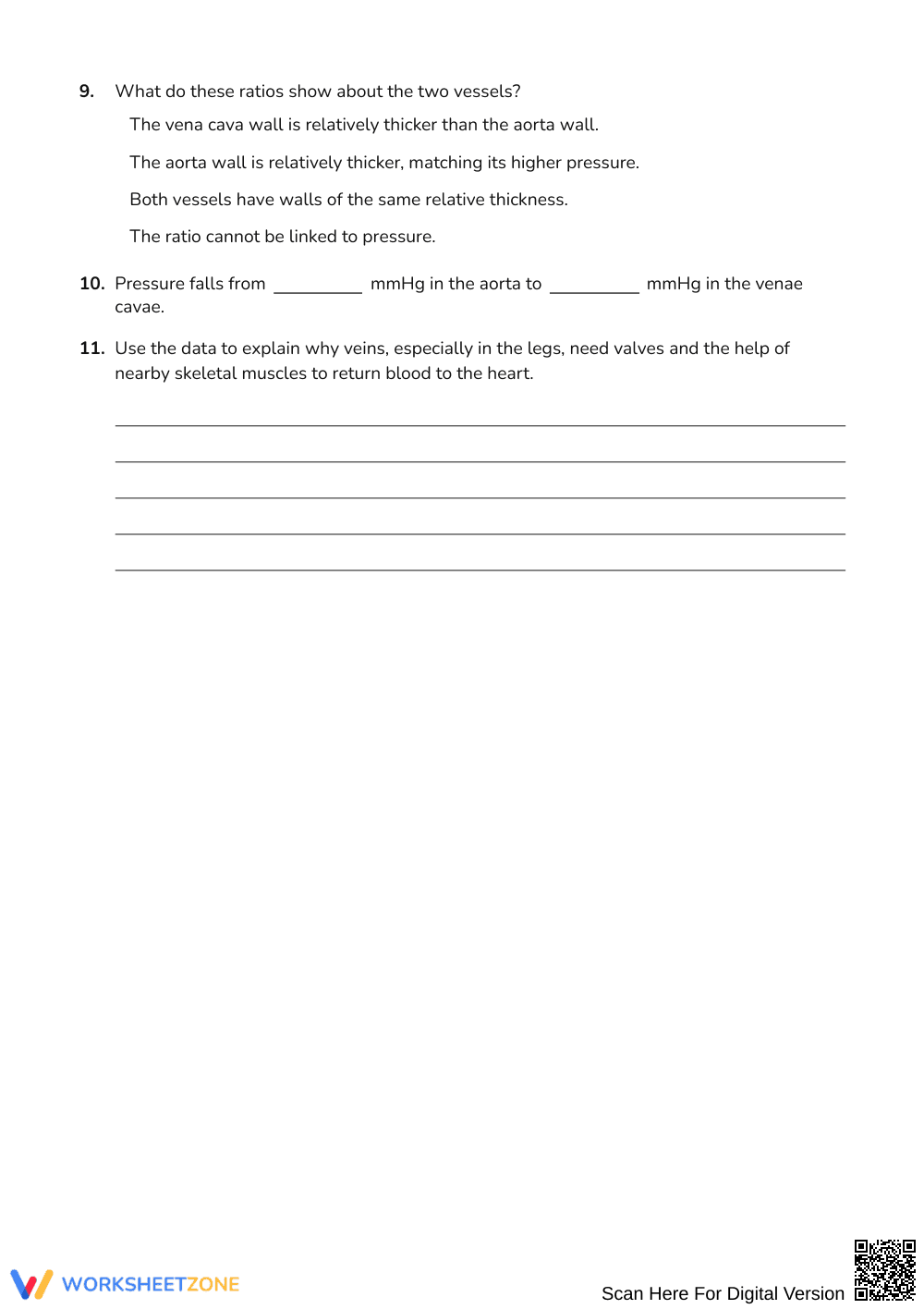
- Independent Practice (Part C, Tasks 21–28): Learners calculate wall-to-lumen ratios and evaluate blood pressure data to justify why veins require valves and skeletal muscle pumps.
This sequence implements a gradual release of responsibility model, guiding learners from anatomical labeling to sophisticated, data-driven model evaluation.
Standards Alignment
This worksheet aligns with secondary life science standards requiring students to develop and use models illustrating how specialized body systems transport essential materials. Supporting standards incorporate mathematical thinking to analyze vessel dimensions. Both standard codes can be copied directly into lesson plans, IEP goals, or district curriculum mapping tools.
How to Use It
Use Parts A and B during direct instruction to support collaborative model building, or assign the full 4-page packet afterward for independent review. Formatively check Part B responses to confirm students correctly identify pulmonary arteries as carrying deoxygenated blood. Students typically complete all 28 problems within 45 to 60 minutes.
Who It's For
This activity serves Grades 6–10 life science and introductory biology classes studying cardiovascular physiology. Visual scaffolds support developing readers, while quantitative ratio calculations provide rigor for advanced learners. Pair this worksheet directly with a whole-group human circulatory system model or a mammalian heart dissection.
According to research by Fisher and Frey (2014), structured modeling progressions that require students to build, evaluate, and iteratively revise diagrams significantly improve conceptual understanding and retention in complex biological sciences. This Grade 6–10 science worksheet directly reflects those instructional principles across 28 tasks focused on blood vessel structure, circulatory pathways, and hemodynamic relationships. By moving from structural identification of the three blood vessel types to evaluating systemic versus pulmonary circulation circuits, learners dismantle persistent misconceptions about vessel oxygenation. Furthermore, integrating quantitative ratios of wall thickness to lumen diameter alongside empirical pressure data enables students to justify anatomical adaptations using mathematical evidence. The comprehensive 4-page resource includes step-by-step model revision prompts and complete teacher answer keys, ensuring educators can readily evaluate student mastery of secondary life science modeling competencies during units on human cardiovascular physiology.


