































Essential Big-Cat Senses Word Search | Grades 4–5 Science

Paste this activity's link or code into your existing LMS (Google Classroom, Canvas, Teams, Schoology, Moodle, etc.).
Students can open and work on the activity right away, with no student login required.
You'll still be able to track student progress and results from your teacher account.
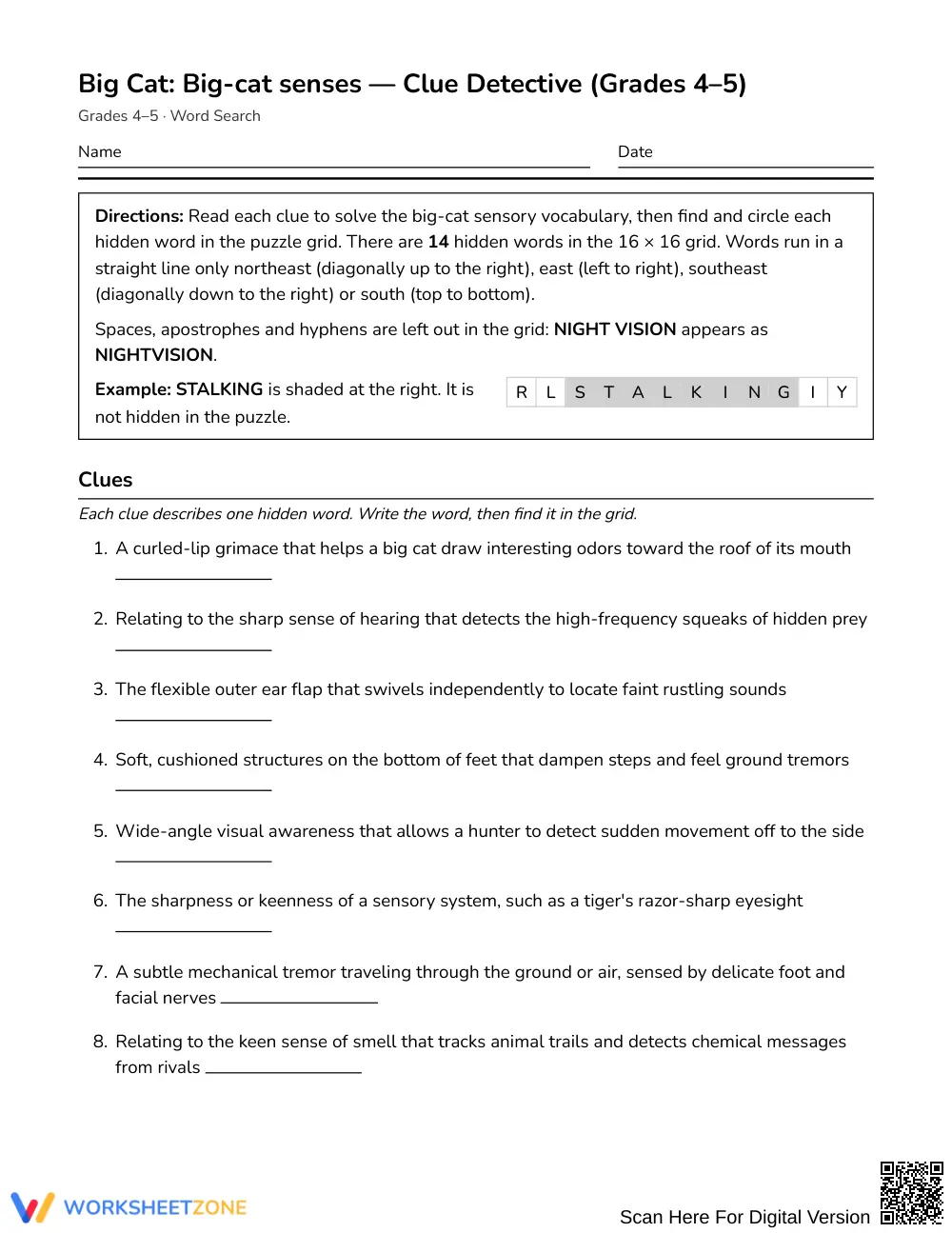
This big-cat senses word search helps upper elementary students master specialized sensory vocabulary through clue-based retrieval. Learners read detailed definitions of feline adaptations, identify each biological term, and locate it within the grid. The activity reinforces animal structure and function concepts, giving students an engaging way to build domain-specific scientific literacy.
At a Glance
- Grade: Grades 4–5 · Subject: Science
- Standard: Not standards-assessed — vocabulary enrichment and morphology review
- Skill Focus: Big-cat sensory adaptations, anatomy, and physiological terminology
- Format: 3 student pages · 14 hidden words · Complete 3-page answer key included · Printable PDF
- Best For: Science vocabulary review, independent stations, fast-finisher enrichment
- Time: 20–30 instructional minutes
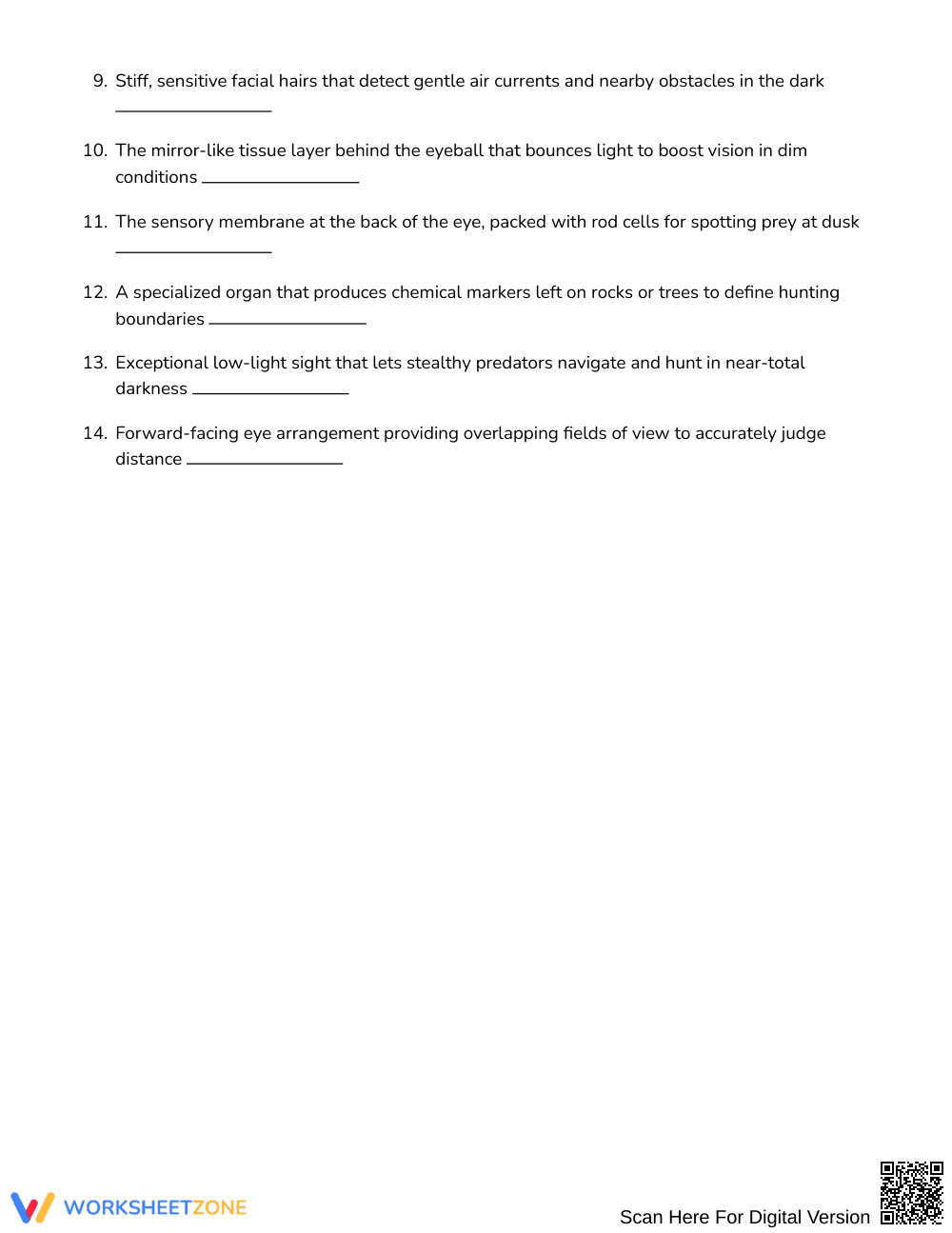
This 3-page science resource features a clue-driven puzzle design that replaces rote searching with active recall. Students analyze 14 challenging scientific terms—such as vibrissae, tapetum, flehmen, and binocular vision—matched to comprehensive biological descriptions. A complete 3-page answer key provides clear letter-by-letter solutions, making independent verification straightforward for learners and instructors alike.
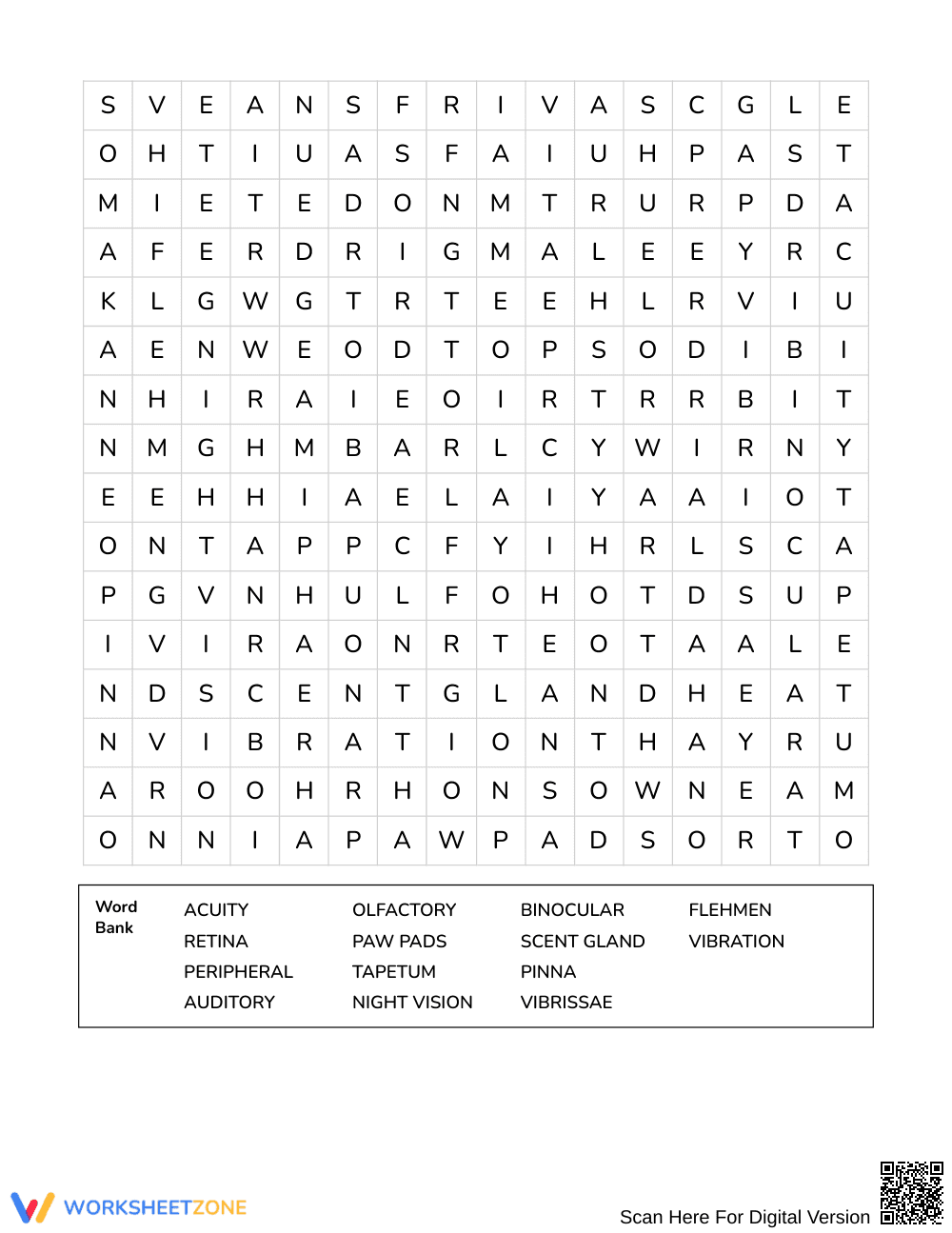
The puzzle is built on an expansive 16 x 16 letter grid containing 14 hidden sensory terms arranged along four distinct directional paths: northeast, east, southeast, and south. Rather than relying on a simple alphabetical list, the layout pairs a shuffled word bank with rigorous contextual clues. Students must read each anatomical definition to deduce the target vocabulary term before hunting through the letter array, strengthening analytical thinking alongside spatial recognition.
This activity serves as supplemental vocabulary enrichment and is not aligned to a specific state or national content standard. It reinforces essential life science concepts regarding sensory organs, physical adaptations, and predator behaviors without the constraints of standardized testing benchmarks.
Incorporate this puzzle during or after direct instruction on sensory systems and predator adaptations. First, use it as a collaborative partner activity following a lesson on animal physiology, allowing pairs to debate definitions before scanning the grid. Second, place the printable at an independent science center or retain it as an enriching fast-finisher task. During the session, observe whether students read clues to define terms independently or default to searching letter strings, prompting them to explain how structures like the tapetum aid survival. Expect completion within 20 to 30 minutes.
This resource is tailored for Grades 4–5 science students exploring internal and external animal structures. It offers built-in differentiation: the descriptive clues assist emerging readers with conceptual context, while advanced students gain exposure to specialized biological terminology. For maximum instructional impact, pair this word search with an illustrated anchor chart on predator anatomy or an informational reading passage covering mammalian vision and audition.
According to research on disciplinary literacy by Fisher & Frey (2014), purposeful vocabulary acquisition requires multiple meaningful interactions with domain-specific language rather than isolated memorization. This word search supports science vocabulary acquisition across Grades 4–5 by linking 14 anatomical terms directly to descriptive clues highlighting sensory adaptations in predatory animals. Rather than passive scanning, students actively retrieve definitions for complex concepts such as the tapetum, vibrissae, and flehmen response, associating each specialized structure with its functional survival benefit. Integrating contextual clue decoding with spatial pattern discovery reinforces long-term retention of life science concepts. Teachers can deploy this resource during animal structure units to stimulate scientific talk and build academic schema. As Fisher & Frey (2014) demonstrate, intentional exposures to specialized terms within engaging contexts establish the foundational knowledge base necessary for rigorous comprehension in elementary science classrooms.


