




























Views
Downloads


Essential Author's Purpose Worksheet | Grade 6 ELA

Paste this activity's link or code into your existing LMS (Google Classroom, Canvas, Teams, Schoology, Moodle, etc.).
Students can open and work on the activity right away, with no student login required.
You'll still be able to track student progress and results from your teacher account.
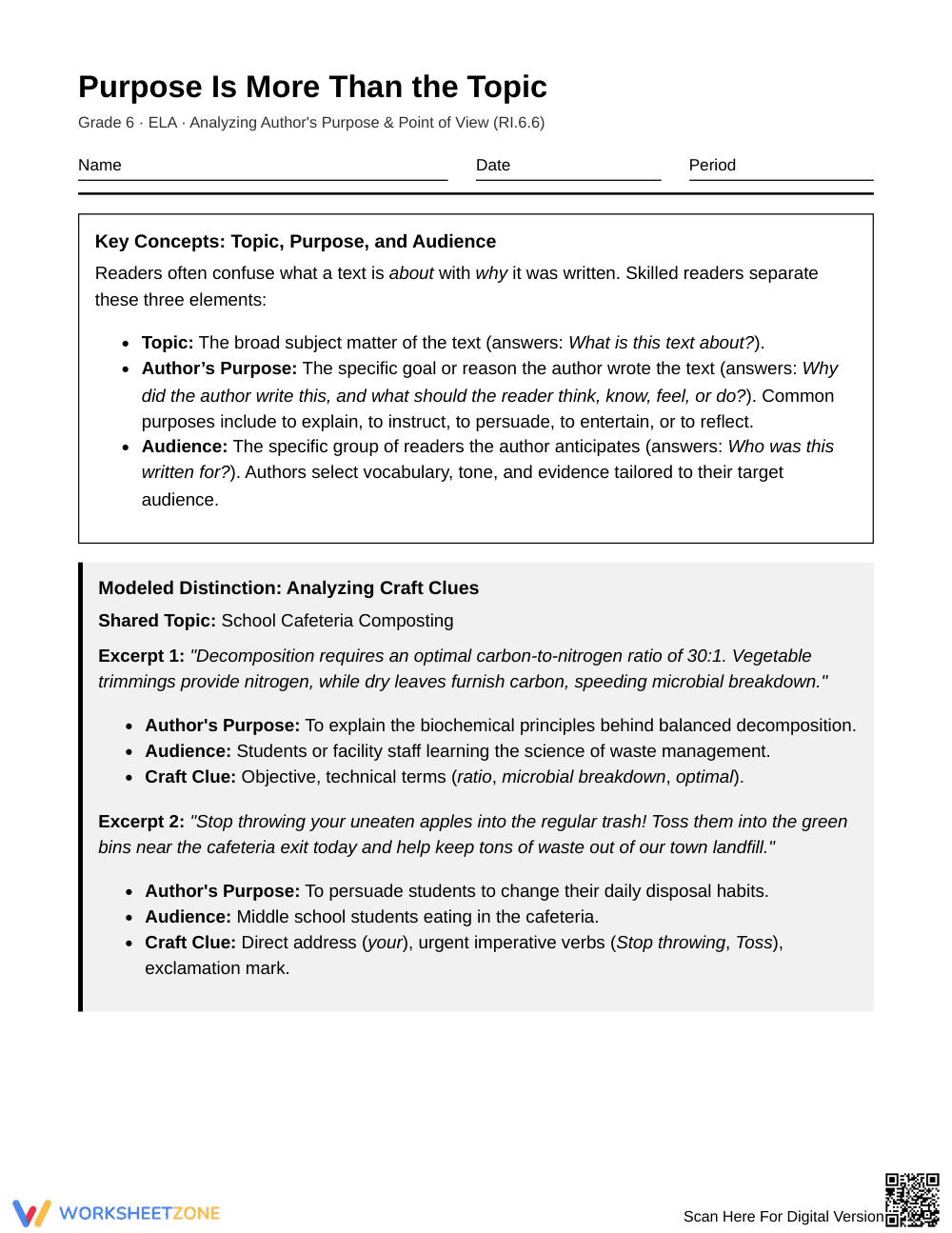
Help sixth-grade readers move beyond surface-level topic identification with this informational text worksheet. Students analyze how two authors address a shared gardening subject with divergent goals, evaluating diction, audience, and structure. This resource ensures learners explain why an author writes rather than merely summarizing what they write.
At a Glance
- Grade: 6 · Subject: ELA
- Standard:
RI.6.6— Determine author purpose and explain how point of view is conveyed- Skill Focus: Distinguishing Topic from Author's Purpose
- Format: 5 pages · 10 problems · Answer key included · PDF
- Best For: Close reading and paired text analysis
- Time: 35–45 minutes
What's Inside
This 5-page printable instructional packet features key concept definitions, a modeled distinction box with craft clues, and two contrasting campus-garden texts. Across 10 structured tasks, students complete multiple-choice identification, audience analysis, and written evidence justification. A comprehensive 3-page answer key provides complete model responses and targeted craft breakdowns.
Skill Progression
- Guided Practice (Part A, Problems 1–3): Students review core concepts and distinguish broad subject matter from authorial intent through multiple-choice discrimination and purpose drafting.
- Supported Practice (Part B, Problems 4–8): Learners analyze craft clues across 5 short-answer questions, connecting technical vocabulary, imperative sentence structures, and evidence selection to specific audiences.
- Independent Practice (Part C, Problems 9–10): Students synthesize learning by writing paragraph justifications evaluating text structure, point of view, and persuasive rhetoric with cited textual evidence.
This sequence implements a gradual-release model, moving students from guided concept discrimination to independent rhetorical analysis.
Standards Alignment
The primary focus aligns to `RI.6.6`: Determine an author's point of view or purpose in a text and explain how it is conveyed in the text. As a supporting standard, `RI.6.1` requires citing textual evidence to support analysis. Both standard codes can be copied directly into lesson plans, IEP goals, or district curriculum mapping tools.
How to Use It
Use this worksheet after direct instruction on author's intent during an informational text unit. For guided partner practice, have pairs annotate Text A and Text B for craft markers before answering Part B. Alternatively, assign the packet as a mid-unit formative assessment. During independent work, verify that students craft purpose statements using active verb infinitives rather than repeating the topic. Expected completion time is 35 to 45 minutes.
Who It's For
This lesson serves general education sixth-grade ELA classrooms, reading intervention groups, and English language learners needing explicit craft modeling. Pair this worksheet directly with an anchor chart detailing author's craft verbs (such as illustrate, persuade, and explain) to support student responses in Part C.
According to Fisher & Frey (2014), middle school readers frequently conflate an informational text's overarching topic with the author's underlying purpose when instruction lacks explicit modeling of craft clues. Mastering standard RI.6.6 requires students to decouple what a text discusses from why an author composed it. By presenting two passages centered on the identical topic of school gardening, this resource isolates authorial intent through contrasting stylistic elements, targeted audience considerations, and intentional vocabulary choices. Students systematically analyze objective technical descriptions versus persuasive recruitment calls, building critical evaluative reading habits. Structured scaffolded tasks move learners from basic identification to rigorous, evidence-based written justification. This deliberate gradual-release architecture reinforces close-reading endurance and textual analysis competencies, ensuring sixth graders accurately determine authorial intent and articulate how specific linguistic choices advance that communicative purpose across varied informational formats.


