




























Views
Downloads




Essential Astronomical Orbit Worksheet | Grade 12 Science

Paste this activity's link or code into your existing LMS (Google Classroom, Canvas, Teams, Schoology, Moodle, etc.).
Students can open and work on the activity right away, with no student login required.
You'll still be able to track student progress and results from your teacher account.
Master orbital mechanics and Keplerian relationships with this rigorous Grade 12 Earth and Space Science worksheet. Students analyze planetary trajectories, calculate orbital periods and eccentricities, and evaluate multi-body resonances across 12 targeted problems. This comprehensive resource strengthens quantitative reasoning and prepares advanced learners for college-level astrophysics and dynamical systems coursework.
At a Glance
- Grade: 12 · Subject: Earth and Space Science
- Standard: Orbital Mechanics — Calculate orbital periods, semimajor axes, and eccentricities using Keplerian laws
- Skill Focus: Astronomical orbit analysis and Kepler's laws
- Format: 5 pages · 12 problems · Answer key included · PDF
- Best For: High school astrophysics and orbital mechanics review
- Time: 45–60 minutes
This 5-page worksheet begins with a dedicated governing equations reference box detailing Kepler's Second and Third Laws, generalized stellar mass equations, and orbital geometry formulas. Students encounter multiple-choice conceptual checks, tabular observational survey datasets, algebraic derivations, and multi-step dynamical inference tasks. A thorough 4-page answer key provides step-by-step mathematical derivations and qualitative justifications for every question.
Skill Progression
- Guided Practice (Part A, Problems 1–3): Students apply fundamental formulas to calculate orbital periods and derive semimajor axes and eccentricities with explicit reference equations provided.
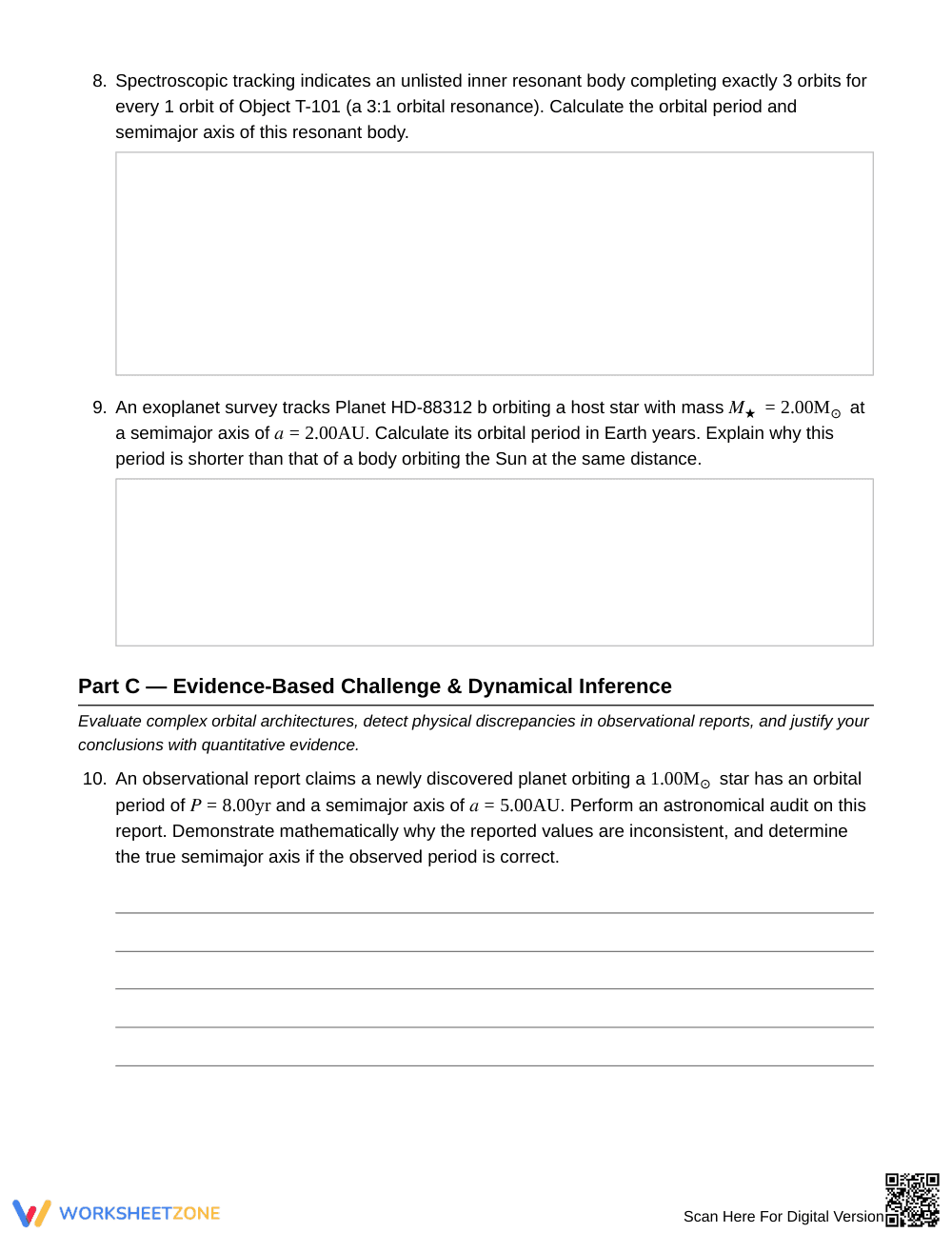
- Supported Practice (Part B, Problems 4–9): Learners analyze a synthetic observational survey table, computing periods, orbital velocities, resonances, and generalized stellar mass variations with moderate scaffolding.
- Independent Practice (Part C, Problems 10–12): Students conduct independent astronomical audits, detect physical discrepancies in observational reports, and evaluate orbital cross-overs in multi-body planetary architectures.
This structured progression follows the gradual release model, guiding learners from foundational formula application to advanced, evidence-based dynamical evaluation.
Standards Alignment
This resource aligns with high school Earth and Space Science standards covering orbital dynamics and gravitational laws. Students apply mathematical representations of Kepler's laws to predict the motion of orbiting objects in solar and extra-solar systems. Both standard descriptions can be copied directly into lesson plans, IEP goals, or district curriculum mapping tools.
How to Use It
Deploy this activity after direct instruction on Kepler's laws as an in-depth collaborative problem set, or assign it as an independent summative review before an astronomy unit exam. During class, monitor how students isolate variables when calculating semimajor axes in generalized mass equations (Part B) to check for algebraic misconceptions. Expected completion time is 45 to 60 minutes.
Who It's For
Designed for Grade 12 Earth and Space Science, Environmental Science, and high school physics students mastering celestial mechanics. Advanced learners can tackle the orbital resonance and multi-body crossing challenges in Part C, while students needing extra support benefit from the governing equations reference header. Pair this worksheet directly with an interactive planetary orbit simulation.
According to research by Fisher & Frey (2014) on effective instructional scaffolding, student mastery of complex scientific and mathematical concepts increases significantly when instruction follows an intentional gradual release framework. This Grade 12 Earth and Space Science resource operationalizes that research across 12 rigorous tasks, guiding students through foundational Keplerian calculations, observational survey analysis, and multi-body astronomical audits. By transitioning learners systematically from direct formula application to high-level dynamical modeling, the resource fosters deep conceptual understanding of gravitational physics, planetary velocity profiles, and orbital geometry. Students not only calculate orbital periods, semimajor axes, and eccentricities with precision, but also evaluate real-world observational discrepancies and long-term orbital stability. Such evidence-based task design ensures that high school science students build the quantitative problem-solving and analytical reasoning skills essential for postsecondary STEM coursework and scientific inquiry.


