




























Views
Downloads



Essential Area & Volume Unit Errors Worksheet | Grade 6 Math

Paste this activity's link or code into your existing LMS (Google Classroom, Canvas, Teams, Schoology, Moodle, etc.).
Students can open and work on the activity right away, with no student login required.
You'll still be able to track student progress and results from your teacher account.
Mastering unit consistency across 1D, 2D, and 3D measurements is vital for middle school geometry. This Grade 6 worksheet provides targeted error analysis tasks that challenge students to identify dimensional misconceptions, explain conversion errors, and calculate accurate surface area and volume solutions across practical packaging scenarios.
At a Glance
- Grade: 6 · Subject: Math
- Standard: Measurement & Unit Conversion — Correct dimensional and unit conversion errors in 2D and 3D geometry
- Skill Focus: Correct Area-Volume Unit Errors
- Format: 5 pages · 10 problems · Answer key included · PDF
- Best For: Geometry error analysis and remediation
- Time: 35–45 minutes
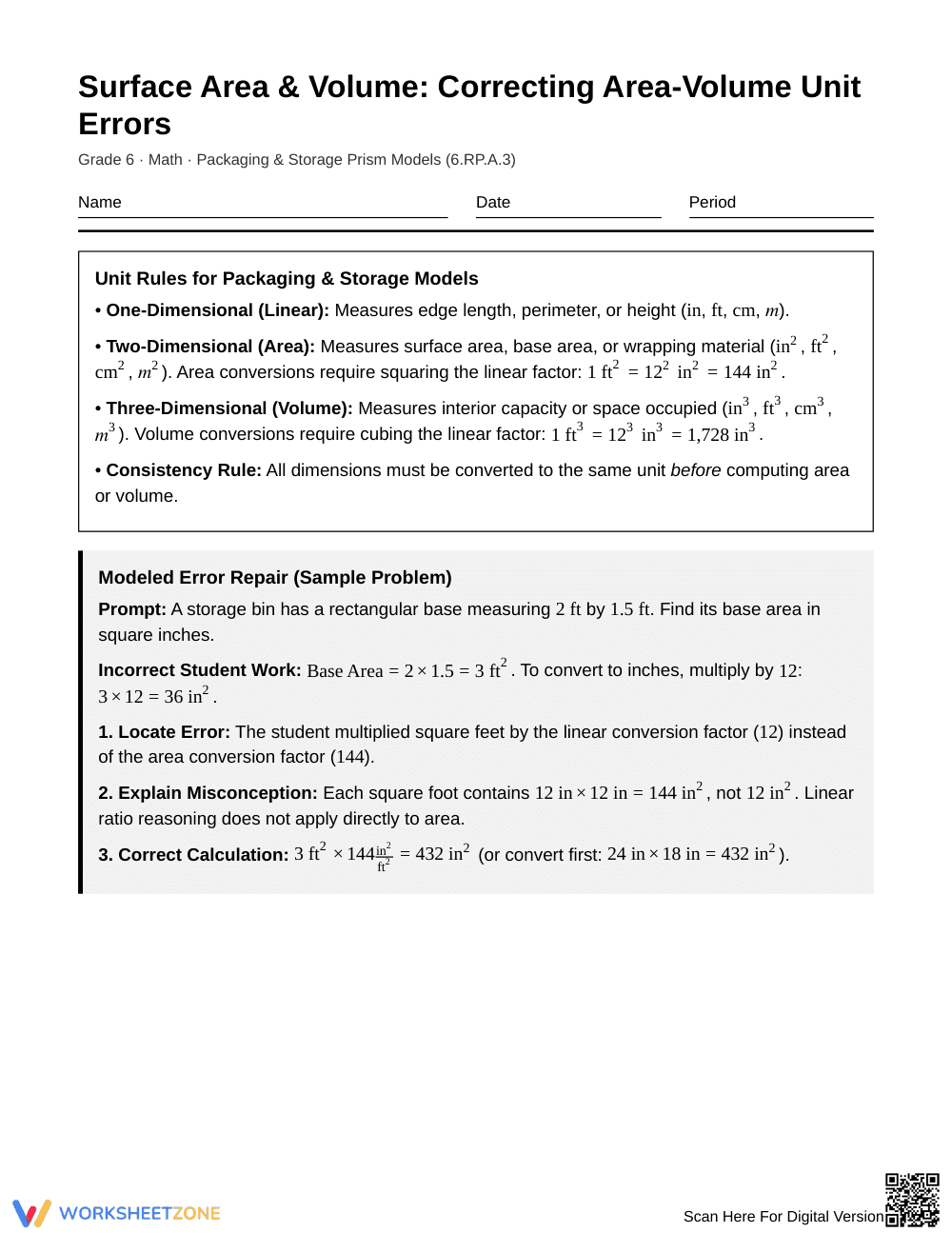
This 5-page printable resource features 10 real-world packaging and storage scenarios requiring error detection, written misconception analysis, and corrected computations. It opens with an explicit dimensional unit reference guide and a three-step modeled error repair example. The included comprehensive 4-page answer key provides step-by-step diagnostic feedback, explicit error explanations, and full mathematical justifications for every task.
Skill Progression
- Guided practice: The introductory section provides explicit unit rules for 1D, 2D, and 3D conversions alongside a fully solved sample error-repair problem demonstrating identification, explanation, and recalculated steps.
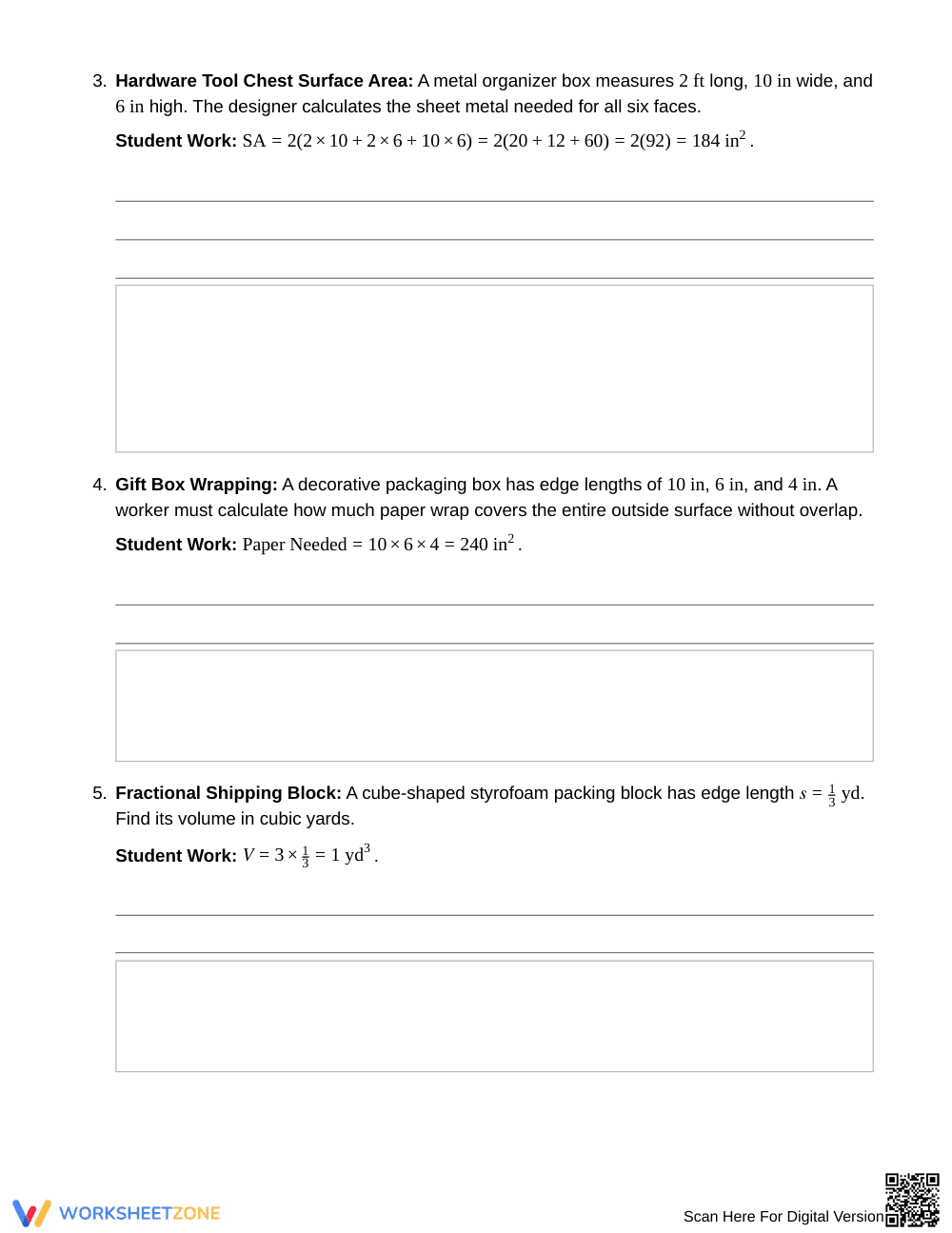
- Supported practice: Problems 1 through 5 present single-step dimensional mistakes, such as missing exponents and linear factor scaling on volume or area, with structured three-part prompts.
- Independent practice: Problems 6 through 10 advance to mixed-unit containers, fractional edge lengths, and multi-step pallet conversions requiring complete autonomous calculation.
This structured progression utilizes the gradual-release framework (I Do, We Do, You Do) to build conceptual precision before independent application.
Standards Alignment
Students apply ratio reasoning to convert measurement units in area and volume contexts, connecting geometric measurement to dimensional analysis. This practice reinforces foundational standards in geometric problem solving and ratio conversion. Both standard codes can be copied directly into lesson plans, IEP goals, or district curriculum mapping tools.
How to Use It
Deploy this worksheet after direct instruction on surface area and volume to cement dimensional distinctions. For small-group intervention, have students orally explain the misconception in Problem 3 before writing their calculations. As a formative assessment tip, check whether students square or cube linear conversion factors when changing units. Expect students to complete the 10 problems within 35 to 45 minutes during class or targeted remediation.
Who It's For
This resource serves general education Grade 6 math students, intervention cohorts needing remediation on dimensional units, and accelerated Grade 5 learners ready for spatial geometry. It pairs effectively with physical unit cube manipulatives, visual net diagrams, or direct instruction lessons on rectangular prism surface area and capacity.
Addressing student misconceptions through explicit error analysis enhances mathematical reasoning and long-term retention. Research by Fisher & Frey (2014) demonstrates that structured error analysis tasks promote deeper conceptual understanding by requiring learners to articulate mathematical principles rather than merely executing rote algorithms. This 5-page Grade 6 geometry worksheet provides 10 rigorous packaging problems focusing on correcting area and volume unit errors. Students evaluate flawed student work, diagnose underlying dimensional mistakes such as applying linear factors to square or cubic measurements, and reconstruct accurate multi-step solutions. Designed to support rigorous measurement and unit conversion objectives, this instructional tool incorporates a complete 4-page diagnostic answer key. Educators can use this structured resource for targeted intervention, formative assessment, or collaborative error-correction discussions to build lasting geometric and dimensional proficiency across diverse middle school math settings.


