

































Essential Ambiguous Density Worksheet | Grade 7 Science

Paste this activity's link or code into your existing LMS (Google Classroom, Canvas, Teams, Schoology, Moodle, etc.).
Students can open and work on the activity right away, with no student login required.
You'll still be able to track student progress and results from your teacher account.
This Grade 7 physical science worksheet trains middle school students to evaluate measurement uncertainty when calculating density and identifying unknown substances. Students analyze interval ranges, account for systematic errors, and select targeted confirmatory physical property tests to resolve ambiguous lab data across 6 rigorous analytical tasks.
At a Glance
- Grade: 7 · Subject: Science
- Standard: Analyze and interpret data on the properties of substances to distinguish materials
- Skill Focus: Resolving ambiguous material identifications under measurement variation
- Format: 5 pages · 6 problems · Answer key included · PDF
- Best For: Post-lab data analysis and critical thinking
- Time: 40–50 minutes
What's Inside
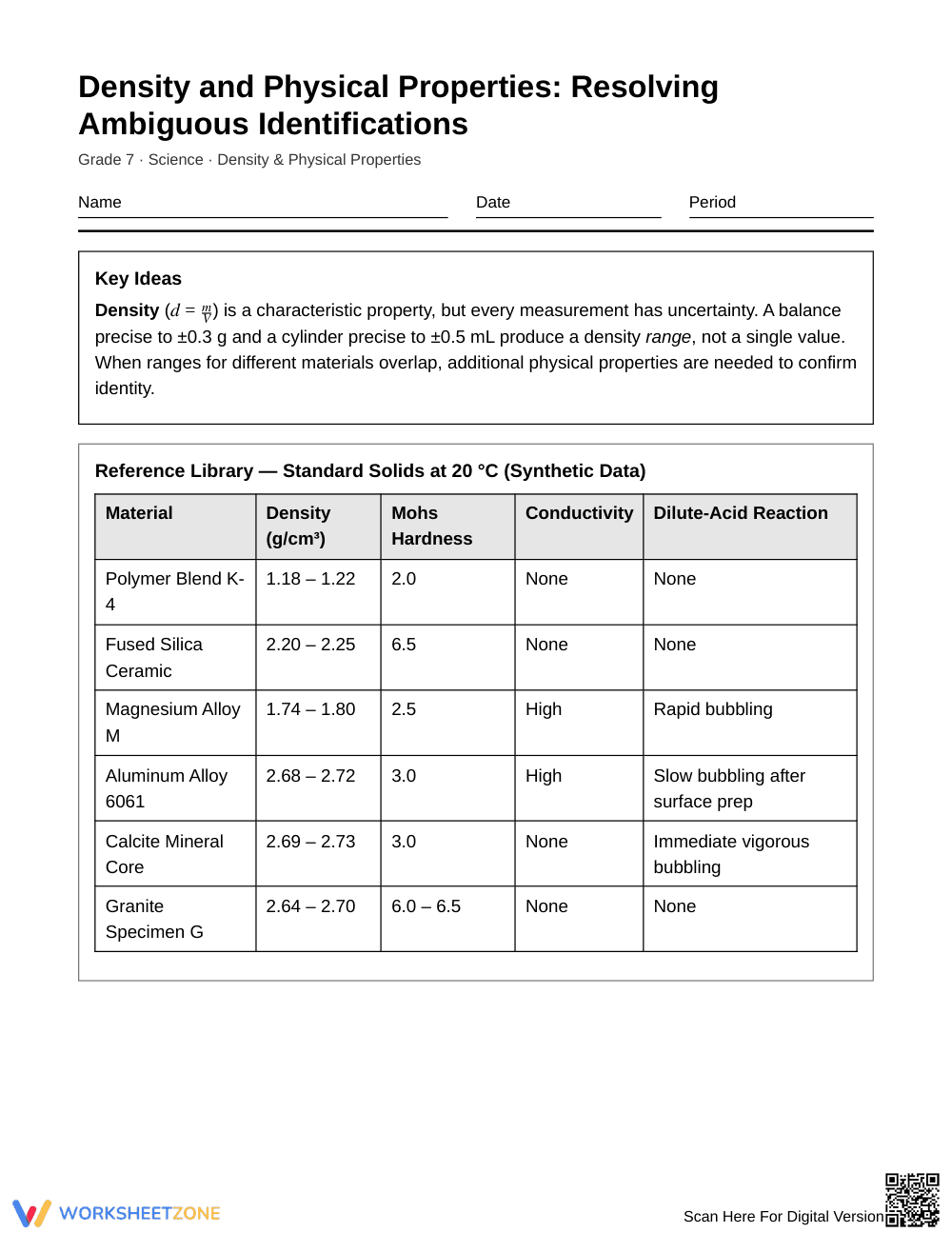
This 5-page printable resource includes 2 student activity pages and a comprehensive 3-page explanatory answer key. It features a reference data library of physical properties (density ranges, Mohs hardness, conductivity, and acid reactivity) alongside systematic error calculation prompts, competing model structural analyses, and a multi-station synthesis dataset.
Skill Progression
- Guided practice (Part A, 2 problems): Students compute minimum and maximum density intervals from given measurement tolerances and identify how systematic displacement errors alter candidate lists.
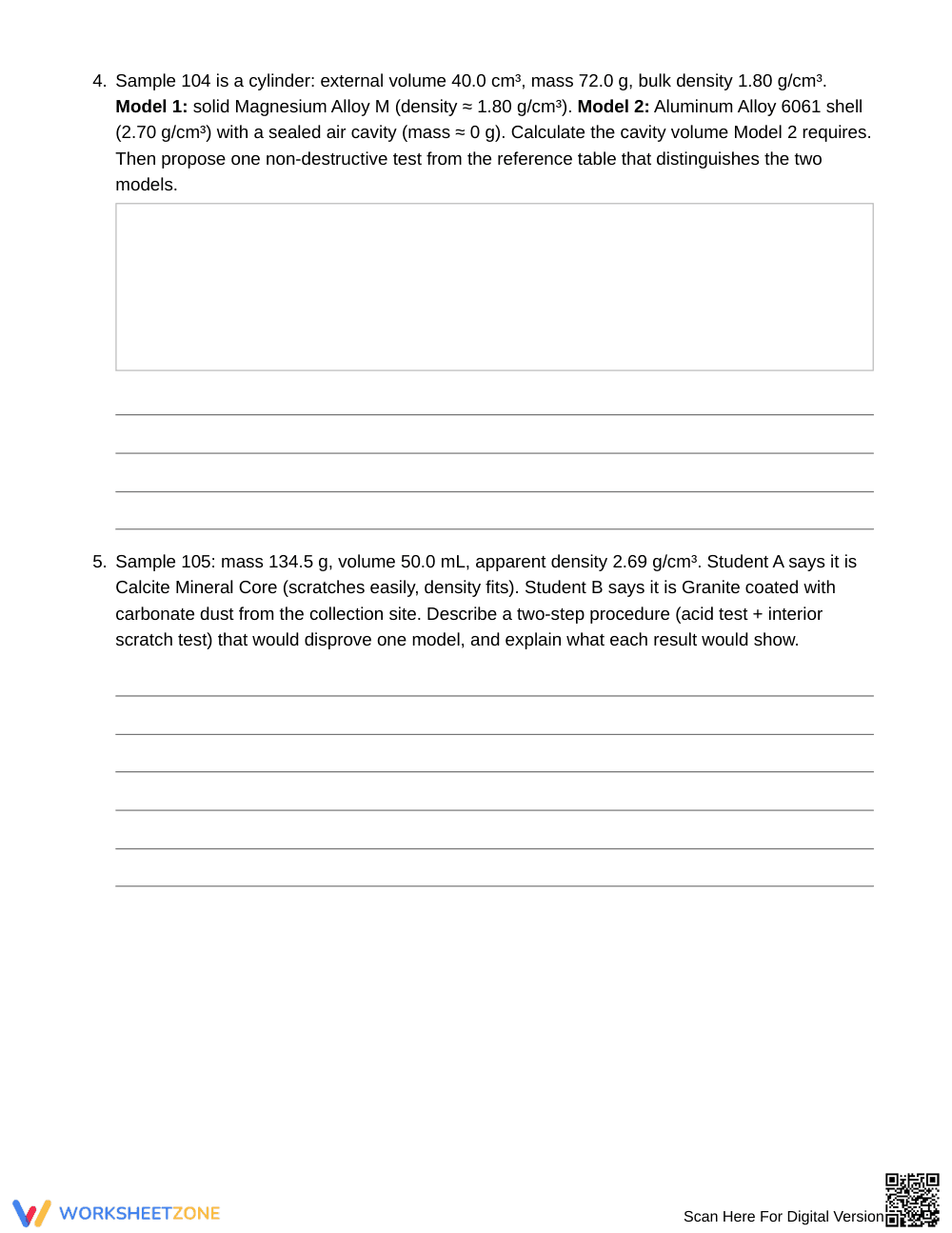
- Supported practice (Part B, 3 problems): Learners solve inverse tolerance equations, calculate hollow-cavity volumes in competing structural models, and design diagnostic two-step chemical and hardness procedures.
- Independent practice (Part C, 1 multi-step problem): Students synthesize four conflicting lab station datasets, eliminating non-matching substances one by one using qualitative properties to defend a final claim.
This structure follows an intentional gradual-release framework, moving students from basic interval calculations to robust, evidence-based scientific argumentation.
Standards Alignment
Students analyze and interpret data on the characteristic properties of substances before and after substances interact to determine if a chemical reaction has occurred or to identify pure substances. Both standard codes can be copied directly into lesson plans, IEP goals, or district curriculum mapping tools.
How to Use It
Implement this worksheet after direct instruction on density calculations and physical properties. For collaborative learning, assign Part A as partner work during guided practice, then have students complete Parts B and C independently. During Part C, circulate formatively to observe whether students use multiple diagnostic tests rather than relying solely on overlapping density ranges. Expect completion in 40 to 50 minutes.
Who It's For
This activity is designed for Grade 7 general science and honors physical science classrooms. Provide struggling learners with a targeted reference highlighter to isolate property rows, and pair this worksheet directly with a hands-on mineral density and acid testing laboratory investigation.
According to Fisher & Frey (2014), purposeful gradual-release instruction significantly enhances student capacity to analyze scientific uncertainty and construct evidence-based explanations. When middle school science learners encounter realistic experimental error in physical science investigations, single-variable data often leads to premature or incorrect conclusions. This Grade 7 resource directly addresses that instructional challenge by guiding students through systematic data analysis, requiring them to evaluate measurement intervals, quantify systematic errors, and cross-examine secondary physical properties including hardness, electrical conductivity, and acid reactivity. By transitioning from constrained density calculations to multi-station synthesis problems, students develop rigorous scientific reasoning skills necessary to defend material identifications when numerical data overlaps. The structured 6-task sequence ensures students internalize the necessity of multi-property testing, transforming standard density practice into an authentic exercise in empirical evaluation and scientific argumentation aligned with contemporary inquiry standards.


