































Essential Alternative Nets Worksheet | Grade 6 Math

Paste this activity's link or code into your existing LMS (Google Classroom, Canvas, Teams, Schoology, Moodle, etc.).
Students can open and work on the activity right away, with no student login required.
You'll still be able to track student progress and results from your teacher account.
This targeted geometry worksheet develops spatial reasoning by guiding Grade 6 students to analyze, map, and compare alternative two-dimensional nets representing the same three-dimensional solid. Students evaluate edge lengths, face arrangements, and surface area equivalences across rectangular prisms, triangular prisms, and pyramids to achieve conceptual mastery.
At a Glance
- Grade: 6 · Subject: Math
- Standard:
6.G.A.4— Represent three-dimensional figures using nets made of rectangles and triangles to solve surface area problems- Skill Focus: Comparing Alternative Nets of One Solid
- Format: 5 pages · 12 problems · Answer key included · PDF
- Best For: Geometry unit practice and spatial reasoning
- Time: 35–45 minutes
What's Inside
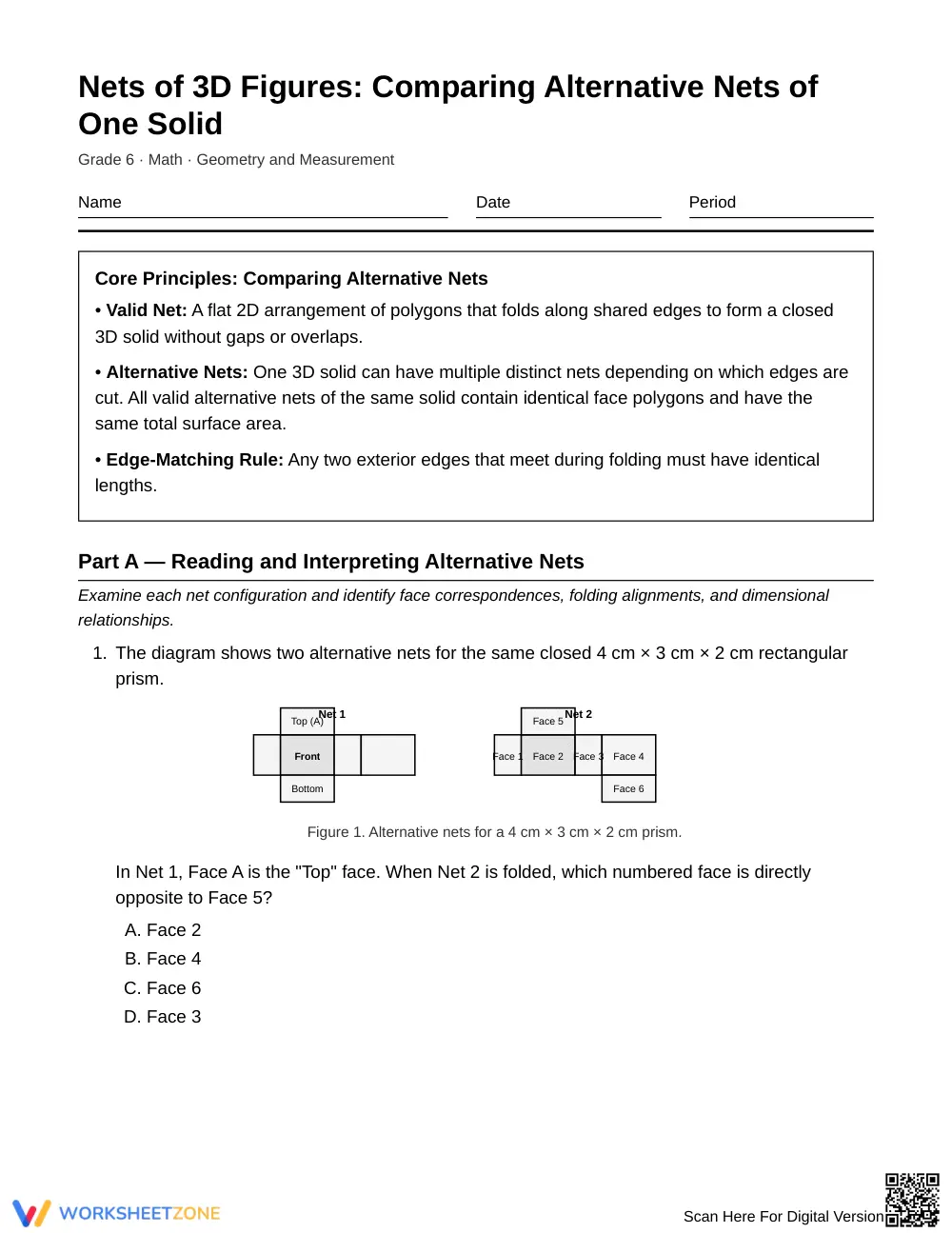
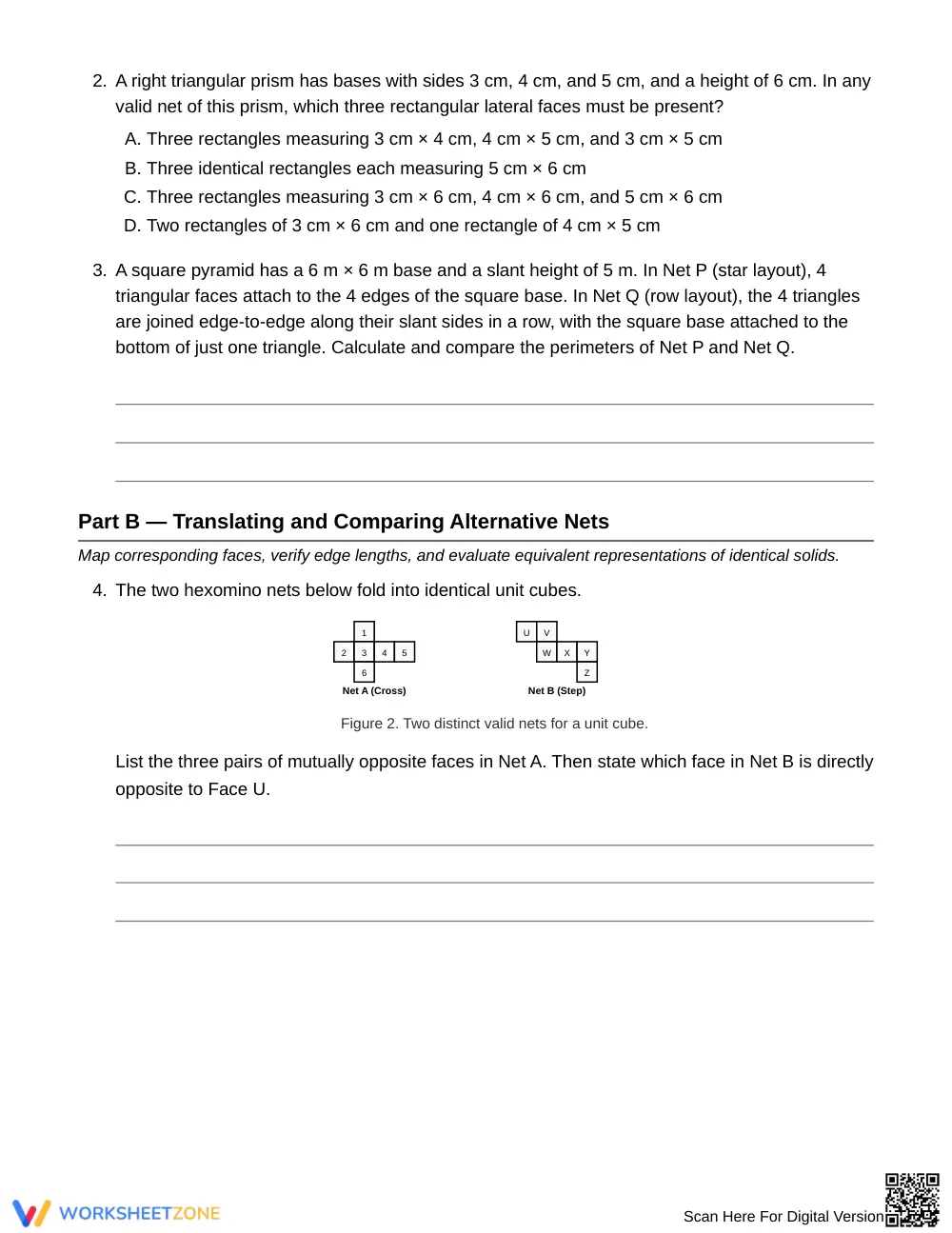
The resource features 12 multi-tiered geometry tasks distributed across five student-facing and reference pages. It opens with foundational core principles defining valid net configurations and the exterior edge-matching rule, followed by diagrams of hexominoes, unrolled prisms, and pyramids. A complete 3-page answer key provides full spatial solutions, dimensional verifications, and written justifications.
Skill Progression
- Guided Practice (Part A, Tasks 1–3): Multiple-choice and short-response items where students interpret face correspondences, identify lateral faces in triangular prisms, and compare perimeters of alternate pyramid nets.
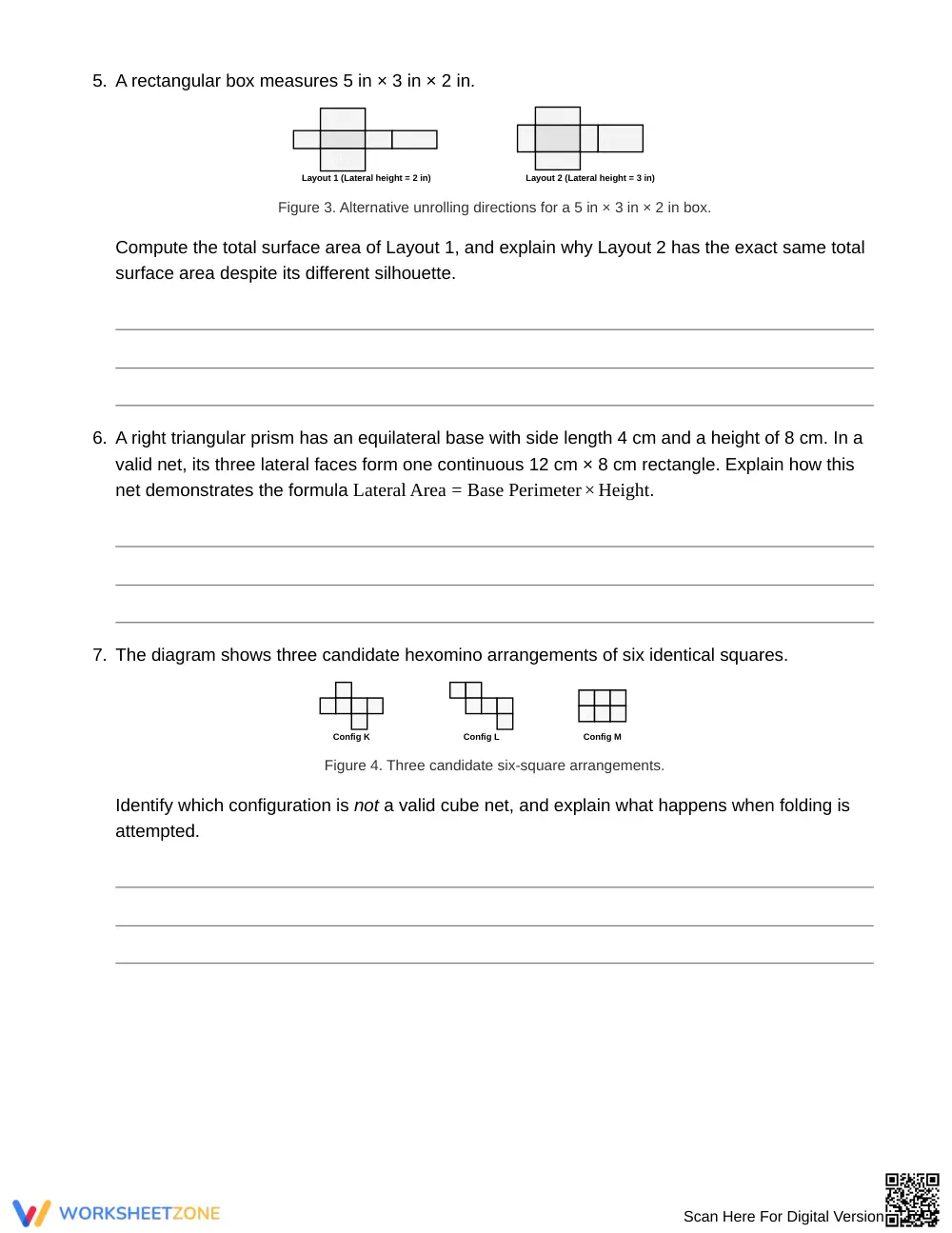
- Supported Practice (Part B, Tasks 4–9): Intermediate mapping tasks where learners analyze hexomino cube pairs, verify surface area invariance across layouts, derive lateral area relationships, identify invalid folding patterns, and complete comparison tables.
- Independent Practice (Part C, Tasks 10–12): Higher-order justification prompts where students construct counterexamples against perimeter claims, explain packaging design equivalence, and diagnose edge mismatch errors.
This structured progression leverages a gradual-release instructional model, shifting students from visual recognition to independent geometric critique.
Standards Alignment
This worksheet aligns directly with 6.G.A.4: Represent three-dimensional figures using nets made up of rectangles and triangles, and use the nets to find the surface area of these figures in the context of solving real-world and mathematical problems. It also reinforces 6.EE.A.2.C through surface area formulas. Both standard codes can be copied directly into lesson plans, IEP goals, or district curriculum mapping tools.
How to Use It
Deploy this worksheet after direct instruction on basic surface area and net folding. During independent work, observe whether students verify edge-matching lengths when folding adjacent faces or mistakenly rely solely on congruent face counts. Alternatively, utilize Part C as a partner discussion activity to encourage mathematical discourse regarding geometric constraints. The entire problem set requires approximately 35 to 45 minutes to complete.
Who It's For
Designed for Grade 6 general mathematics classrooms, this resource also supports Grade 7 review and spatial geometry intervention. Tactile learners benefit from pairing this activity with paper cutouts or folding manipulatives to verify ambiguous arrangements.
According to Fisher & Frey (2014), structured spatial tasks that progress from guided visual analysis to rigorous written justification solidify student understanding of dimensional properties. This worksheet delivers 12 focused geometry problems aligned with standard 6.G.A.4, requiring sixth-grade students to represent three-dimensional solids using alternative two-dimensional nets and verify surface area equivalence. By evaluating valid edge alignments, identifying non-folding hexomino configurations, and contrasting rectangular prism layouts, learners build robust spatial reasoning. The gradual-release architecture moves students systematically from interpreting diagrams to critiquing flawed geometric assertions, ensuring learners develop both procedural computation skills and conceptual structural understanding.


