































Essential Acts Travel Word Search | Grades 8–10 ELA

Paste this activity's link or code into your existing LMS (Google Classroom, Canvas, Teams, Schoology, Moodle, etc.).
Students can open and work on the activity right away, with no student login required.
You'll still be able to track student progress and results from your teacher account.
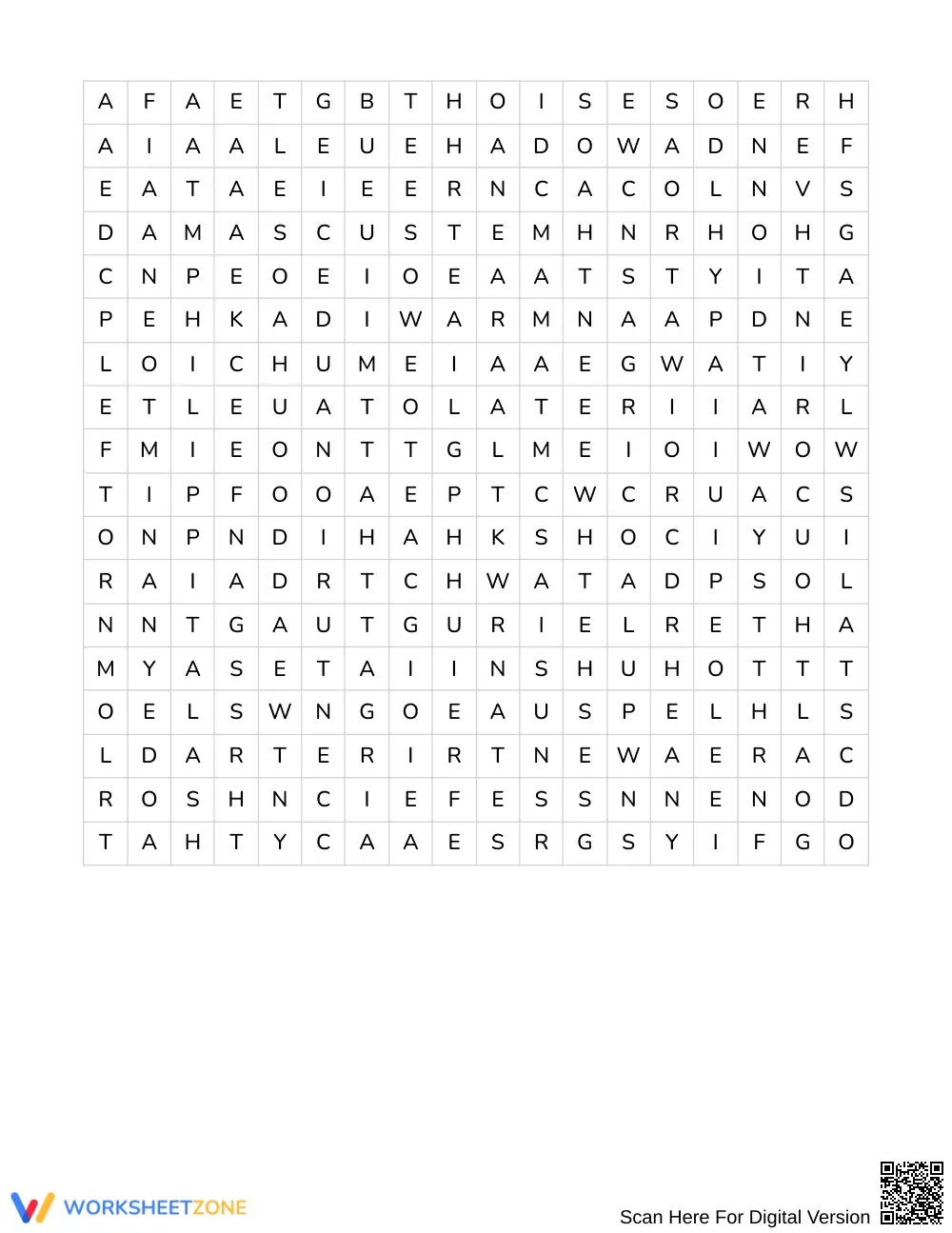
This travel in Acts word search builds academic vocabulary and historical recall for secondary students reading biblical narratives. Students solve 16 descriptive clues, determine the target geographic locations and figures, and locate each term within an 18 x 18 grid, strengthening contextual inference and lexical retrieval.
At a Glance
- Grade: Grades 8–10 secondary students · Subject: English Language Arts (ELA)
- Standard: Not standards-assessed — vocabulary enrichment
- Skill Focus: Travel in Acts vocabulary and ancient geography
- Format: 3 pages · 16 hidden words · Answer key included · PDF
- Best For: Context clue practice, unit review, and fast finishers
- Time: 25–40 minutes
This 3-page printable PDF features a challenging clue-based format without an explicit word bank. Students evaluate 16 detailed historical clues to deduce target terms like Antioch, Berea, and Malta before locating them. The resource includes a full 4-page answer key showing exact letter coordinates for quick grading.
Puzzle Mechanics
The puzzle features an 18 x 18 grid containing 16 hidden vocabulary words. Without a word bank, students must solve the clues to identify what to look for. Words run in all eight possible compass directions: north, northeast, east, southeast, south, southwest, west, and northwest, providing rigorous visual scanning practice.
Standards Alignment
This resource provides vocabulary enrichment and is not aligned to a specific academic standard. It supports cross-curricular literacy by reinforcing historical geography, reading comprehension, and contextual deduction across ancient texts.
How to Use It
Incorporate this puzzle during a literature or history unit after reading accounts of ancient Mediterranean travel. Have students work individually or in pairs to deduce the 16 words from the clues before scanning the grid. To assess learning formatively, monitor whether students solve the clues via textual knowledge or resort to blind grid searching. Completion typically takes 25 to 40 minutes.
Who It's For
Designed for learners in Grades 8–10, this activity suits secondary English language arts, classical literature, and religious studies courses. For differentiation, provide struggling learners with first-letter hints for selected clues, or challenge advanced students to compose sentences explaining each figure's historical significance. Pair this worksheet with an ancient Mediterranean map.
Explicit vocabulary acquisition in secondary grades requires active cognitive processing rather than passive word memorization. According to Fisher & Frey (2014), engaging students in clue-driven vocabulary tasks fosters deep word consciousness and improves domain-specific language retention across informational and historical texts. By removing traditional word banks, this travel in Acts word search compels learners to retrieve semantic knowledge directly from textual descriptions before executing complex orthographic searches across an 18 x 18 grid. This dual-demand structure—combining contextual inference with multi-directional letter scanning—strengthens orthographic mapping and reinforces thematic vocabulary. Research in secondary literacy emphasizes that generative retrieval exercises produce significantly greater long-term recall than rote copying or passive list reading. As students identify cities, figures, and maritime events from narrative clues, they solidify foundational background knowledge essential for interpreting complex historical and religious literature with analytical confidence.


