































Equivalent Fractions and Decimals: Guided Skill Practice

Paste this activity's link or code into your existing LMS (Google Classroom, Canvas, Teams, Schoology, Moodle, etc.).
Students can open and work on the activity right away, with no student login required.
You'll still be able to track student progress and results from your teacher account.
This 3-page math worksheet helps fourth-grade students master decimal notation for tenths and hundredths while connecting them directly to equivalent fractions. Learners analyze area models, number lines, conversion tables, and inequality comparisons, then write mathematical explanations across 31 structured practice items.
At a Glance
- Grade: 4 · Subject: Math
- Standard:
4.NF.C.6— Convert tenths and hundredths between fractions and decimals- Skill Focus: Scaffolded conversion between tenths, hundredths, fractions, and decimals
- Format: 3 printable pages · 31 structured problems · 3-page answer key included · PDF
- Best For: Core guided instruction and skill consolidation
- Time: 30–45 minutes of classroom practice
What's Inside
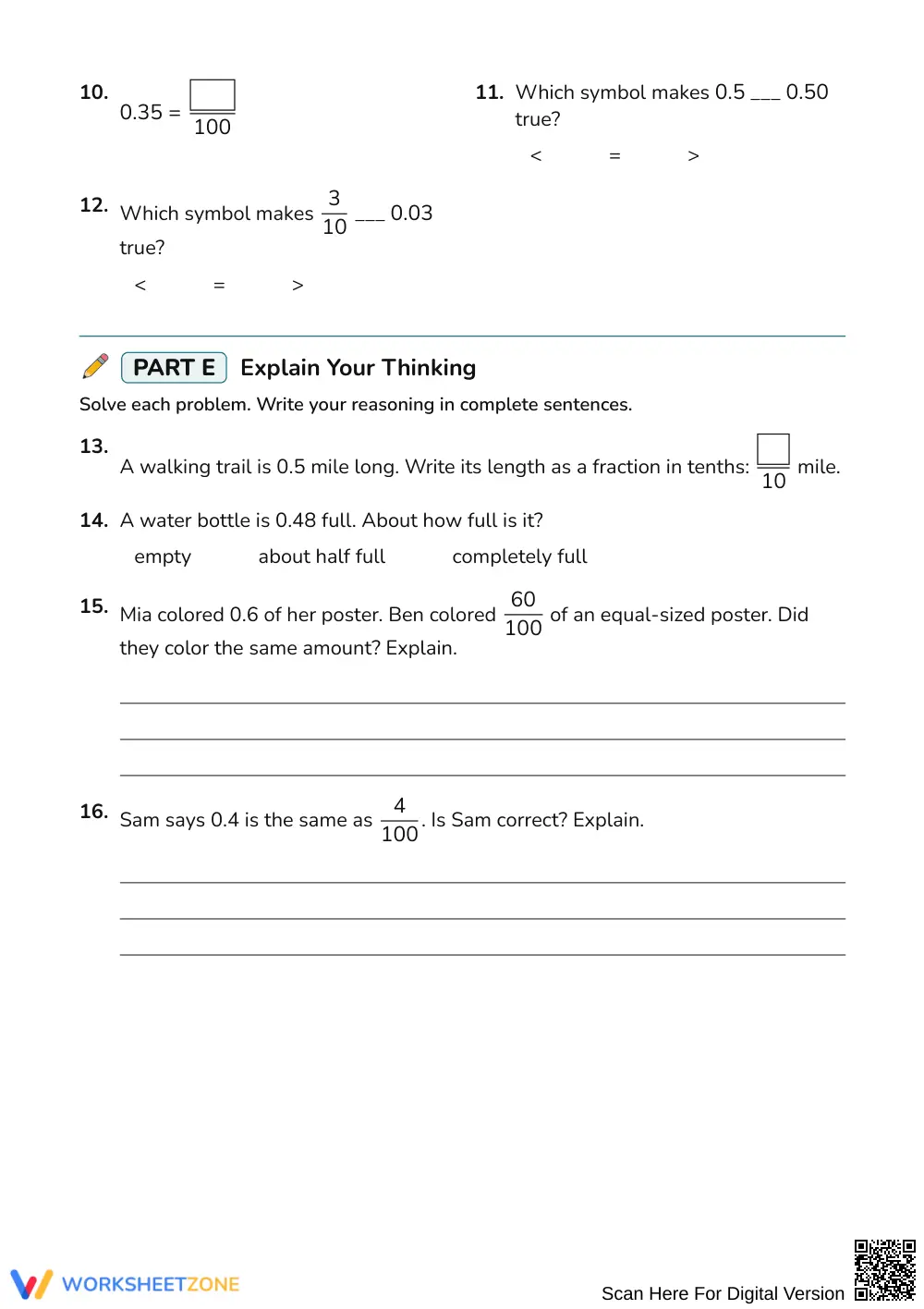
This 3-page resource delivers 31 scaffolded tasks across Parts A through E. Students examine a 10-by-10 grid and a segmented number line, complete place value and conversion tables, solve symbolic comparisons, and compose written explanations. A complete 3-page answer key provides point-by-point solutions and sample written justifications for efficient grading.
Skill Progression
- Guided Practice (Parts A & B, 10 problems): High scaffolding uses 100-square grid models, place-value charts, and number-line benchmarks to anchor fraction-decimal equivalence.
- Supported Practice (Part C, 8 problems): Medium scaffolding prompts learners to complete ratio conversion tables bridging tenths and hundredths without visual models.
- Independent Practice (Parts D & E, 13 problems): Minimal scaffolding tasks students with direct decimal-to-fraction conversions, inequalities, and written explanations.
This sequence reflects the gradual-release framework, shifting responsibility from teacher modeling to autonomous student work.
Standards Alignment
This worksheet aligns with 4.NF.C.6: Use decimal notation for fractions with denominators 10 or 100. It also reinforces 4.NF.C.5 by having students express tenths as equivalent hundredths. Both standard codes can be copied directly into lesson plans, IEP goals, or district curriculum mapping tools.
How to Use It
Use this resource during guided math stations following direct instruction on decimals, or assign it for post-lesson consolidation. During group practice, observe whether students confuse tenths with hundredths when evaluating decimals like 0.4 and 0.04 in Part A and Part E. Student completion takes approximately 30 to 45 minutes.
Who It's For
This worksheet is built for fourth-grade learners mastering decimal concepts, but also serves fifth graders needing targeted remediation. Support striving students by pairing the sheet with base-ten blocks or a conversion anchor chart, while prompting early finishers to create their own real-world decimal problems.
Under standard 4.NF.C.6, fourth-grade students learn to translate fractions with denominators of 10 and 100 into decimal notation, establishing the foundational conceptual bridge between fractional parts and the base-ten decimal system. Mastery of this skill requires students to recognize that 4 tenths represents 40 hundredths (0.4 = 0.40), interpret area models, plot decimal values on segmented number lines, and justify equivalence through written mathematical explanations. Research synthesized by Fisher & Frey (2014) highlights that intentional, scaffolded progression across visual representations, guided conversion tables, and independent verbal explanations produces measurable gains in conceptual mathematical understanding. By combining dual visual models with rigorous place-value tables and comparative reasoning prompts across 31 structured items, this instructional tool provides educators with clear formative diagnostic evidence, confirming that learners develop durable fluency across equivalent fraction and decimal concepts prior to multi-digit decimal operations.


