































Equivalent Fractions and Decimals: Essential Strategies

Paste this activity's link or code into your existing LMS (Google Classroom, Canvas, Teams, Schoology, Moodle, etc.).
Students can open and work on the activity right away, with no student login required.
You'll still be able to track student progress and results from your teacher account.
This Grade 4 math worksheet develops conceptual understanding of equivalent fractions and decimals by prompting students to analyze, compare, and evaluate distinct mathematical representations. Across 20 targeted tasks, learners contrast visual models, number line placements, and algebraic multiplication strategies to identify why equivalent values remain equal and diagnose common calculation errors.
At a Glance
- Grade: 4 · Subject: Math
- Standard:
4.NF.A.1— Explain why fractions are equivalent using visual models and generate equivalent fractions- Skill Focus: Comparing solution strategies and representations
- Format: 3 pages · 20 problems · Answer key included · PDF
- Best For: Small-group guided math and partner discussions
- Time: 30–45 minutes
What's Inside
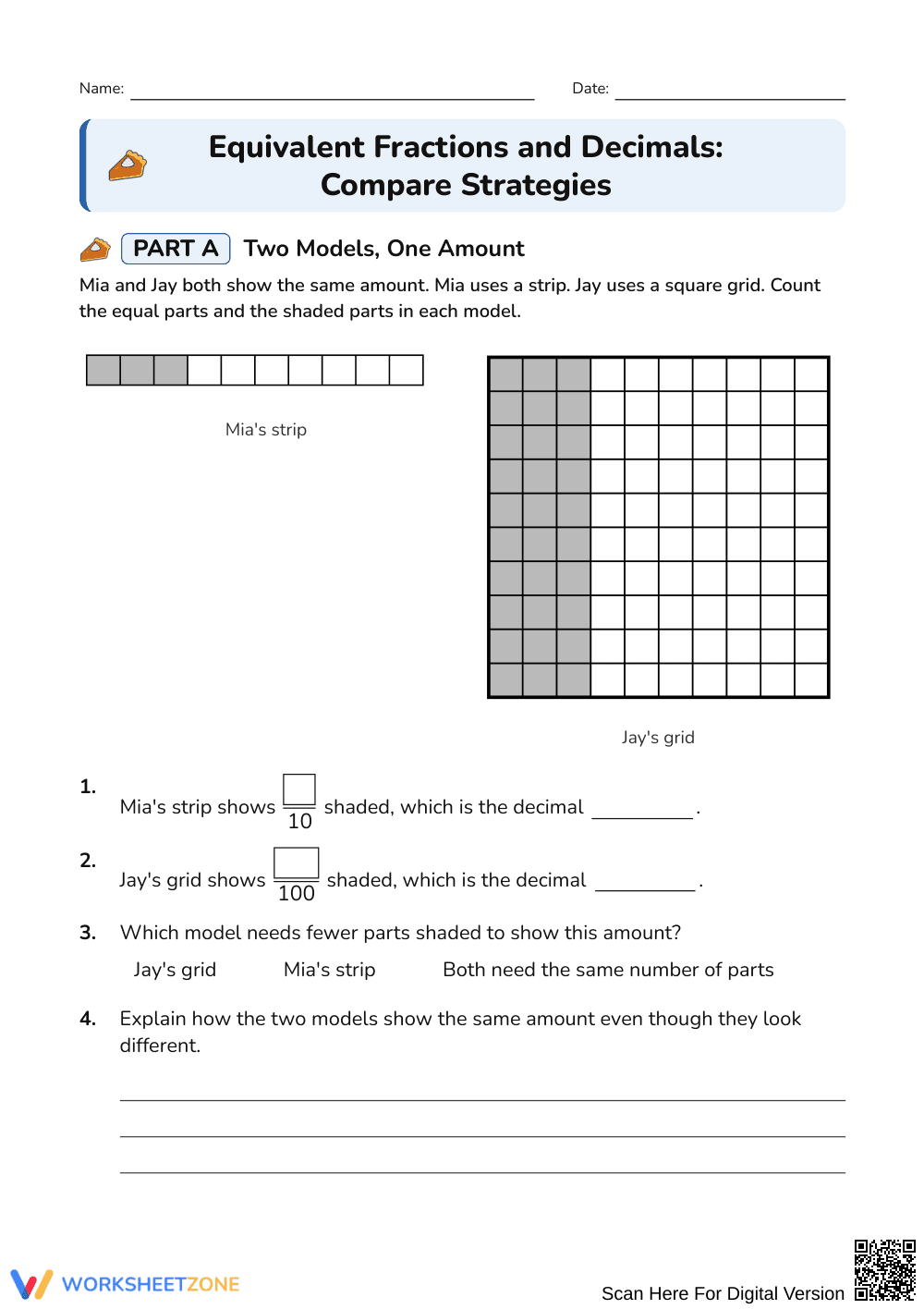
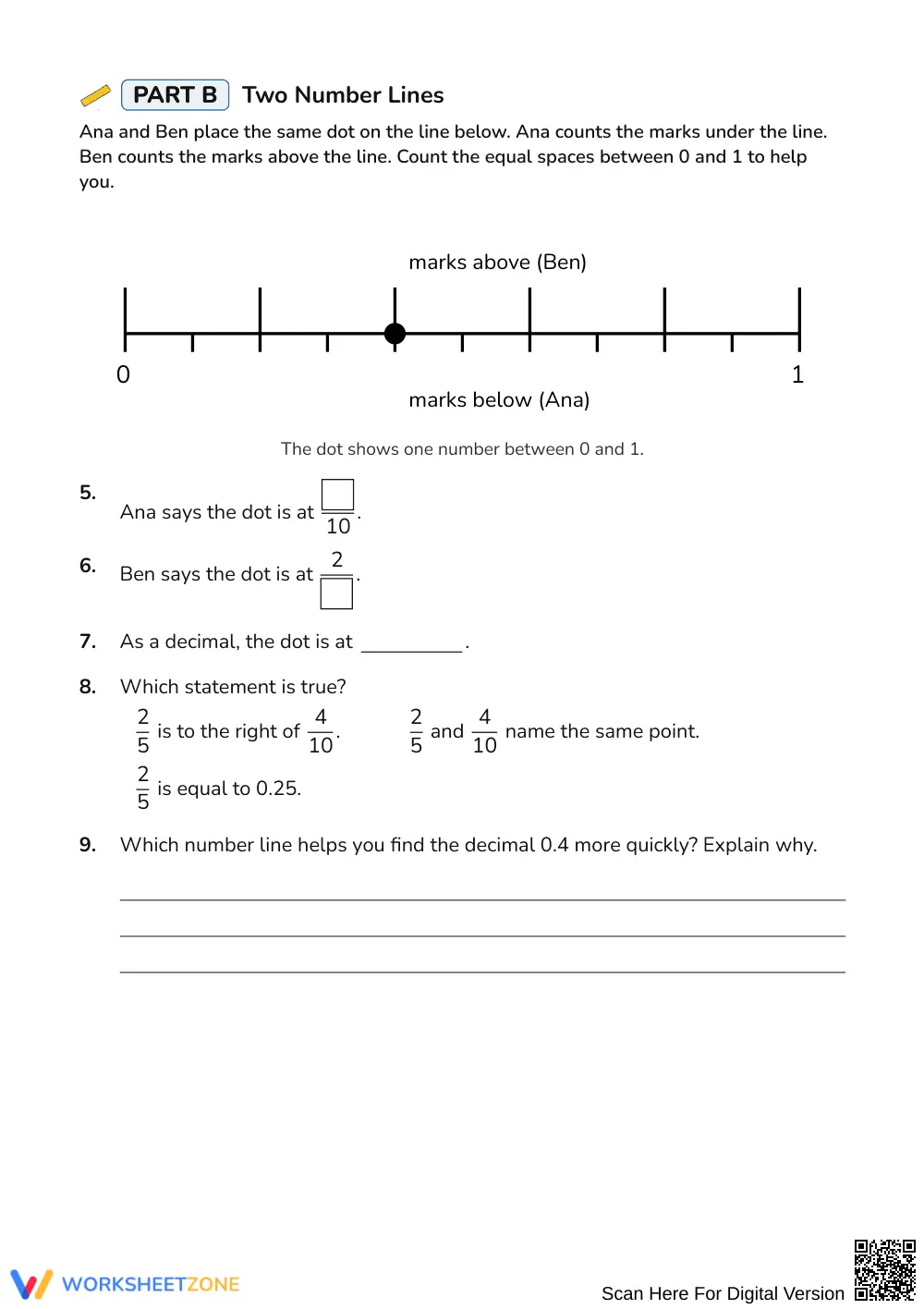
The 3-page resource contains 20 structured analytical items organized into three coherent sections, complete with a 3-page answer key showing full student justifications. Students examine area models comparing tenths strips to hundredths grids, inspect dual-labeled number lines, and evaluate work samples from fictional peers featuring multiplication methods and common place-value errors.
Skill Progression
- Guided Practice (Part A, 6 problems): High visual support comparing strip diagrams and hundredths grids to establish conceptual equivalence between tenths and hundredths.
- Supported Practice (Part B, 7 problems): Moderate scaffolding using dual-calibrated number lines to compare fractional increments against decimal markers.
- Independent Practice (Part C, 7 problems): Low scaffolding requiring students to evaluate written peer strategies, identify misconception errors, and generate their own conversion method.
This sequence follows the gradual-release framework, moving learners purposefully from concrete visual examination toward independent algebraic evaluation.
Standards Alignment
This worksheet directly aligns with primary standard `4.NF.A.1`, which requires students to explain why a fraction is equivalent to another fraction by using visual fraction models and recognizing how parts change. In addition, it supports standard `4.NF.C.5` by demonstrating how tenths convert into hundredths using equivalent fractions. Both standard codes can be copied directly into lesson plans, IEP goals, or district curriculum mapping tools.
How to Use It
Deploy this worksheet during the core practice phase after direct instruction on fraction equivalence to solidify conceptual reasoning before procedural drills. During student work, circulate with a formative checklist to observe whether students recognize that multiplying numerator and denominator by the same factor subdivides parts without changing total value. Complete within a 30 to 45 minute instructional block.
Who It's For
This activity is designed for fourth-grade general education students, while offering valuable visual remediation for fifth graders struggling with decimal relationships. Teachers can differentiate by providing fraction tiles for learners needing tactile verification or assigning the open-ended strategy explanation in Part C as an extension for advanced math students. Pair this worksheet directly with an anchor chart illustrating tenths and hundredths models.
According to Fisher & Frey (2014), structured instructional activities that prompt students to compare multiple solution strategies and examine common non-examples significantly deepen conceptual mastery and metacognitive awareness. This Grade 4 mathematics resource implements that instructional design through 20 targeted tasks aligned directly to 4.NF.A.1. By analyzing both valid and partially flawed student work samples, fourth-grade learners explain why fraction equivalence holds true across area models, number lines, and multiplication algorithms. Instead of relying solely on rote multiplication procedures, students articulate how partitioning wholes into smaller, equal units preserves overall fractional value while translating tenths into hundredths and decimal notation with conceptual confidence. Rigorous research demonstrates that asking learners to compare contrasting representations strengthens mathematical reasoning and helps prevent persistent decimal misconceptions, making this 3-page printable an essential, research-backed formative tool for standards-based elementary classrooms.


