































Equivalent Fractions and Decimals: Essential Check

Paste this activity's link or code into your existing LMS (Google Classroom, Canvas, Teams, Schoology, Moodle, etc.).
Students can open and work on the activity right away, with no student login required.
You'll still be able to track student progress and results from your teacher account.
This diagnostic worksheet helps fourth-grade students review essential fraction and decimal concepts before starting decimal operations. Students examine fraction bars, locate values on number lines, convert tenths and hundredths, and evaluate misconceptions. Completing these 18 targeted tasks ensures learners develop conceptual understanding of equivalence and decimal notation.
At a Glance
- Grade: Grade 4 · Subject: Elementary Math
- Standard:
4.NF.C.6— Use decimal notation for fractions with denominators 10 or 100 accurately- Skill Focus: Equivalent fraction visual models and decimal place value notation
- Format: 3 student pages · 18 total problems · Full answer key included · Printable PDF
- Best For: Pre-unit diagnostic assessment, math intervention, and reteaching
- Time: 25–35 instructional minutes
What's Inside
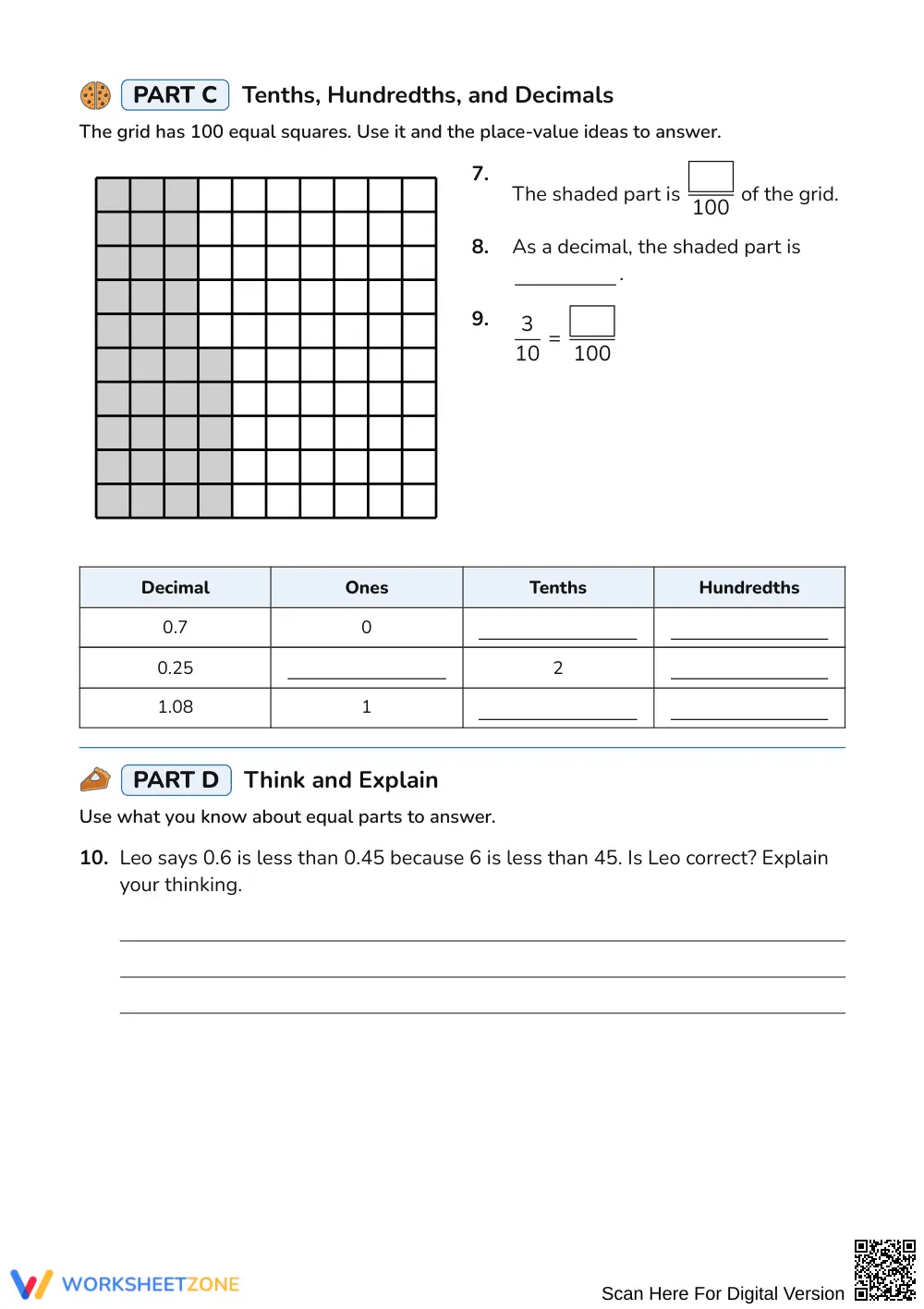
Across 3 student pages, this printable resource includes 18 diagnostic problems divided into four focused sections. Part A uses shaded fraction bars to evaluate equivalence, while Part B prompts students to identify fractions and decimals on number lines. Part C features a 100-grid and a place-value table covering ones, tenths, and hundredths. Part D concludes with an error-analysis reflection. A complete 3-page answer key provides worked explanations for fast grading.
Skill Progression
- Guided practice (Tasks 1–5): Visual fraction bars and number lines provide strong visual scaffolds to help students connect equivalent parts and decimals.
- Supported practice (Tasks 6–14): Hundredth grids and place-value tables offer structured guidance as students translate tenths into hundredths and record decimals.
- Independent practice (Tasks 15–18): Students work independently to critique reasoning, explain misconceptions, and justify decimal comparisons without scaffolding.
This sequence follows a gradual-release model, moving learners from I Do and We Do support to autonomous You Do problem solving.
Standards Alignment
This worksheet aligns directly to 4.NF.C.6: Use decimal notation for fractions with denominators 10 or 100. It also supports 4.NF.C.5 by reinforcing equivalent fractions with tenths and hundredths. Both standard codes can be copied directly into lesson plans, IEP goals, or district curriculum mapping tools.
How to Use It
Administer this worksheet before direct instruction to assess prerequisite readiness, or assign it during small-group intervention for targeted remediation. During work time, observe whether students confuse tenths with hundredths in Part D; students who think 0.45 exceeds 0.6 need immediate decimal-grid modeling. Students typically complete all 18 items within 25 to 35 minutes.
Who It's For
This resource serves fourth-grade math students beginning fraction-decimal units, as well as fifth graders requiring targeted intervention. Differentiate by providing physical base-ten blocks for striving learners, or challenge advanced students to write their own error-analysis problems. Pair this activity with a fraction-decimal anchor chart or introductory decimal lesson.
According to Fisher & Frey (2014), purposeful prerequisite diagnostics combined with structured gradual-release frameworks significantly accelerate conceptual transfer during complex math transitions. Grade 4 standard 4.NF.C.6 requires learners to use decimal notation for fractions with denominators of 10 or 100, bridging rational number understanding with standard base-ten place value. Students frequently falter when moving from familiar visual fraction bars to abstract decimal symbols due to unaddressed whole-number comparison misconceptions. By combining dual visual representations, structured place-value matrices, and written justification tasks, this diagnostic packet delivers actionable performance data for classroom teachers. When educators systematically target prerequisite equivalence before introducing decimal computation, retention increases and procedural errors drop across subsequent unit assessments. This resource establishes an evidence-based foundation that prepares elementary students to translate between tenths, hundredths, and decimal notation with lasting conceptual confidence.


