
































Equivalent Fractions and Decimals: Complete Reasoning

Paste this activity's link or code into your existing LMS (Google Classroom, Canvas, Teams, Schoology, Moodle, etc.).
Students can open and work on the activity right away, with no student login required.
You'll still be able to track student progress and results from your teacher account.
This Grade 4 math worksheet develops conceptual understanding of decimal notation and equivalent fractions through written arguments. Students analyze visual models, critique common misconceptions, and write clear explanations showing why tenths and hundredths represent identical values, moving beyond rote conversion into rigorous mathematical reasoning.
At a Glance
- Grade: 4 · Subject: Mathematics
- Standard:
4.NF.C.6— Use decimal notation to represent and justify fractions with denominators 10 or 100- Skill Focus: Conceptual Reasoning & Mathematical Justification
- Format: 3 pages · 16 problems · Complete answer key included · Printable PDF
- Best For: Post-lesson guided practice or math intervention
- Time: 30–45 minutes
What's Inside
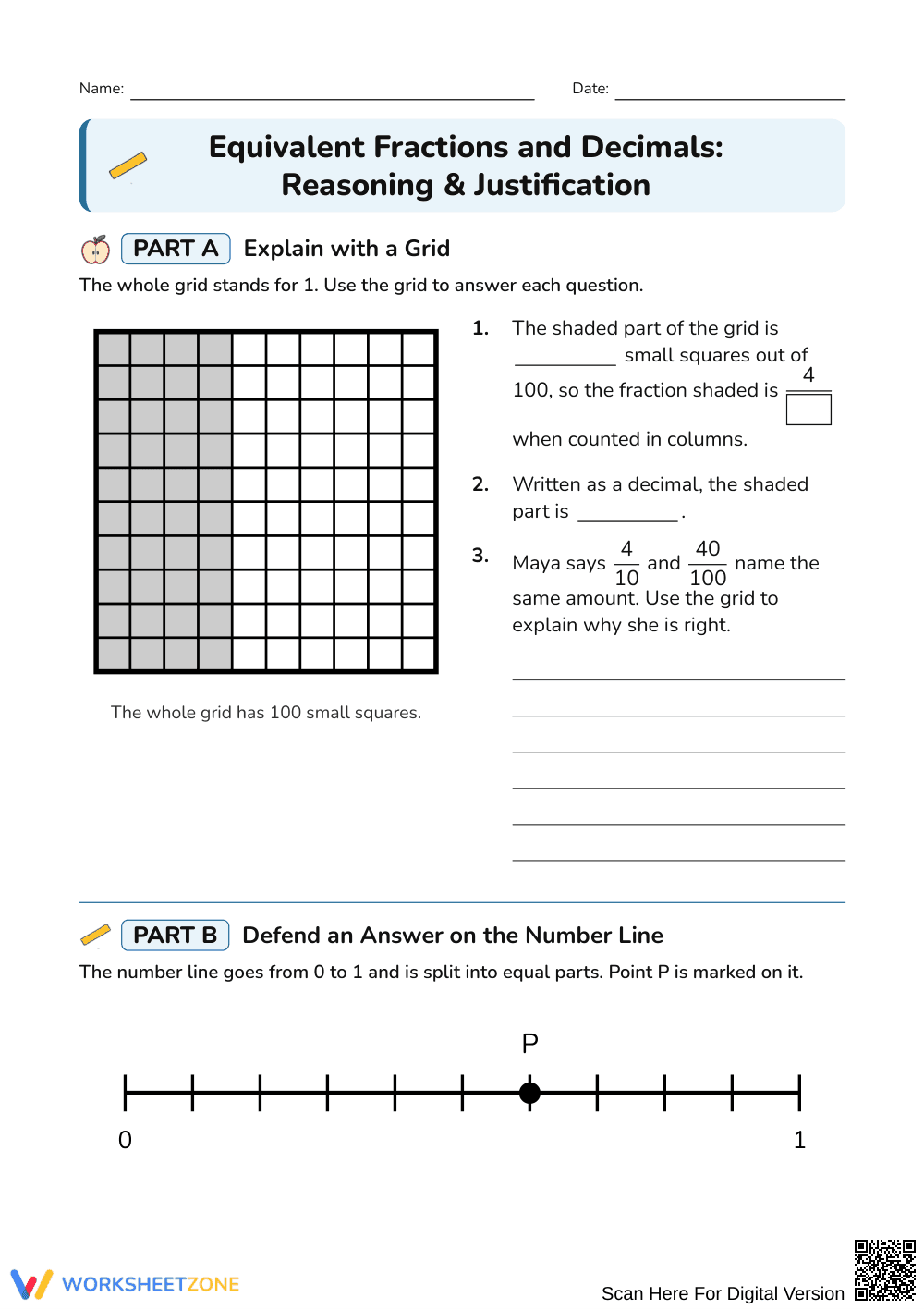
The 3-page student packet features 16 reasoning items across four sections: grid models, number lines, pattern analysis, and justification problems. Students evaluate peer reasoning and identify place-value errors. A complete 3-page answer key provides full written explanation models alongside numerical answers for easy evaluation.
Skill Progression
- Guided Practice (Part A & Part B, 5 items): Students use grids and number lines to verify equivalence and refute place-value misconceptions.
- Supported Practice (Part C, 5 items): Students analyze tenths-to-hundredths patterns, explaining why multiplying numerator and denominator by 10 preserves value.
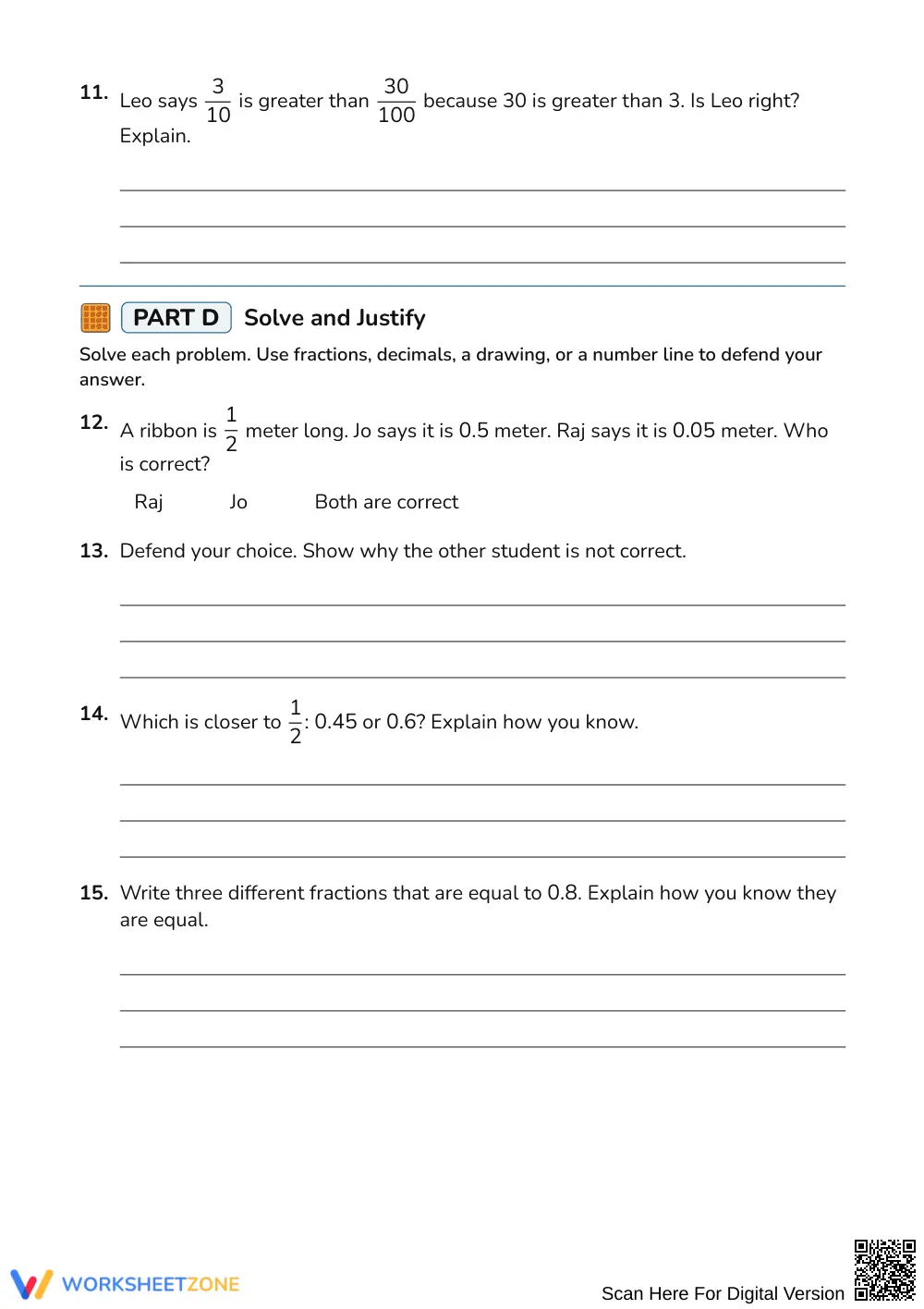
- Independent Practice (Part D, 6 items): Students independently defend decimal comparisons, benchmark distances, and equivalent fractions.
This sequence follows a gradual-release framework, guiding students from visual verification to abstract justification.
Standards Alignment
This resource aligns to primary standard `4.NF.C.6` (use decimal notation for fractions with denominators 10 or 100) by requiring students to justify decimal equivalence. It also supports `4.NF.C.5` by expressing tenths as hundredths. Both standard codes can be copied directly into lesson plans, IEP goals, or district curriculum mapping tools.
How to Use It
Use this worksheet during guided practice after direct instruction on decimal models, having student pairs discuss justifications before writing. Alternatively, assign Part D as an exit ticket to assess individual mastery. While circulating, observe whether students confuse tenths and hundredths on the number line. Completion time is 35 to 45 minutes.
Who It's For
This resource serves fourth-grade math students mastering decimal concepts and fifth graders needing fraction-decimal intervention. For students needing support, provide hundredths grid templates to scaffold written explanations. Pair this resource with direct instruction using base-ten visual models.
According to Fisher & Frey (2014), student mastery of abstract mathematical concepts depends on structured opportunities to verbalize and defend reasoning rather than merely completing computational drills. This Grade 4 worksheet aligns with standard 4.NF.C.6 by requiring learners to translate fractions with denominators 10 and 100 into decimal notation while constructing written justifications for equivalence. Rather than treating decimals as disconnected numerical values, the 16 tasks challenge students to analyze hundredths grids, interrogate number lines, and critique peer reasoning. By articulating why 0.4 equals 40/100 and why 0.06 is distinct from 0.6, students build robust conceptual schemas that bridge fractional parts and base-ten place value. Integrating oral and written justification into decimal instruction solidifies foundational number sense, preparing elementary learners for complex coordinate graphing, operations with decimals, and advanced rational number problem-solving in upper elementary and middle school mathematics.


