































Equivalent Fractions and Decimals: Complete Practice

Paste this activity's link or code into your existing LMS (Google Classroom, Canvas, Teams, Schoology, Moodle, etc.).
Students can open and work on the activity right away, with no student login required.
You'll still be able to track student progress and results from your teacher account.
This Grade 4 math worksheet builds conceptual fluency in translating between fractions and decimals through visual models, number lines, and place-value charts. Students solve 23 multi-step problems to represent tenths and hundredths in multiple formats, developing lasting number sense before moving to abstract decimal operations.
At a Glance
- Grade: 4 · Subject: Math
- Standard:
4.NF.C.6— Use decimal notation for fractions with denominators 10 or 100- Skill Focus: Equivalent fractions and decimals across multiple visual representations
- Format: 3 pages · 23 problems · Answer key included · PDF
- Best For: Guided practice and conceptual math intervention
- Time: 30–45 minutes
What's Inside
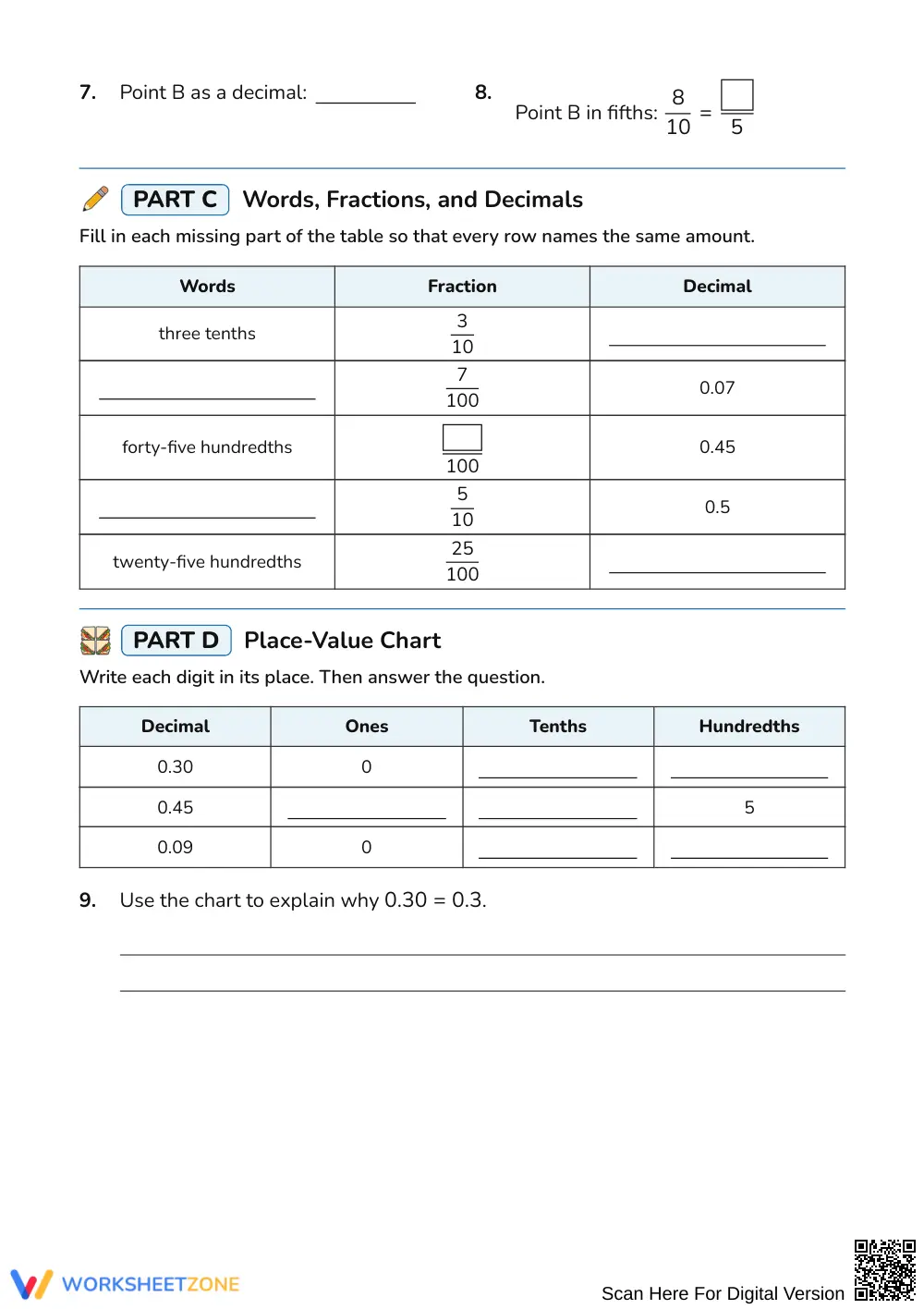
The 3-page printable worksheet includes 23 structured tasks divided across five distinct sections: shaded area models, a graduated number line, a multi-column equivalence chart, a place-value table, and conceptual error-analysis questions. A matching 3-page answer key provides complete solutions, fraction simplifications, and student-facing reasoning samples.
Skill Progression
- Guided practice (Parts A & B, 8 problems): Visual area models and a number line provide concrete scaffolds, prompting learners to link tenths and hundredths strips directly to decimal notations like 0.6 and 0.35.
- Supported practice (Parts C & D, 11 problems): Tabular frameworks and place-value charts guide students to convert written number names into fractions and decimals while justifying equivalences such as 0.30 = 0.3.
- Independent practice (Part E, 4 problems): Multiple-choice evaluation and written error analysis require students to detect misconceptions regarding tenths versus hundredths without visual prompts.
This sequence embodies the gradual-release model, transitioning students smoothly from visual scaffolding to independent conceptual reasoning.
Standards Alignment
This worksheet directly addresses 4.NF.C.6: Use decimal notation for fractions with denominators 10 or 100, and locate decimals on a number line. It also reinforces supporting standard 4.NF.C.5 by requiring students to express tenths as equivalent hundredths when comparing values. Both standard codes can be copied directly into lesson plans, IEP goals, or district curriculum mapping tools.
How to Use It
Use this resource during the mid-unit guided practice phase following direct instruction on decimal place value, or assign it as a targeted small-group intervention activity. As a formative assessment checkpoint, observe student explanations on Part D and Part E to check whether learners recognize that 0.07 is ten times smaller than 0.7 rather than merely focusing on matching digits. Students typically complete the three pages in 30 to 45 minutes.
Who It's For
This activity is designed for fourth-grade general education students, fifth-grade math intervention groups needing decimal foundations, and special education students who benefit from structured visual representations. Provide base-ten blocks or hundred-grid manipulatives for students needing tactile support, or pair this worksheet with a decimal place-value anchor chart during independent practice.
Fourth-grade students mastering standard 4.NF.C.6 must develop a solid conceptual bridge between fractional parts and decimal notation rather than treating decimals as unrelated whole numbers separated by a dot. According to Fisher & Frey (2014), structured instructional progressions that guide learners from concrete visual representations—such as shaded tenths strips and hundredths grids—to representational number lines and abstract symbolic tables yield significantly deeper conceptual retention than drill-based practice alone. This 23-problem, 3-page resource operationalizes that evidence base by systematically requiring students to translate values across words, fractions, and decimals before asking them to justify equivalence and identify common misconceptions. By grounding decimal comprehension in base-ten fraction equivalence, teachers prevent persistent misunderstandings about place value and magnitude, equipping elementary learners with the essential visual models necessary for successful multi-digit decimal addition, comparison, and metric measurement problem-solving in upper elementary mathematics.


