































Equivalent Fractions and Decimals: Complete Error Analysis

Paste this activity's link or code into your existing LMS (Google Classroom, Canvas, Teams, Schoology, Moodle, etc.).
Students can open and work on the activity right away, with no student login required.
You'll still be able to track student progress and results from your teacher account.
This Grade 4 math worksheet targets decimal and fraction misconceptions through systematic error analysis. Students analyze visual models, inspect place-value representations, identify common computational flaws, and write mathematical explanations justifying correct notation. By diagnosing authentic student mistakes across 16 focused problems, learners solidify conceptual understanding of equivalent tenths and hundredths.
At a Glance
- Grade: 4 · Subject: Math
- Standard:
4.NF.C.6— Use decimal notation to represent and explain fractions with denominators 10 or 100- Skill Focus: Identifying, correcting, and explaining equivalent fraction and decimal misconceptions
- Format: 3 pages · 16 problems · Answer key included · PDF
- Best For: Post-lesson formative assessment and targeted error intervention
- Time: 30–45 minutes
What's Inside
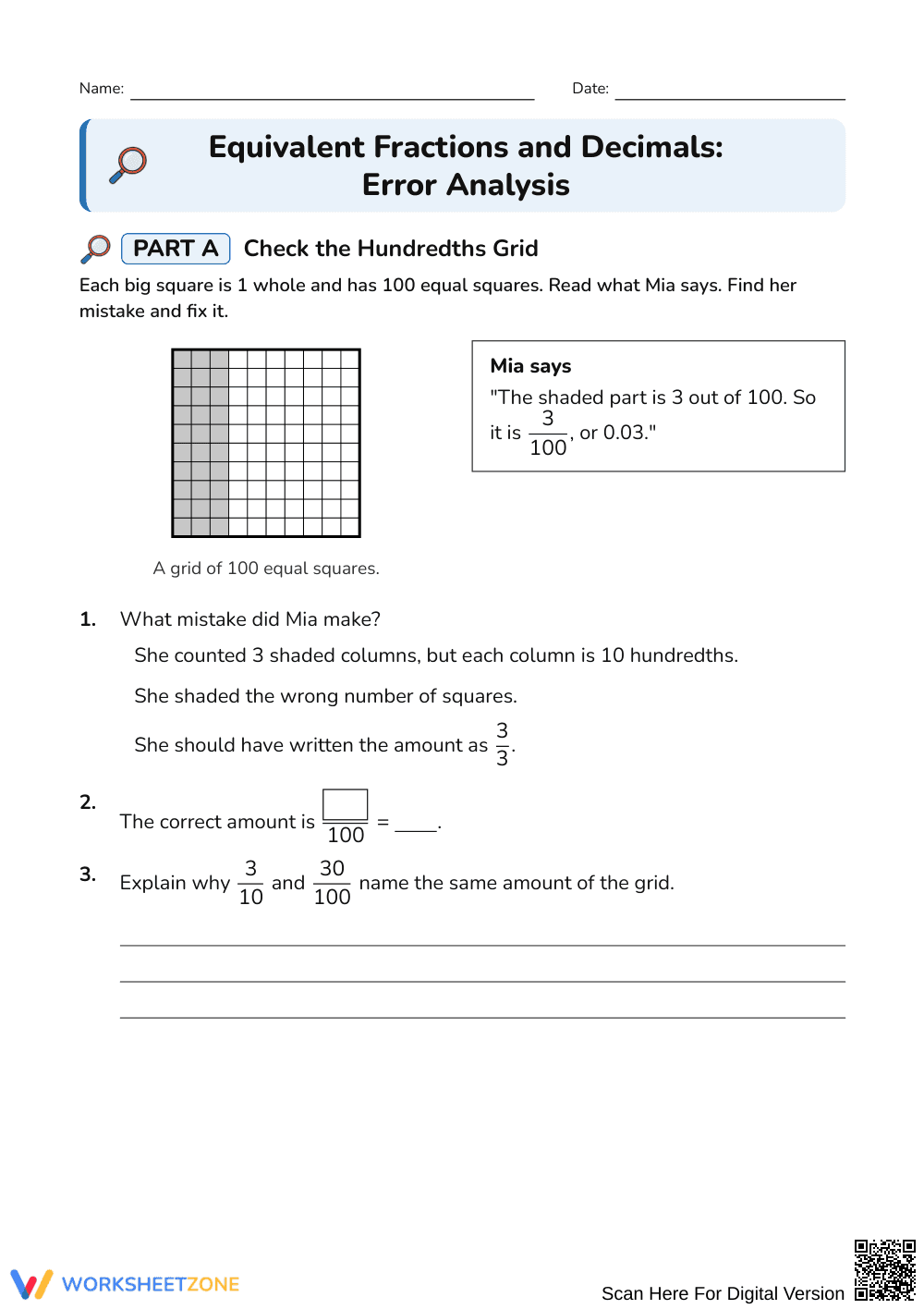
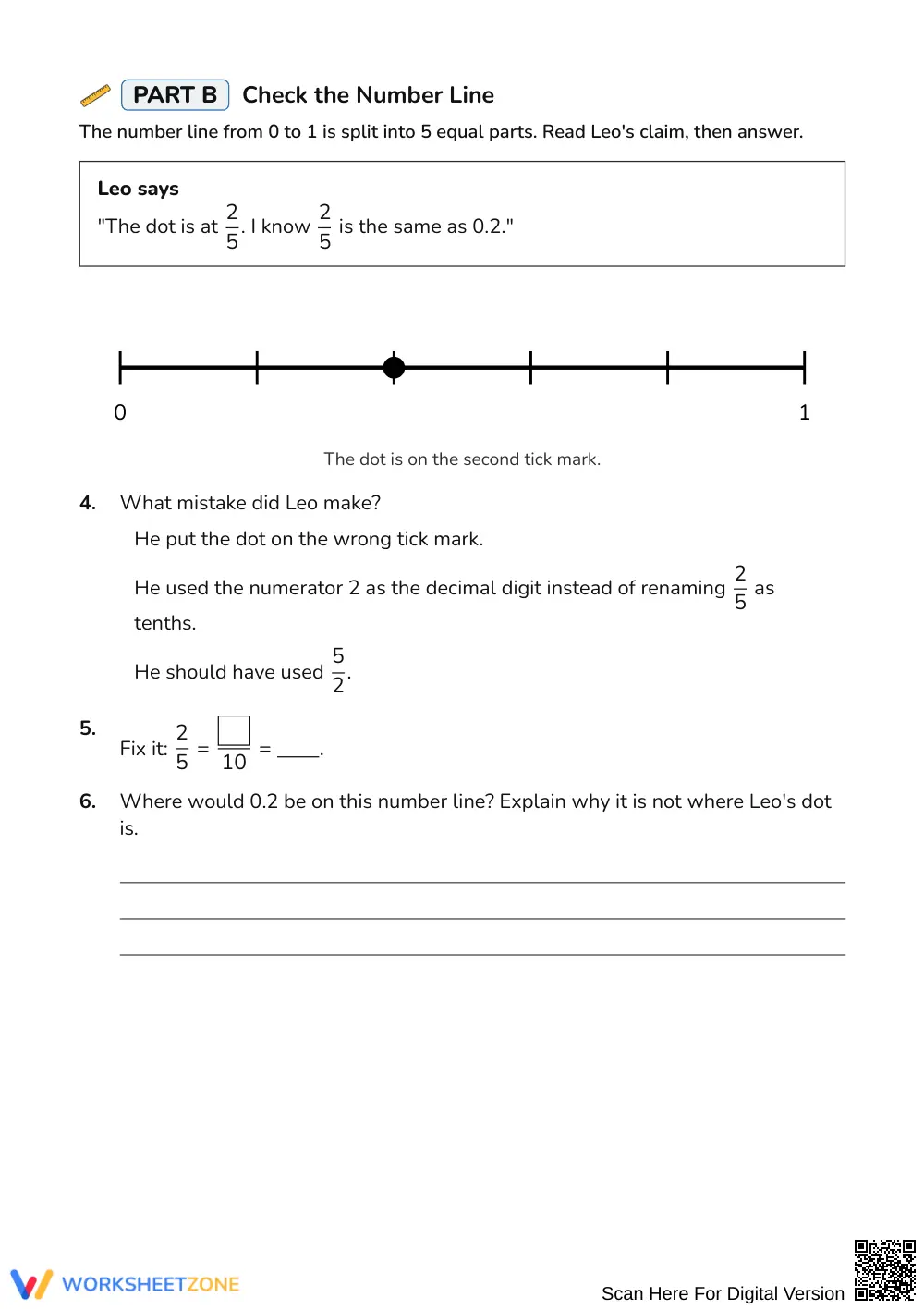
This 3-page resource features 16 tasks across three sections. Part A uses shaded hundredths grids to address column-counting errors. Part B employs a 0-to-1 number line to fix numerator-to-decimal misidentifications. Part C leverages a place-value chart to resolve equivalence and trailing-zero misconceptions. A complete 3-page answer key provides written explanations and correct calculations.
Skill Progression
- Guided practice (Part A, 4 tasks): Hundredths grids provide strong visual scaffolding to spot miscounted columns and justify decimal equivalents.
- Supported practice (Part B, 4 tasks): Number lines offer intermediate support as students convert fifths to tenths before plotting.
- Independent practice (Part C, 8 tasks): Place-value charts guide independent correction of symbolic fractions, decimals, and trailing zeros.
This sequence implements a gradual-release model, moving students from visual diagnosis to independent symbolic justification.
Standards Alignment
Aligned primarily to `4.NF.C.6` (use decimal notation for fractions with denominators 10 or 100). The worksheet also reinforces supporting standard `4.NF.C.5` by converting tenths to hundredths before writing decimals. Both standard codes can be copied directly into lesson plans, IEP goals, or district curriculum mapping tools.
How to Use It
Use this worksheet after direct instruction on decimal tenths and hundredths. Facilitate partner discussions during Part A to analyze student errors collaboratively, or assign Part C as an independent exit ticket. During work time, check if students confuse the numerator with the first decimal digit (such as writing 2/5 as 0.2). Completion takes 30 to 45 minutes.
Who It's For
Designed for fourth-grade general classrooms, Tier 2 math intervention, and resource room support. Provide struggling learners with base-ten blocks alongside grids, while challenging advanced students to generate their own error scenarios. Pair this worksheet directly with a decimal place-value anchor chart lesson.
Mastering decimal notation under standard 4.NF.C.6 requires students to connect visual models with symbolic place-value reasoning. Rather than relying solely on repetitive drill, analyzing authentic mathematical errors forces learners to explain why fractions with denominators 10 or 100 correspond to specific tenths and hundredths decimals. According to Fisher & Frey (2014), evaluating non-examples and correcting peer mistakes accelerates conceptual transfer, fostering metacognitive awareness and deeper procedural fluency across elementary math domains. When fourth graders identify why 7/100 cannot equal 0.7 or why 0.6 equals 0.60, they dismantle persistent misconceptions regarding place value and terminal zeros that undermine middle school rational number computation. This 3-page error-analysis activity provides 16 structured opportunities for students to debug flawed thinking, verify equivalent quantities across grids and number lines, and articulate rigorous mathematical explanations that demonstrate verified standard mastery.


