


























Views
Downloads
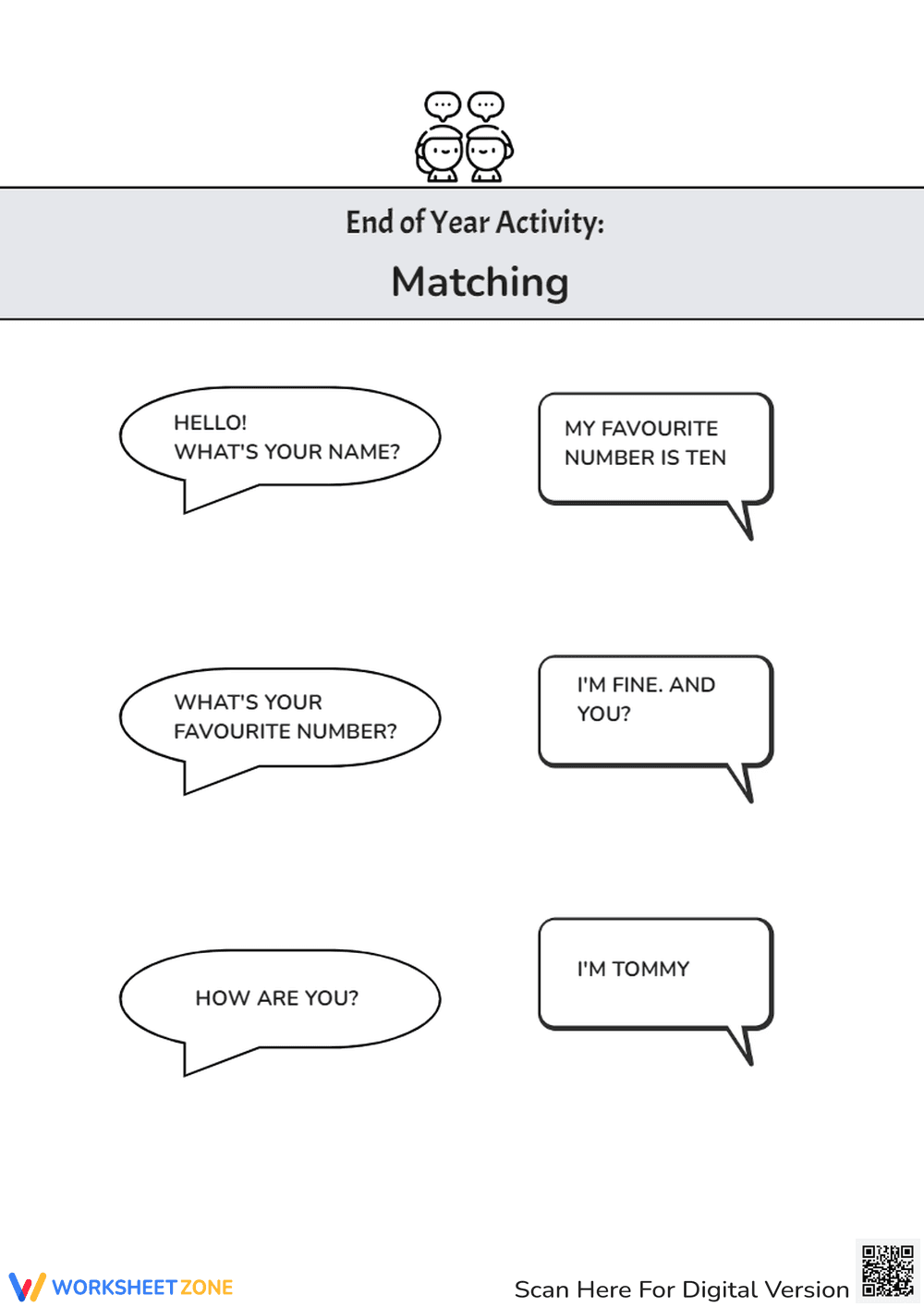

End of Year Talk Matching | Grade 1-3 Essential
Paste this activity's link or code into your existing LMS (Google Classroom, Canvas, Teams, Schoology, Moodle, etc.).
Students can open and work on the activity right away, with no student login required.
You'll still be able to track student progress and results from your teacher account.
This Grade 1-3 conversational matching worksheet helps students master the logic of social exchanges by pairing common questions with appropriate responses. By identifying the relationship between inquiries and answers, learners strengthen their functional language skills and social-emotional awareness. It provides a clear, visual way to wrap up the school year with meaningful communication practice.
At a Glance
- Grade: 1-3 · Subject: ELA
- Standard:
CCSS.ELA-LITERACY.SL.1.1— Participate in collaborative conversations with diverse partners about grade 1 topics- Skill Focus: Conversational Logic
- Format: 1 page · 3 problems · Answer key included · PDF
- Best For: End-of-year social-emotional review
- Time: 5–10 minutes
What's Inside: This single-page PDF features three distinct speech bubble pairs designed for easy visual processing. Students read questions on the left—such as "How are you?"—and draw lines to the correct response on the right. The layout uses clear, sans-serif typography and friendly icons to support early readers and English Language Learners. A full answer key is provided for quick grading.
Zero-Prep Workflow: This resource is designed for immediate classroom implementation. Print the single-page PDF (30 seconds). Distribute the sheets to students as a warm-up or transition activity (1 minute). Review the answers as a whole group to model proper conversational prosody and turn-taking (3 minutes). Total teacher preparation time is under two minutes, making it an ideal choice for busy end-of-year schedules or unexpected sub plans.
Standards Alignment: The primary focus is `CCSS.ELA-LITERACY.SL.1.1`, which requires students to follow agreed-upon rules for discussions, including responding to the comments of others. By matching specific questions to their logical answers, students demonstrate an understanding of conversational reciprocity. This standard code can be copied directly into lesson plans, IEP goals, or district curriculum mapping tools.
How to Use It: Assign this worksheet during the final week of school as a reflective review. It works best during the "You Do" phase of a lesson on social cues. Teachers can use this as a formative assessment by observing if students can read the dialogue bubbles independently or if they require auditory support. Expect completion within 5 to 10 minutes.
Who It's For: This activity is tailored for first through third-grade students, particularly those developing foundational literacy and social skills. It is highly effective for English Language Learners (ELLs) who need structured practice with common English idioms and greetings. Pair this worksheet with a classroom "mixer" activity where students practice these specific phrases aloud with their peers.
Research from Fisher & Frey (2014) emphasizes that oral language serves as the foundation for all literacy development, particularly when students are asked to map the structure of collaborative conversations. This worksheet addresses that need by isolating the question-and-answer relationship within a controlled, visual environment. By focusing on `CCSS.ELA-LITERACY.SL.1.1`, the activity ensures that students are not just reading words, but are understanding the functional intent behind social interactions. According to NAEP data, students who engage in regular structured talk activities show higher proficiency in reading comprehension and social-emotional regulation. This resource provides a low-stakes, high-clarity method for reinforcing these essential communication loops. The 3-task structure allows for immediate feedback, which is critical for early learners. Educators can use this tool to bridge the gap between decoding text and understanding the pragmatics of language, ensuring a comprehensive approach to primary ELA instruction.


