


























Views
Downloads

Printable Emotional Clues Worksheet | Grade 2 SEL
Paste this activity's link or code into your existing LMS (Google Classroom, Canvas, Teams, Schoology, Moodle, etc.).
Students can open and work on the activity right away, with no student login required.
You'll still be able to track student progress and results from your teacher account.
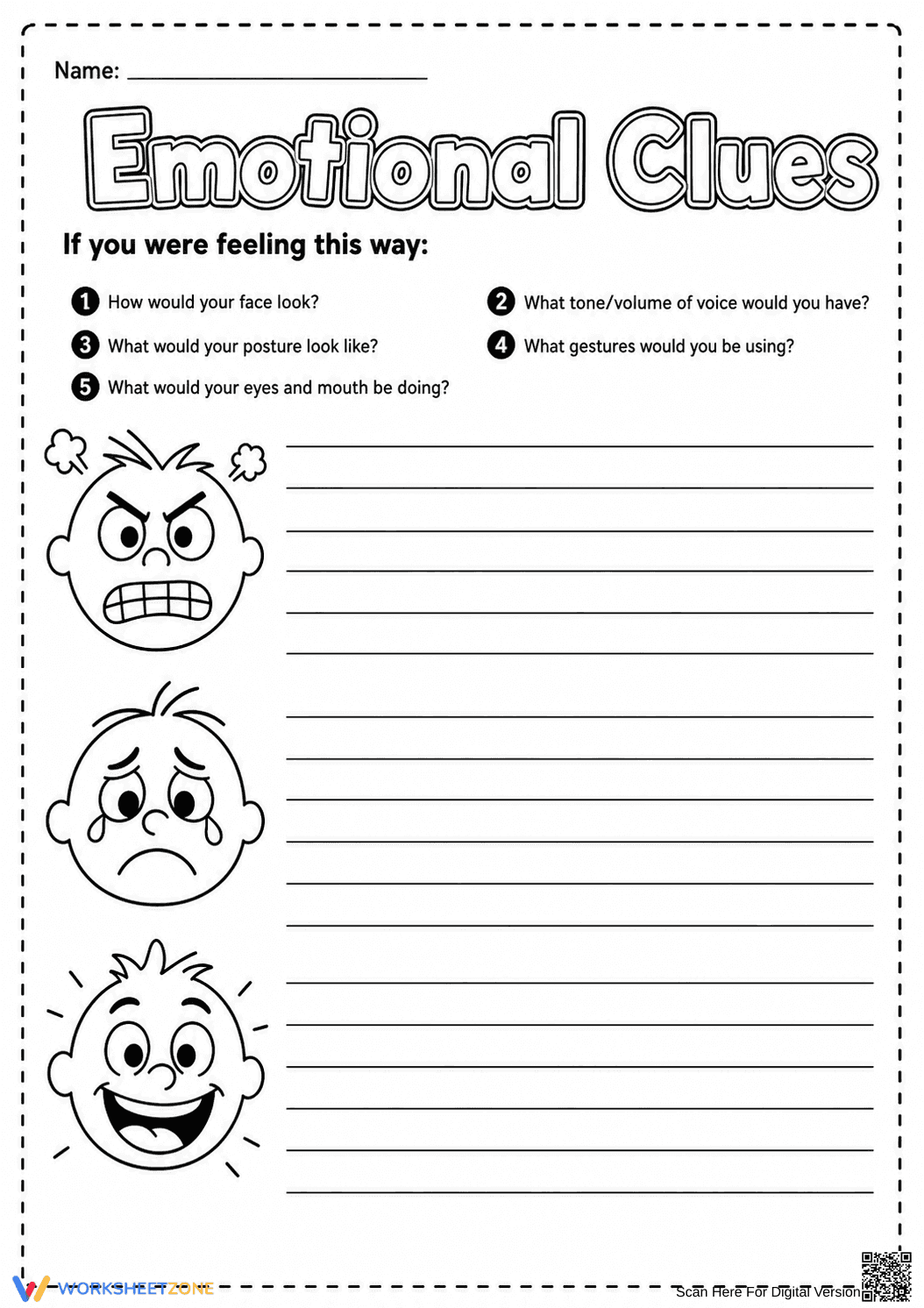
This foundational social-emotional learning worksheet helps students identify and articulate the physical and verbal clues associated with different feelings. By analyzing facial expressions, posture, and tone of voice, learners develop critical self-awareness and empathy, translating abstract emotions into concrete, observable behaviors through guided descriptive writing.
At a Glance
- Grade: 2 · Subject: Social Skills
- Standard:
CCSS.ELA-LITERACY.W.2.8— Recall information from experiences to answer questions- Skill Focus: Identifying emotional clues
- Format: 1 page · 3 problems · PDF
- Best For: Morning work or SEL blocks
- Time: 15–20 minutes
This single-page resource features three distinct cartoon faces representing core emotions: anger, sadness, and happiness. For each emotion, students are provided with five specific guiding questions prompting them to describe facial appearance, vocal tone, posture, gestures, and eye/mouth movements. Ample lined space is provided next to each character, encouraging detailed, reflective written responses without requiring a separate answer key, as student answers will draw from personal experience.
Designed for immediate classroom implementation, this resource requires minimal teacher preparation:
- Print (1 minute): The black-and-white design ensures quick, ink-friendly copying for the entire class.
- Distribute (1 minute): Hand out the worksheet during morning meetings, advisory periods, or dedicated SEL time.
- Review (3 minutes): Briefly read the five guiding questions aloud to ensure students understand which physical traits to analyze.
With under two minutes of total teacher setup, this activity is highly suitable for emergency sub plans or spontaneous social skills interventions.
This activity aligns with CCSS.ELA-LITERACY.W.2.8: "Recall information from experiences or gather information from provided sources to answer a question." By asking students to reflect on how their own bodies react during specific emotional states, the worksheet directly supports experiential recall and descriptive writing. Both standard codes can be copied directly into lesson plans, IEP goals, or district curriculum mapping tools.
Teachers can utilize this worksheet as a standalone reflective exercise following a read-aloud focused on character feelings. Before direct instruction on conflict resolution, have students complete the anger section to build baseline awareness of their physical triggers. As a formative assessment observation tip, circulate the room while students write to note whether they can accurately connect physical sensations to the corresponding emotion. Expected completion time ranges from 15 to 20 minutes.
This resource is primarily designed for second and third-grade students developing foundational emotional literacy. It is highly effective for neurodivergent learners or students with IEP goals related to social skills and emotional regulation, as it breaks down complex feelings into observable parts. Pair this worksheet with an anchor chart displaying various emotion words to provide vocabulary scaffolding for students who need extra support.
Integrating structured emotional reflection into daily academic routines significantly impacts student well-being, interpersonal communication, and overall classroom climate. According to a comprehensive RAND AIRS 2024 report, explicit instruction in emotional vocabulary and physical self-awareness drastically reduces behavioral disruptions and increases peer empathy in elementary school settings. This specific worksheet directly supports these positive outcomes by aligning with CCSS.ELA-LITERACY.W.2.8, requiring students to recall information from personal experiences to answer targeted questions about their unique emotional responses. By systematically breaking down complex feelings into easily observable physical traits—such as body posture, vocal tone, hand gestures, and facial expressions—educators provide a highly concrete framework for understanding abstract social concepts. This targeted, evidence-based practice not only builds essential communication skills but also fosters a much more supportive, emotionally intelligent learning environment where young students feel fully equipped to navigate their daily interpersonal interactions successfully.


