


























0
Views
0
Downloads

Save
0 Likes
Share
Emotion Matching Worksheet for Kids
0 Views
0 Downloads
Paste this activity's link or code into your existing LMS (Google Classroom, Canvas, Teams, Schoology, Moodle, etc.).
Students can open and work on the activity right away, with no student login required.
You'll still be able to track student progress and results from your teacher account.
Information
Description
What It Is:
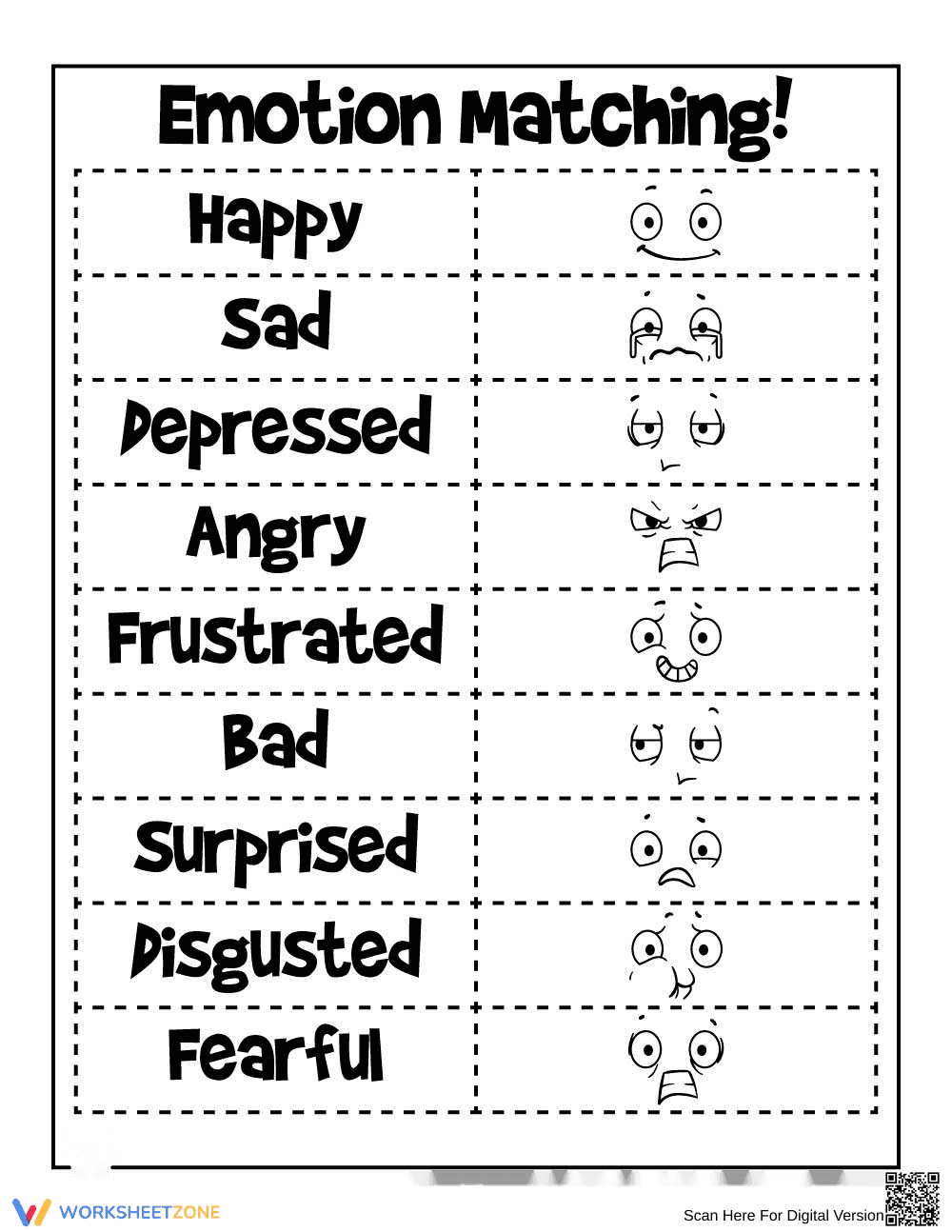
This is an emotion matching worksheet. It features a list of feelings such as Happy, Sad, Depressed, Angry, Frustrated, Bad, Surprised, Disgusted and Fearful. Each emotion needs to be matched to a corresponding cartoon face expressing that emotion. The worksheet is designed with dotted lines, suggesting it can be cut into strips for a matching game.
Grade Level Suitability:
This worksheet is most suitable for preschool and kindergarten (ages 3-6). The emotions are basic and the cartoon faces are simple, making it easy for young children to understand and match. It can also be used for early elementary grades (1st grade) for children who need extra help with emotional recognition.
Why Use It:
This worksheet helps children develop emotional literacy by associating words with facial expressions. It improves their ability to recognize and understand different emotions, which is crucial for social-emotional development and communication skills. It promotes visual discrimination and matching skills.
How to Use It:
The worksheet can be used as a matching activity. Cut along the dotted lines to separate the emotion words and the faces. Have the child match each emotion word to the correct facial expression. Alternatively, keep the worksheet whole and have the child draw a line connecting the words to the faces.
Target Users:
The target users are preschool and kindergarten children, children with autism spectrum disorder (ASD) who need help with emotional recognition, and students in special education settings working on social skills. It can also be used by parents and educators to teach children about emotions in a fun and engaging way.
This is an emotion matching worksheet. It features a list of feelings such as Happy, Sad, Depressed, Angry, Frustrated, Bad, Surprised, Disgusted and Fearful. Each emotion needs to be matched to a corresponding cartoon face expressing that emotion. The worksheet is designed with dotted lines, suggesting it can be cut into strips for a matching game.
Grade Level Suitability:
This worksheet is most suitable for preschool and kindergarten (ages 3-6). The emotions are basic and the cartoon faces are simple, making it easy for young children to understand and match. It can also be used for early elementary grades (1st grade) for children who need extra help with emotional recognition.
Why Use It:
This worksheet helps children develop emotional literacy by associating words with facial expressions. It improves their ability to recognize and understand different emotions, which is crucial for social-emotional development and communication skills. It promotes visual discrimination and matching skills.
How to Use It:
The worksheet can be used as a matching activity. Cut along the dotted lines to separate the emotion words and the faces. Have the child match each emotion word to the correct facial expression. Alternatively, keep the worksheet whole and have the child draw a line connecting the words to the faces.
Target Users:
The target users are preschool and kindergarten children, children with autism spectrum disorder (ASD) who need help with emotional recognition, and students in special education settings working on social skills. It can also be used by parents and educators to teach children about emotions in a fun and engaging way.


