


























0
Views
0
Downloads

0.0
0
Save
0 Likes
Share
Understanding Ecological Pyramids Worksheet
0 Views
0 Downloads
Paste this activity's link or code into your existing LMS (Google Classroom, Canvas, Teams, Schoology, Moodle, etc.).
Students can open and work on the activity right away, with no student login required.
You'll still be able to track student progress and results from your teacher account.
Information
Description
What It Is:
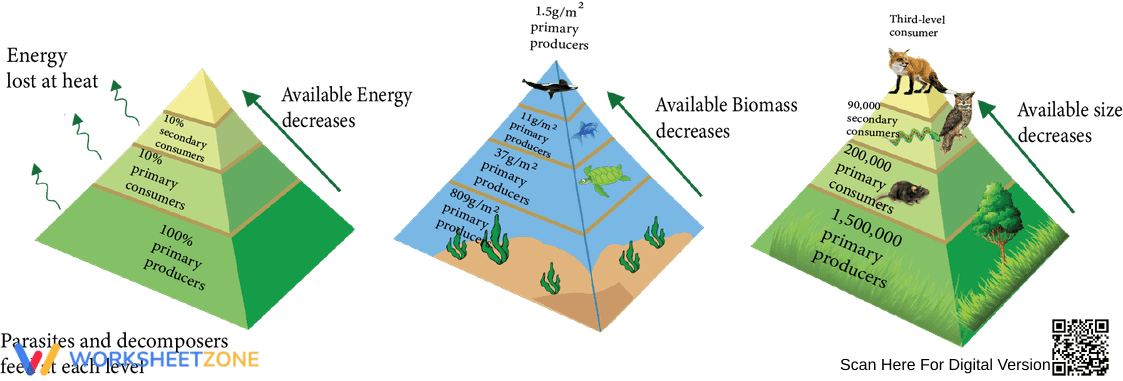
This is an educational worksheet showing three different food pyramids: one for a terrestrial ecosystem, one for an aquatic ecosystem, and one for a forest ecosystem. Each pyramid illustrates the energy flow from producers at the bottom to apex predators at the top. The worksheet labels each level of the pyramid with examples of organisms that belong to that trophic level, such as plants, herbivores, carnivores, and apex predators. Arrows indicate the direction of energy flow.
Grade Level Suitability:
This worksheet is suitable for grades 4-7. The concept of food pyramids and trophic levels is typically introduced in elementary and middle school science curricula. The visual representation and examples provided make it accessible to students in these grades.
Why Use It:
This worksheet helps students understand the concept of energy flow in ecosystems. It visually demonstrates how energy is transferred from one trophic level to another and how the number of organisms decreases as you move up the pyramid. It also reinforces vocabulary related to food chains and food webs.
How to Use It:
Use this worksheet as a visual aid during a lesson on food chains, food webs, and ecosystems. You can use it to introduce the concept of energy pyramids or as a review activity. Students can use it to identify different trophic levels and the organisms that belong to each level.
Target Users:
The target users are elementary and middle school students learning about ecosystems, food chains, food webs, and energy transfer. It is also suitable for teachers who need a visual aid to explain these concepts.
This is an educational worksheet showing three different food pyramids: one for a terrestrial ecosystem, one for an aquatic ecosystem, and one for a forest ecosystem. Each pyramid illustrates the energy flow from producers at the bottom to apex predators at the top. The worksheet labels each level of the pyramid with examples of organisms that belong to that trophic level, such as plants, herbivores, carnivores, and apex predators. Arrows indicate the direction of energy flow.
Grade Level Suitability:
This worksheet is suitable for grades 4-7. The concept of food pyramids and trophic levels is typically introduced in elementary and middle school science curricula. The visual representation and examples provided make it accessible to students in these grades.
Why Use It:
This worksheet helps students understand the concept of energy flow in ecosystems. It visually demonstrates how energy is transferred from one trophic level to another and how the number of organisms decreases as you move up the pyramid. It also reinforces vocabulary related to food chains and food webs.
How to Use It:
Use this worksheet as a visual aid during a lesson on food chains, food webs, and ecosystems. You can use it to introduce the concept of energy pyramids or as a review activity. Students can use it to identify different trophic levels and the organisms that belong to each level.
Target Users:
The target users are elementary and middle school students learning about ecosystems, food chains, food webs, and energy transfer. It is also suitable for teachers who need a visual aid to explain these concepts.


