


























Views
Downloads
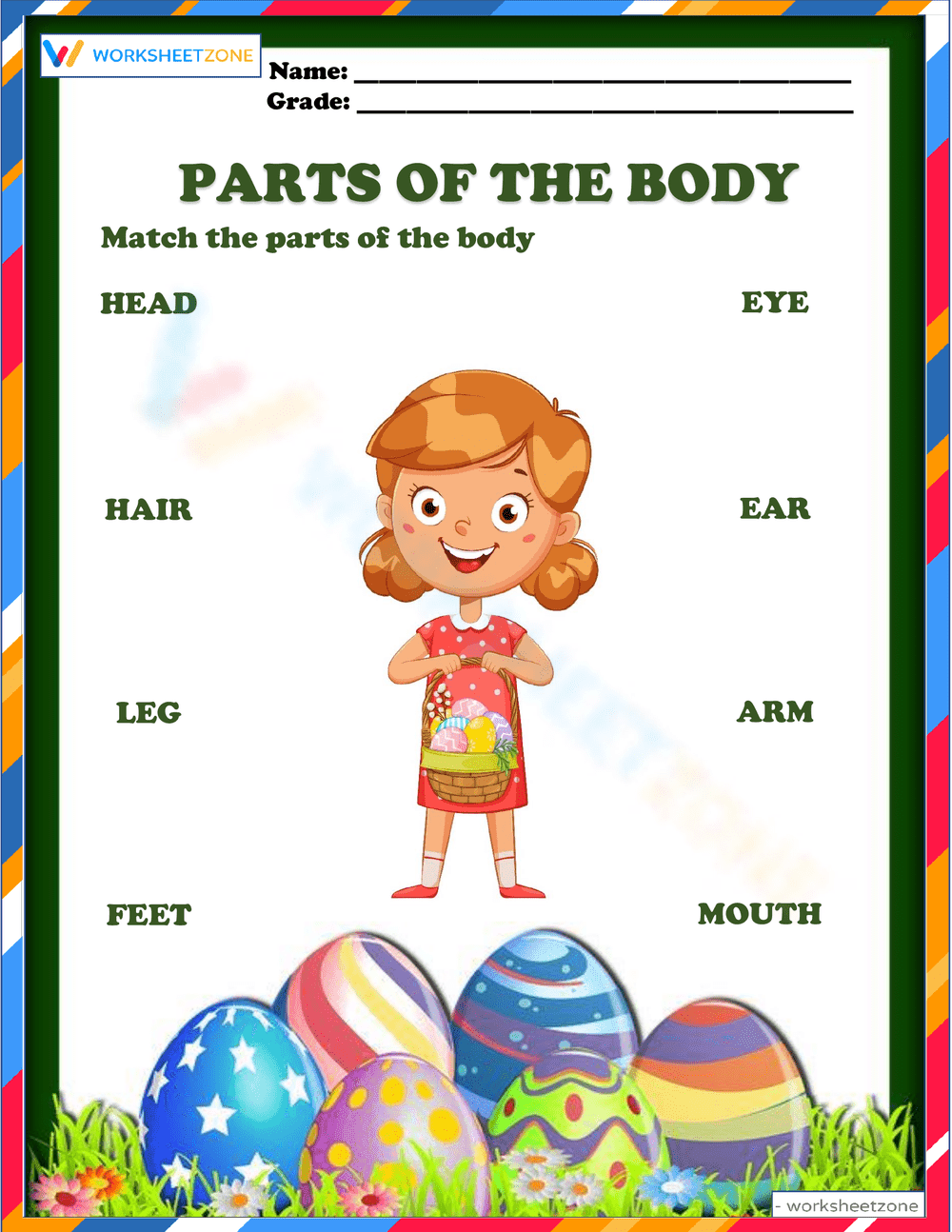

Human Body Parts Worksheet | Grade K-1 Essential
Paste this activity's link or code into your existing LMS (Google Classroom, Canvas, Teams, Schoology, Moodle, etc.).
Students can open and work on the activity right away, with no student login required.
You'll still be able to track student progress and results from your teacher account.
This Grade K-1 human body parts worksheet helps young learners identify and label eight primary external structures. By matching vocabulary words to a central diagram, students build foundational biological knowledge and scientific observation skills. It provides a clear, visual way to assess anatomical recognition in early childhood science settings.
At a Glance
- Grade: K-1 · Subject: Science
- Standard:
K-LS1-1— Use observations to describe patterns of what plants and animals need to survive- Skill Focus: External body part identification
- Format: 1 page · 8 problems · Answer key included · PDF
- Best For: Early finishers or science center activity
- Time: 10–15 minutes
The resource features a single-page layout with a central illustration of a child surrounded by Easter-themed graphics. It includes eight specific vocabulary terms: head, hair, leg, feet, eye, ear, arm, and mouth. Students draw lines from the text to the corresponding part of the image. A full-color answer key is provided for quick grading or self-correction.
This worksheet is designed for immediate classroom implementation. Teachers can print the PDF in under 30 seconds, distribute it to the class in 1 minute, and review the eight matching pairs together in less than 5 minutes. The intuitive design makes it an ideal choice for emergency sub plans or independent morning work during the spring season.
This activity aligns with `K-LS1-1`, focusing on using observations to identify the physical structures of living things. By recognizing that humans have specific parts like eyes and ears to interact with their environment, students meet early life science benchmarks. Both standard codes can be copied directly into lesson plans, IEP goals, or district curriculum mapping tools.
Use this as a formative assessment after a direct instruction lesson on the five senses or human anatomy. It works well as a quiet time activity. Teachers should observe if students can distinguish between similar terms like head and hair to gauge visual-spatial processing and vocabulary retention. Completion typically takes 10 to 15 minutes.
This resource is tailored for Kindergarten and 1st-grade students, including English Language Learners (ELLs) who benefit from the direct visual-to-word association. It pairs naturally with a My Body anchor chart or a read-aloud book about human growth and development to reinforce the lesson.
According to the RAND AIRS 2024 report, high-quality visual aids in early science education significantly improve vocabulary acquisition for Tier 1 and Tier 2 learners. This worksheet utilizes the K-LS1-1 standard to bridge the gap between simple observation and scientific labeling. By identifying eight distinct body parts, students develop the foundational schema necessary for later studies in human biology and physiology. Research from Fisher & Frey (2014) emphasizes that matching tasks serve as effective scaffolds for independent practice, allowing students to demonstrate mastery without the cognitive load of complex writing. This resource provides a structured environment for students to apply their knowledge of external structures, ensuring they meet grade-level expectations for scientific literacy and anatomical recognition in a classroom-ready format.


