


























0
Views
0
Downloads

Save
0 Likes
Share
Dysfunctional Family Roles
0 Views
0 Downloads
Paste this activity's link or code into your existing LMS (Google Classroom, Canvas, Teams, Schoology, Moodle, etc.).
Students can open and work on the activity right away, with no student login required.
You'll still be able to track student progress and results from your teacher account.
Information
Description
What It Is:
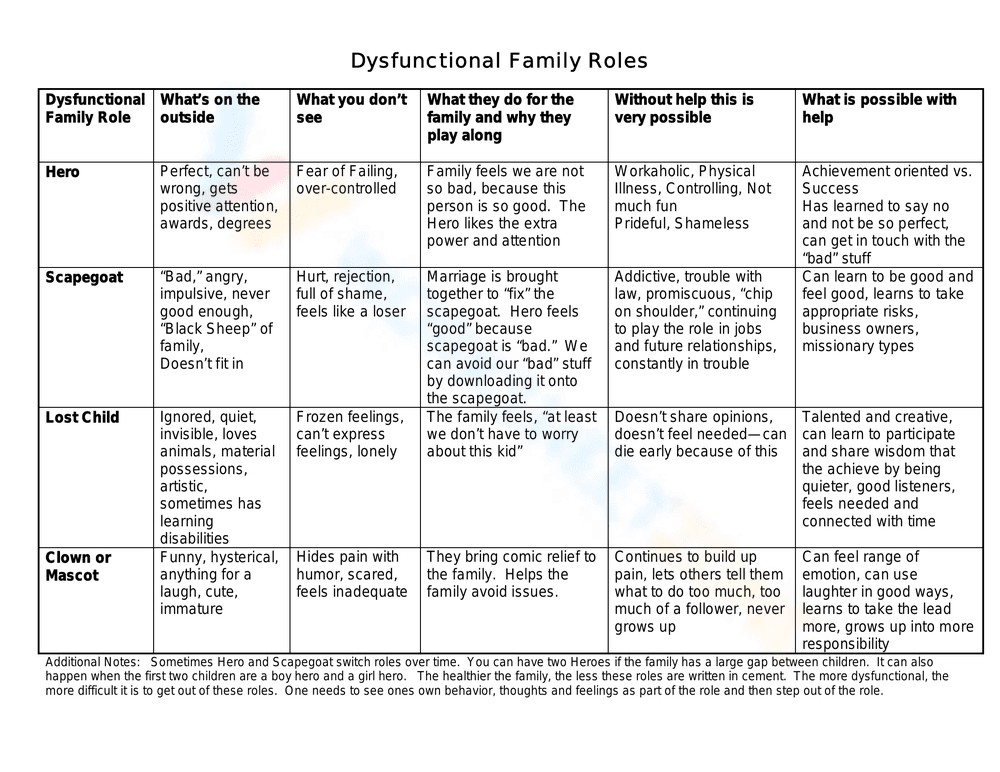
This is an educational worksheet titled 'Dysfunctional Family Roles.' It presents a table with different roles (Hero, Scapegoat, Lost Child, Clown/Mascot) listed in the first column. Subsequent columns describe each role in terms of 'What's on the outside,' 'What you don't see,' 'What they do for the family and why they play along,' 'Without help this is very possible,' and 'What is possible with help.' The worksheet also includes additional notes at the bottom discussing role switching and family dynamics.
Grade Level Suitability:
This worksheet is most suitable for high school students (grades 9-12) and adult learners. The content deals with complex social and psychological concepts related to family dynamics, requiring a level of maturity and critical thinking skills typically developed in later adolescence and adulthood.
Why Use It:
This worksheet helps students understand different roles that individuals may adopt within a dysfunctional family system. It promotes critical thinking about family dynamics, encourages empathy, and can provide insights into personal relationships. It can also serve as a starting point for discussions about healthy communication and coping mechanisms within families.
How to Use It:
Students can use this worksheet by reading through each row and column to understand the characteristics of each family role. It can be used for individual reflection, group discussions, or as a basis for writing assignments. Teachers can use it as a tool to introduce the topic of family dynamics and to facilitate discussions about healthy relationships. Students can also be encouraged to analyze fictional characters or real-life scenarios using the framework provided.
Target Users:
The target users for this worksheet are high school students, college students studying psychology or sociology, and adults interested in learning more about family dynamics and interpersonal relationships. Counselors and therapists may also find it useful as a tool for client education.
This is an educational worksheet titled 'Dysfunctional Family Roles.' It presents a table with different roles (Hero, Scapegoat, Lost Child, Clown/Mascot) listed in the first column. Subsequent columns describe each role in terms of 'What's on the outside,' 'What you don't see,' 'What they do for the family and why they play along,' 'Without help this is very possible,' and 'What is possible with help.' The worksheet also includes additional notes at the bottom discussing role switching and family dynamics.
Grade Level Suitability:
This worksheet is most suitable for high school students (grades 9-12) and adult learners. The content deals with complex social and psychological concepts related to family dynamics, requiring a level of maturity and critical thinking skills typically developed in later adolescence and adulthood.
Why Use It:
This worksheet helps students understand different roles that individuals may adopt within a dysfunctional family system. It promotes critical thinking about family dynamics, encourages empathy, and can provide insights into personal relationships. It can also serve as a starting point for discussions about healthy communication and coping mechanisms within families.
How to Use It:
Students can use this worksheet by reading through each row and column to understand the characteristics of each family role. It can be used for individual reflection, group discussions, or as a basis for writing assignments. Teachers can use it as a tool to introduce the topic of family dynamics and to facilitate discussions about healthy relationships. Students can also be encouraged to analyze fictional characters or real-life scenarios using the framework provided.
Target Users:
The target users for this worksheet are high school students, college students studying psychology or sociology, and adults interested in learning more about family dynamics and interpersonal relationships. Counselors and therapists may also find it useful as a tool for client education.


