


























Views
Downloads
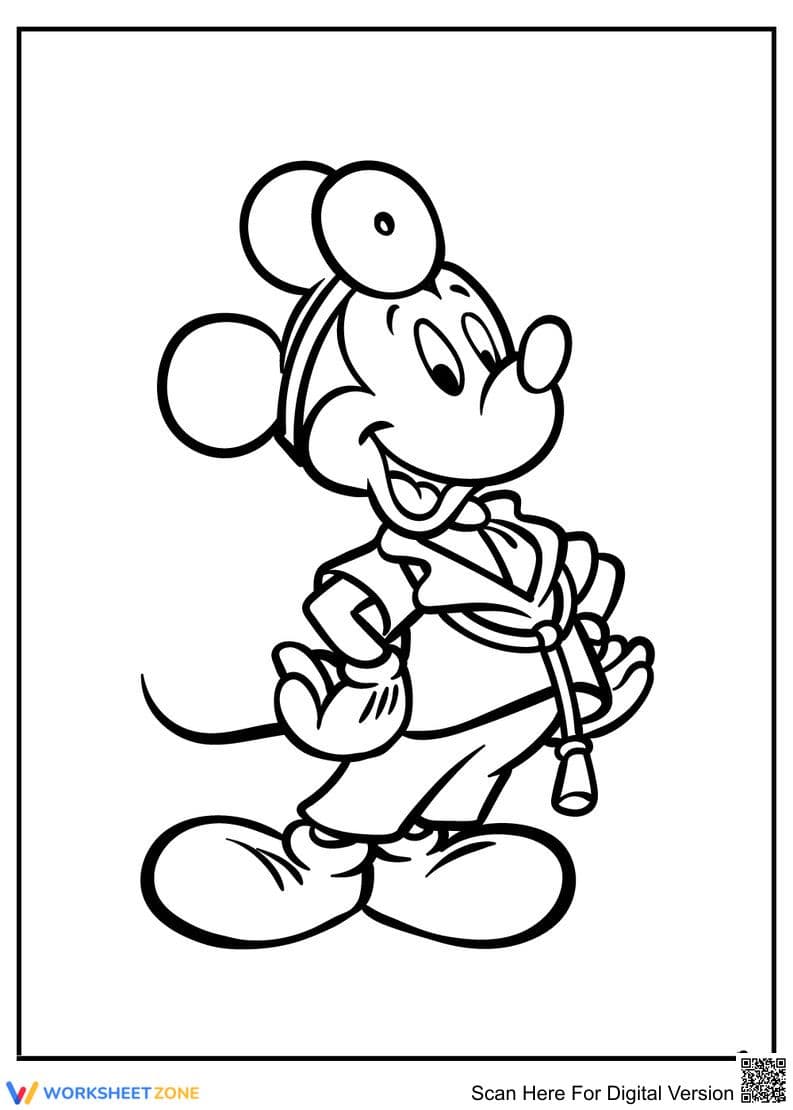

Doctor Mickey Coloring Page | Printable Grade K-5 Art
Paste this activity's link or code into your existing LMS (Google Classroom, Canvas, Teams, Schoology, Moodle, etc.).
Students can open and work on the activity right away, with no student login required.
You'll still be able to track student progress and results from your teacher account.
This Doctor Mickey coloring worksheet provides a high-interest creative outlet for students in Kindergarten through Grade 5. By engaging with a familiar character in a professional role, learners develop essential fine motor control and hand-eye coordination while exploring career-themed imagery. It serves as a perfect bridge between artistic expression and narrative discussion.
At a Glance
- Grade: K-5 · Subject: Arts & English
- Standard:
CCSS.ELA-LITERACY.SL.K.5— Add drawings or visual displays to descriptions to provide additional detail- Skill Focus: Fine Motor Control
- Format: 1 page · 1 task · No answer key · PDF
- Best For: Early finishers and creative brain breaks
- Time: 15–20 minutes
This single-page PDF features a high-quality line-art illustration of Mickey Mouse dressed in medical attire, including a stethoscope and head mirror. The clear, bold outlines are designed to support younger students in practicing spatial awareness and staying within boundaries, while the detailed character costume offers older students opportunities for complex shading, color blending, and artistic experimentation.
The zero-prep workflow for this activity is designed for maximum efficiency in a busy classroom. First, print the single-page PDF (30 seconds). Second, distribute the sheets along with crayons, markers, or colored pencils (1 minute). Third, review the completed work by having students describe what Doctor Mickey might be doing in a hospital setting (1 minute). Total teacher preparation time is under two minutes, making it an ideal resource for unexpected schedule changes.
This resource aligns with CCSS.ELA-LITERACY.SL.K.5, which encourages students to add visual displays to descriptions to provide additional detail. While primarily an art activity, it supports language development by providing a visual prompt for storytelling and vocabulary building related to community helpers and healthcare. Both standard codes can be copied directly into lesson plans, IEP goals, or district curriculum mapping tools.
Use this worksheet as a calming morning work activity to settle the class or as a rewarding task for students who complete their primary assignments ahead of schedule. For a formative assessment, observe the student's pencil grip and pressure control during the coloring process to identify those needing additional fine motor support. Expected completion time ranges from 15 to 20 minutes depending on the medium used.
This worksheet is ideal for elementary students, particularly those in Tier 1 general education settings or students receiving occupational therapy support for fine motor delays. It pairs naturally with a read-aloud book about doctors or a social studies unit on community helpers. It is also a reliable option for substitute teacher folders due to its self-explanatory nature.
According to research by Fisher & Frey (2014), incorporating visual arts and familiar characters into the classroom environment significantly increases student engagement and provides a low-stakes entry point for complex motor tasks. This Doctor Mickey worksheet utilizes the CCSS.ELA-LITERACY.SL.K.5 framework to help students bridge the gap between visual representation and descriptive language. By focusing on a community helper version of a beloved character, the activity encourages students to practice fine motor precision—a prerequisite for legible handwriting—while simultaneously building thematic vocabulary. Analysis from the RAND AIRS 2024 report suggests that high-interest visual materials reduce task-avoidance behaviors in early childhood settings. This printable resource ensures that teachers can provide a high-quality, standards-aligned creative break without sacrificing instructional time or requiring extensive setup. It remains a staple for inclusive classrooms seeking to balance academic rigor with necessary developmental play.


