


























Views
Downloads

Flower Dissection Worksheet | Grade 10 Essential
Paste this activity's link or code into your existing LMS (Google Classroom, Canvas, Teams, Schoology, Moodle, etc.).
Students can open and work on the activity right away, with no student login required.
You'll still be able to track student progress and results from your teacher account.
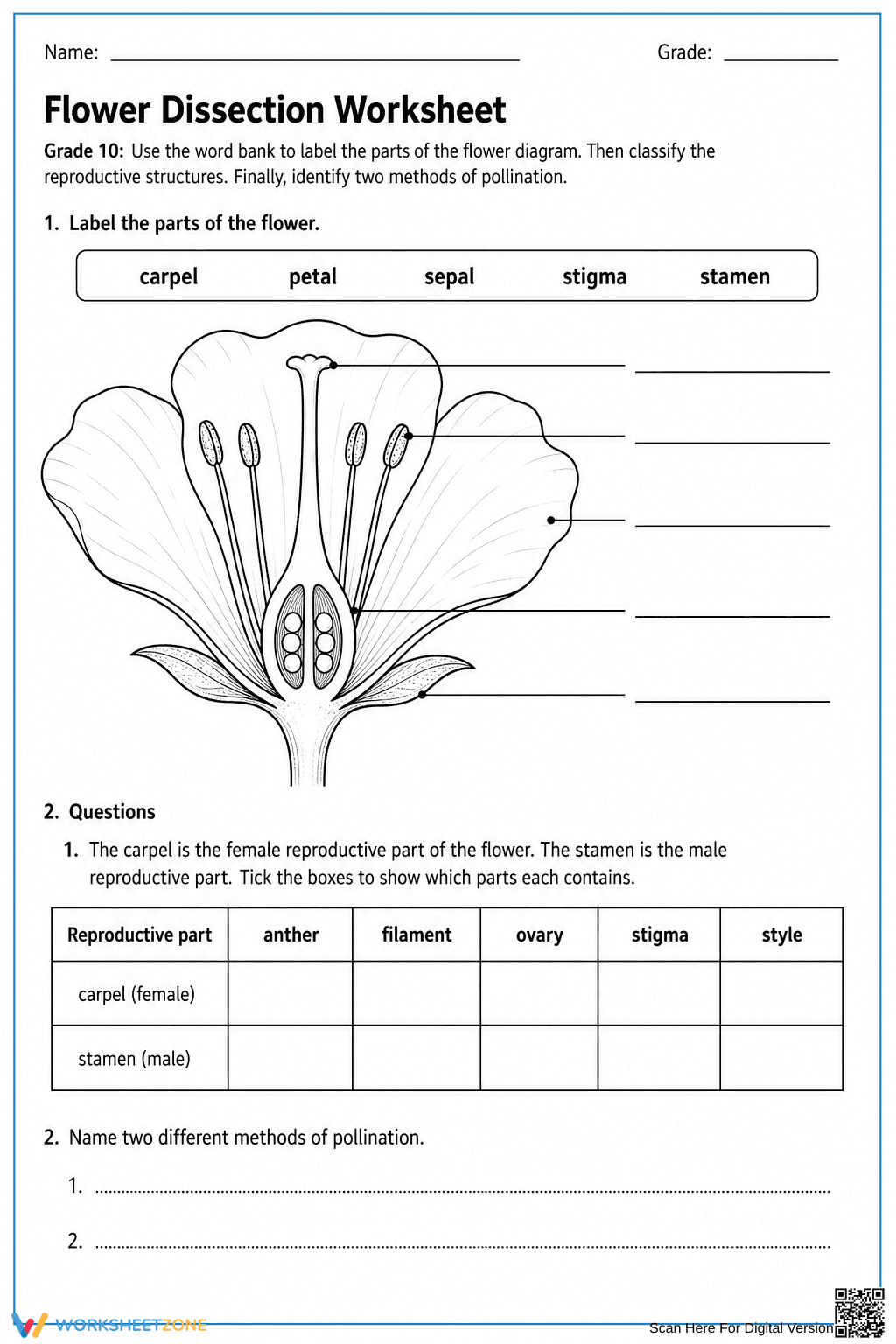
This Grade 10 flower dissection worksheet provides a structured approach for students to identify and categorize the reproductive components of angiosperms. By engaging with anatomical diagrams and classification tables, learners develop a concrete understanding of how plant structures support biological functions. It is an ideal companion for laboratory practicals or as a standalone anatomy review.
At a Glance
- Grade: 10 · Subject: Science
- Standard:
HS-LS1-2— Explain how hierarchical structural organization of multicellular organisms supports life functions- Skill Focus: Flower anatomy and reproductive systems
- Format: 1 page · 3 tasks · Answer key included · PDF
- Best For: Biology lab follow-up or anatomy review
- Time: 15–20 minutes
The resource features a detailed botanical illustration for labeling, a word bank containing key anatomical terms, and a comprehensive classification matrix. Students must distinguish between male (stamen) and female (carpel) reproductive organs, including the anther, filament, ovary, stigma, and style. The final section requires students to synthesize their knowledge by identifying pollination methods.
Zero-Prep Workflow
- Print: Generate copies for your entire class in less than 60 seconds.
- Distribute: Hand out the sheets as a pre-lab guide or a post-dissection assessment.
- Review: Use the included answer key for rapid grading or peer-review sessions.
Total teacher preparation time is under 2 minutes, making this an excellent choice for emergency sub plans or bell-ringer activities.
Standards Alignment
This worksheet aligns with HS-LS1-2, which requires students to develop and use a model to illustrate the hierarchical organization of interacting systems that provide specific functions within multicellular organisms. By focusing on the reproductive system of plants, students see how specialized tissues and organs work together for species survival.
How to Use It
Assign this worksheet during the "Explain" phase of a 5E lesson cycle to solidify vocabulary after a hands-on dissection. Alternatively, use it as a formative assessment to check for misconceptions regarding the location of the ovary versus the anther. Expect students to complete the labeling and classification tasks within 20 minutes of focused work.
Who It's For
This resource is designed for Grade 10 Biology students, including those in honors or general science tracks. It provides enough visual support for English Language Learners while maintaining the academic rigor required for high school anatomy.
High-quality visual aids in science education are critical for cognitive load management, as noted in the Fisher & Frey (2014) framework for intentional instruction. This HS-LS1-2 aligned worksheet focuses on the specific skill of identifying flower anatomy and reproductive structures, which is a foundational component of high school life science. Research from the NAEP indicates that students who can successfully relate biological structures to their specific functions demonstrate higher proficiency in complex systems thinking. By providing a clear, 1-page format with 3 distinct tasks, this resource ensures that students move from simple identification to the classification of reproductive systems. The inclusion of a classification table for the carpel and stamen allows for immediate feedback on student understanding of plant physiology. This structured approach supports the gradual release of responsibility and ensures that Grade 10 learners meet state and national science benchmarks efficiently.


