

































Essential Place Value & Number Sense Worksheet | Grade 3

Paste this activity's link or code into your existing LMS (Google Classroom, Canvas, Teams, Schoology, Moodle, etc.).
Students can open and work on the activity right away, with no student login required.
You'll still be able to track student progress and results from your teacher account.
This Essential Place Value and Number Sense worksheet provides Grade 3 students with a comprehensive review of the base-ten number system. By working through various representations, students solidify their understanding of how hundreds, tens, and ones combine to form 3-digit numbers. This resource ensures learners can fluently manipulate numbers before moving toward complex multi-digit addition and subtraction operations.
At a Glance
- Grade: 3 · Subject: Math
- Standard:
CCSS.MATH.CONTENT.3.NBT.A.2— Fluently add and subtract within 1000 using strategies based on place value- Skill Focus: 3-digit place value and number patterns
- Format: 3 pages · 10 main tasks · Answer key included · PDF
- Best For: Small group intervention and daily warm-ups
- Time: 20–30 minutes
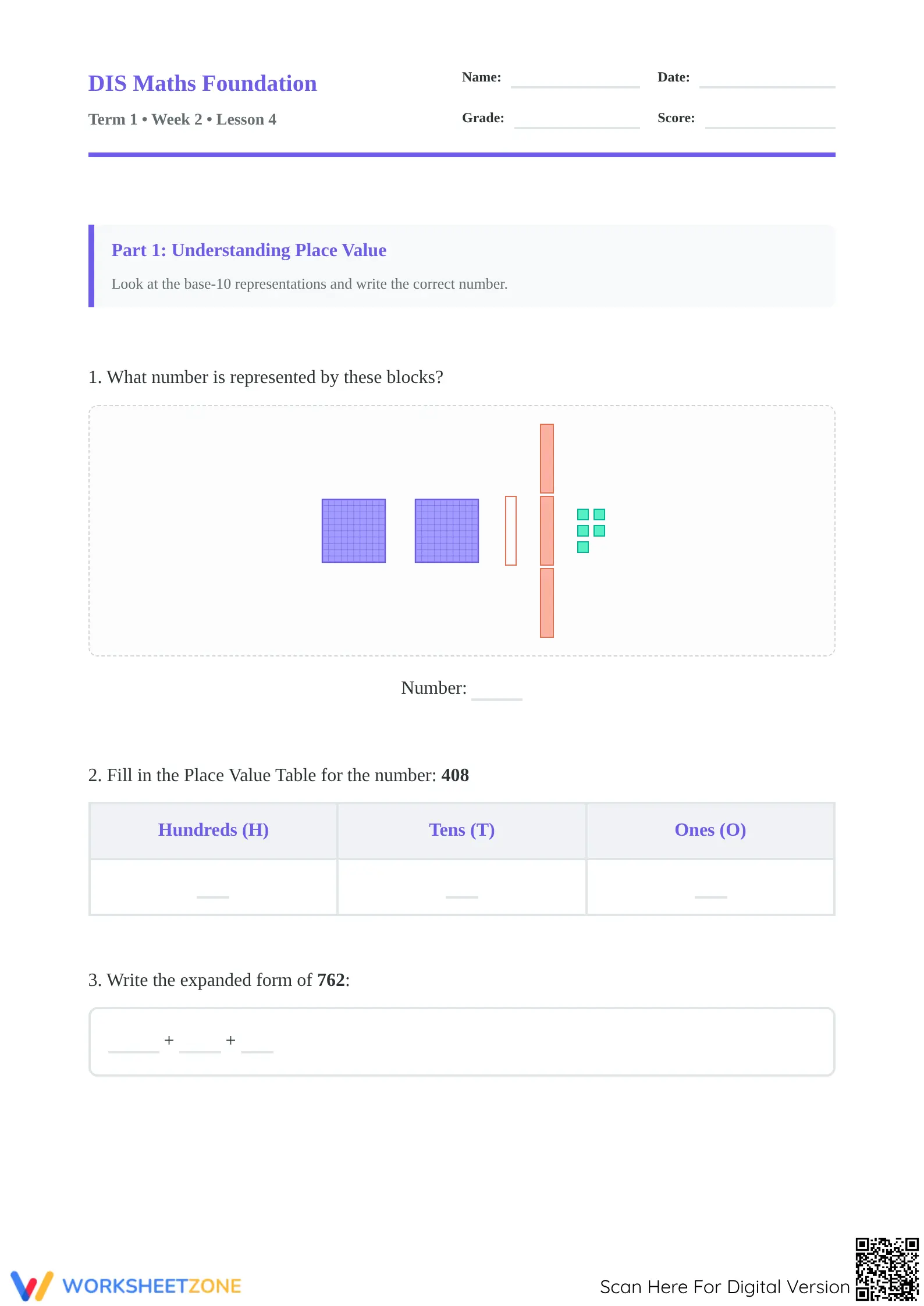
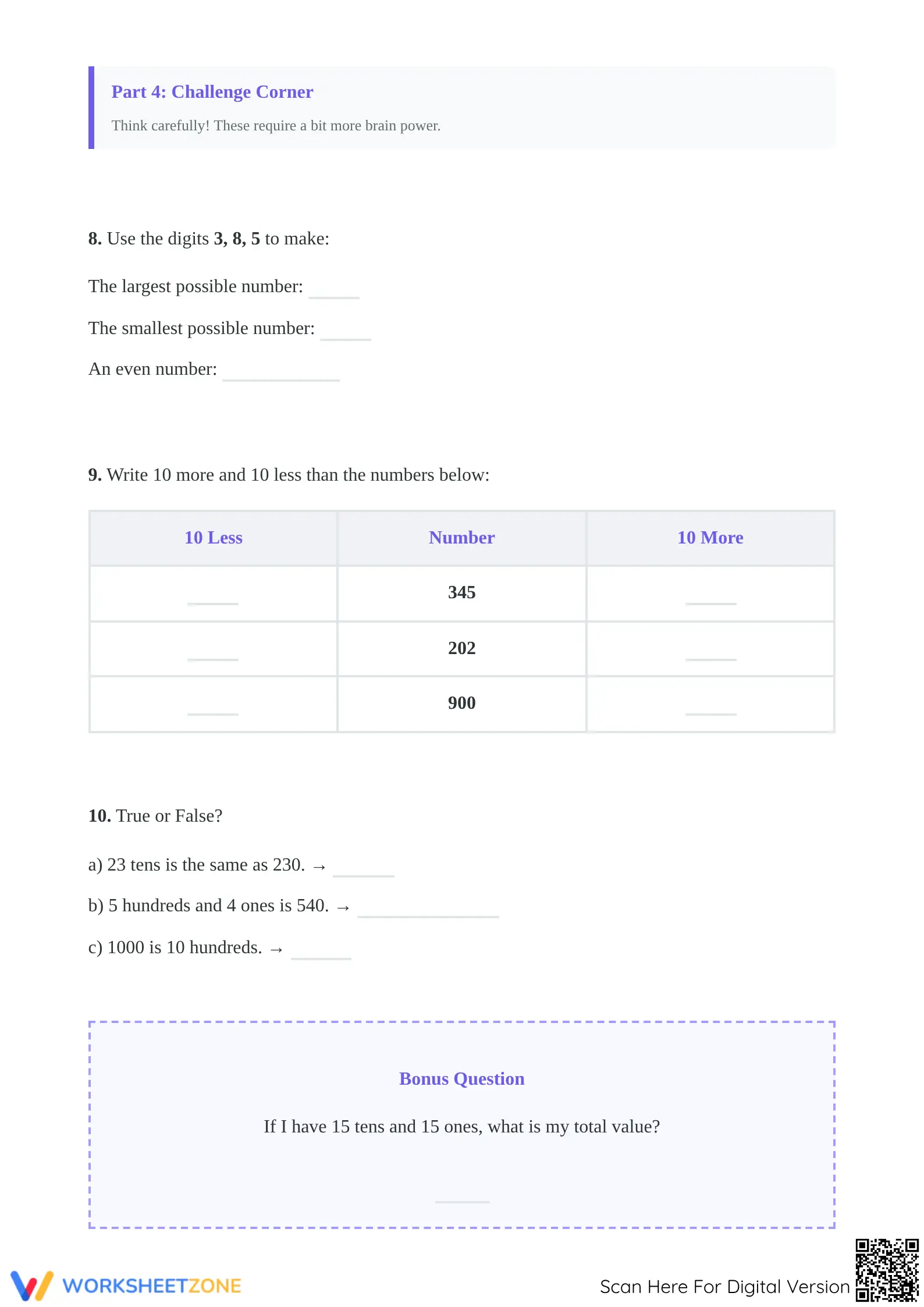
Inside this three-page packet, you will find a logical progression of number sense activities. The worksheet begins with visual base-10 block representations and place value tables to ground students in concrete math concepts. It then moves into abstract representations including expanded form and symbol-based comparisons. The final page features a "Challenge Corner" designed to push students toward higher-order thinking with digit manipulation and multi-step reasoning puzzles.
- Guided Practice: Students start with high-scaffold tasks, identifying numbers from visual block sets and filling in structured hundreds-tens-ones tables to establish a baseline of understanding.
- Supported Practice: Learners transition to representing numbers in expanded form and comparing numerical values using greater than, less than, and equal to symbols across multiple problem sets.
- Independent Practice: The packet concludes with independent number sequences, 10 more/10 less calculations, and critical thinking questions that require students to compose and decompose 3-digit values without visual aids.
This resource is aligned to CCSS.MATH.CONTENT.3.NBT.A.2, which requires students to fluently add and subtract within 1000 using strategies based on place value and the properties of operations. By mastering the foundational tasks in this worksheet, students build the prerequisite skills necessary for regrouping and multi-digit computation. This standard code can be copied directly into lesson plans, IEP goals, or district curriculum mapping tools to ensure instructional alignment.
Teachers can use this worksheet as a formative assessment during the first week of a new unit. Observe students as they work on Task 5 ("I have 4 hundreds, 2 tens, and 17 ones") to see if they can correctly regroup ones into tens, as this is a primary indicator of readiness for addition with carrying. Expect most students to complete the three pages in approximately 25 minutes, making it an ideal choice for a stationary math center or a high-utility homework assignment.
This packet is specifically designed for Grade 3 students but serves as an excellent "Foundation" review for Grade 4 learners who show gaps in their understanding of 3-digit values. It naturally pairs with physical base-10 block manipulatives or a digital place value chart. For students requiring extra support, provide the first page only to focus on visual identification before attempting the reasoning puzzles on pages two and three.
Place value is a cornerstone of elementary mathematics, bridging simple counting and advanced algebraic thinking. This worksheet, aligned with EdReports 2024 findings, emphasizes the structural properties of numbers. Students interact with numbers through visual, tabular, expanded, and comparative modalities. This approach helps prevent the misconception that numbers are isolated digits, fostering a stable mathematical framework. Educators can use this structured sequence to identify and correct errors, supporting long-term retention of number properties and preparing students for future mathematical challenges. This summary is suitable for professional development logs or lesson plan citations.


