




























Views
Downloads

Printable Letter D Tracing Worksheet | Kindergarten ELA

Paste this activity's link or code into your existing LMS (Google Classroom, Canvas, Teams, Schoology, Moodle, etc.).
Students can open and work on the activity right away, with no student login required.
You'll still be able to track student progress and results from your teacher account.
This foundational handwriting worksheet helps early learners master the letter D through guided tracing and visual association. Students practice proper stroke order for both uppercase and lowercase forms, building essential fine motor skills and letter recognition required for fluent writing and reading development.
At a Glance
- Grade: Kindergarten · Subject: ELA
- Standard:
CCSS.ELA-LITERACY.L.K.1.A— Print many upper- and lowercase letters- Skill Focus: Letter D Tracing and Recognition
- Format: 1 page · 12 problems · No answer key needed · PDF
- Best For: Independent practice
- Time: 10–15 minutes
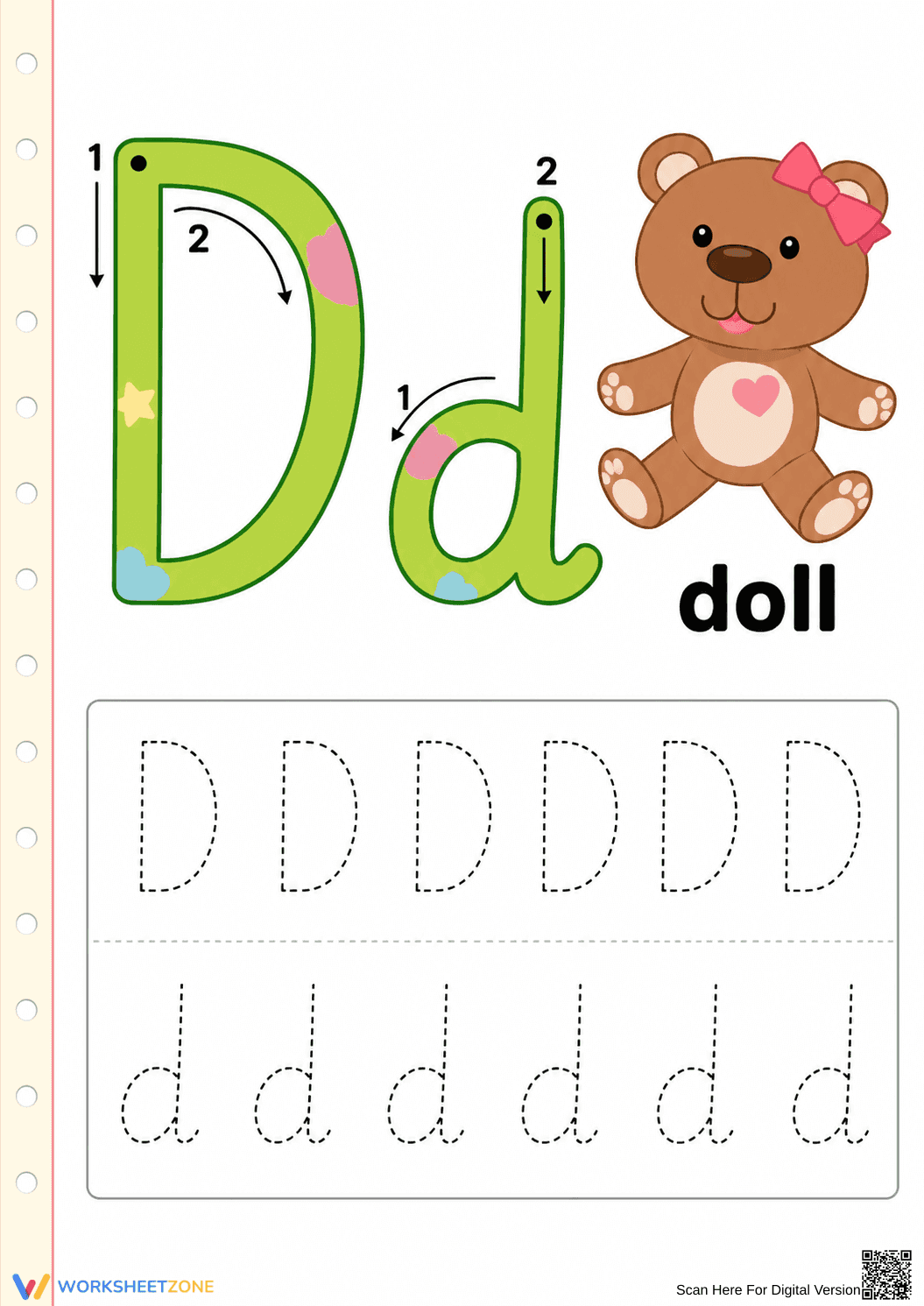
This single-page resource features a large, color-coded demonstration of the letter D with numbered directional arrows to guide proper stroke formation. Alongside a visual vocabulary cue, the page provides two distinct practice rows: six dashed uppercase 'D's and six dashed lowercase 'd's. The clear, dotted guidelines ensure students can confidently trace each letter, reinforcing muscle memory without requiring an answer key.
Zero-Prep Workflow
Designed for immediate classroom implementation:
- Print (1 minute): Simply download the PDF and print the required number of copies. Dashed lines print clearly.
- Distribute (1 minute): Hand out the sheets along with pencils or crayons. Visual guides make the task obvious.
- Review (1 minute): Quickly scan student work to ensure they are following the directional arrows rather than drawing the letters backward.
Total teacher prep time is under two minutes, making this an excellent, reliable option for emergency sub plans or morning work routines.
Standards Alignment
This resource is directly aligned to the primary standard CCSS.ELA-LITERACY.L.K.1.A: Print many upper- and lowercase letters. Structured tracing tasks ensure students develop precise motor control to form the letter D accurately, while supporting foundational phonics. Both standard codes can be copied directly into lesson plans, IEP goals, or district curriculum mapping tools.
How to Use It
This tracing sheet is highly versatile for early childhood classrooms. Use it as a focused morning work activity as students settle into the day, or incorporate it into a dedicated literacy center focused on the alphabet. During independent practice, observe students formatively to ensure they start their pencil strokes at the top line and follow the numbered arrows, correcting any bottom-up writing habits early. Expected completion time ranges from 10 to 15 minutes depending on the student's fine motor development.
Who It's For
This worksheet is primarily designed for Kindergarten students, but it also serves as an effective intervention tool for first or second graders who struggle with letter reversals or legibility. For differentiation, provide textured materials like glitter glue over the large demonstration letters for tactile learners, or pair this sheet with a direct instruction lesson on the /d/ sound using an alphabet anchor chart.
Developing automaticity in handwriting is a critical precursor to expressive writing and reading fluency. This resource targets CCSS.ELA-LITERACY.L.K.1.A, helping students print many upper- and lowercase letters with accuracy and confidence. According to Fisher & Frey (2014), explicit, guided practice with clear visual models significantly reduces cognitive load, allowing early learners to focus on motor execution rather than letter recall. Integrating numbered stroke directions and repetitive tracing tasks ensures students build necessary muscle memory for the letter D. Consistent practice with structured guidelines prevents incorrect writing habits, such as bottom-up strokes or letter reversals, which can impede later literacy development. This targeted approach bridges the gap between visual letter recognition and physical letter production, establishing a strong foundation for future academic success in early elementary language arts.


