


























Views
Downloads
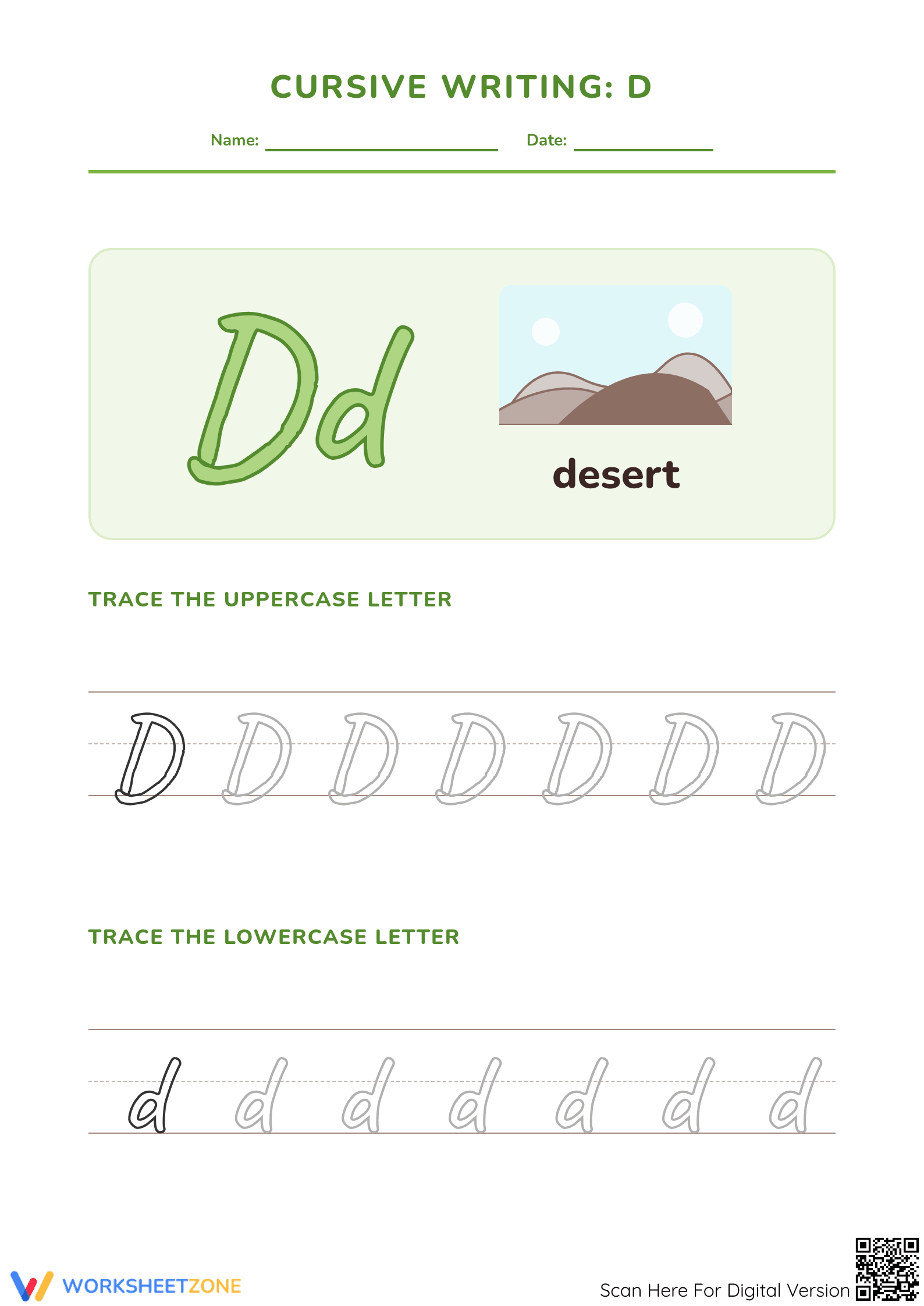

Printable Cursive Letter D Worksheet | Grade 2 ELA
Paste this activity's link or code into your existing LMS (Google Classroom, Canvas, Teams, Schoology, Moodle, etc.).
Students can open and work on the activity right away, with no student login required.
You'll still be able to track student progress and results from your teacher account.
This cursive letter D worksheet provides students with focused handwriting practice to develop fine motor skills. By tracing uppercase and lowercase letters, young learners build the muscle memory required for fluid writing. The clear visual guides ensure students master the cursive alphabet.
At a Glance
- Grade: 2 · Subject: ELA
- Standard:
CCSS.ELA-LITERACY.L.1.1.A— Form upper- and lowercase letters- Skill Focus: Cursive Letter Formation
- Format: 1 page · 14 problems · No answer key · PDF
- Best For: Independent handwriting practice
- Time: 10–15 minutes
Inside this single-page resource, teachers will find a straightforward layout designed for early cursive learners. The page features a reference graphic showing the letter D alongside a desert illustration to reinforce phonics. Students complete 14 tracing tasks divided evenly between uppercase and lowercase letters. The dotted guidelines provide essential scaffolding for correct letter proportion.
This resource is designed for a zero-prep workflow.
- Print (1 minute): Download the PDF and print.
- Distribute (1 minute): Hand out during morning work without complex instructions.
- Review (1 minute): Quickly scan student work to check for proper stroke direction.
With total teacher prep time under two minutes, this worksheet is perfect for sub plans.
This worksheet aligns to CCSS.ELA-LITERACY.L.1.1.A, requiring students to print all upper- and lowercase letters. This resource extends that foundational skill into cursive writing, ensuring students maintain proper conventions as they transition to connected text. Both standard codes can be copied directly into lesson plans, IEP goals, or district curriculum mapping tools.
Teachers can integrate this worksheet as a morning bell-ringer, allowing students to settle in with a quiet task before direct instruction. Alternatively, it works well as a dedicated literacy center station. As a formative assessment tip, observe students while they trace to ensure they start strokes from the correct position. Expected completion time ranges from 10 to 15 minutes.
This resource is designed for first and second-grade students beginning their cursive journey. It is also beneficial for older students requiring remedial handwriting practice, as the large tracing guides offer differentiation for developing fine motor control. Pair this worksheet with a direct instruction session modeling the cursive letter D.
Developing fluent handwriting is a critical component of early literacy that directly impacts a student's ability to generate written text. According to Fisher & Frey (2014), explicit instruction in letter formation and consistent, guided practice are essential for reducing the cognitive load associated with writing, allowing students to focus on content creation rather than mechanics. This worksheet supports that instructional goal by providing targeted repetition for the cursive letter D. Aligned with CCSS.ELA-LITERACY.L.1.1.A, the activity ensures students can accurately form upper- and lowercase letters. By integrating visual cues and structured tracing guidelines, educators can effectively support fine motor development and phonetic recognition simultaneously. This evidence-based approach to handwriting practice helps solidify the foundational skills necessary for long-term academic success and confident written communication across all subject areas.


