


























Views
Downloads

Printable Women's Day Coloring Worksheet | Grades 1-5
Paste this activity's link or code into your existing LMS (Google Classroom, Canvas, Teams, Schoology, Moodle, etc.).
Students can open and work on the activity right away, with no student login required.
You'll still be able to track student progress and results from your teacher account.
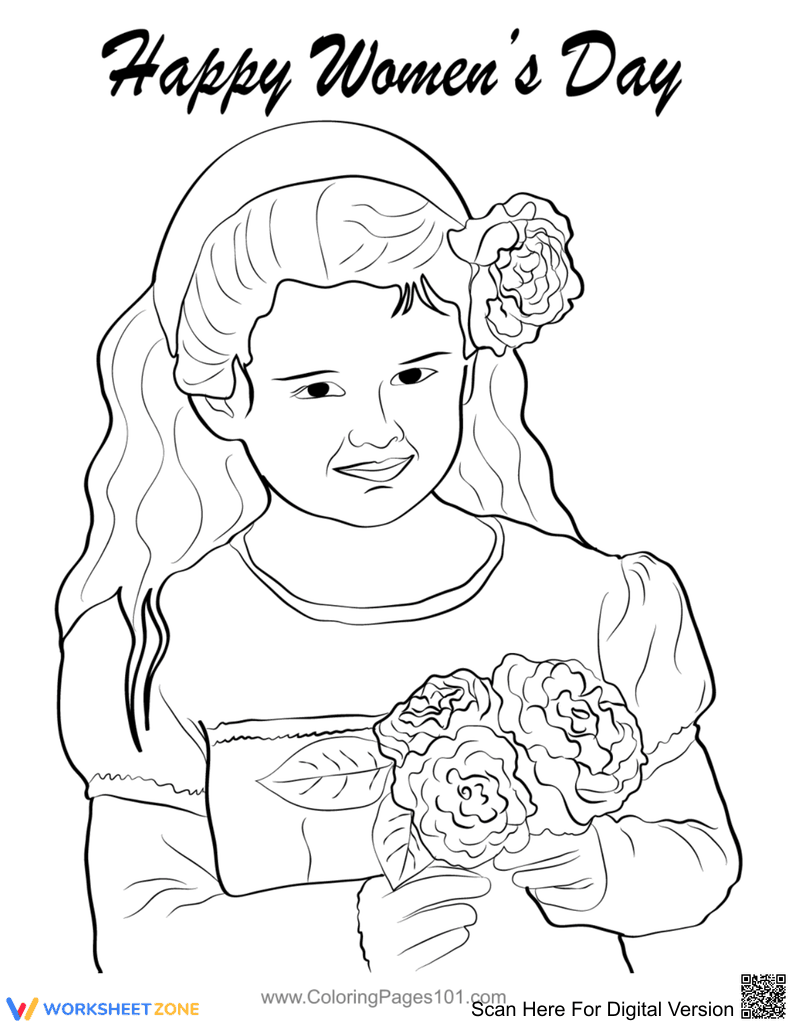
This printable Women's Day coloring worksheet provides students with a creative outlet to celebrate the holiday while developing essential fine motor control. By engaging with the thematic illustration of a young girl holding flowers, learners practice color mixing and visual expression in a relaxing, focused classroom activity.
At a Glance
- Grade: 1 · Subject: English
- Standard:
CCSS.ELA-LITERACY.SL.1.2— Discuss details in visual media- Skill Focus: Fine motor skills and visual literacy
- Format: 1 page · 1 problem · No answer key · PDF
- Best For: Morning work or holiday centers
- Time: 15–20 minutes
Inside this single-page resource, educators will find a high-quality line drawing featuring a girl holding roses beneath the text "Happy Women's Day." The bold outlines help younger students practice staying within lines while offering older students space to experiment with shading. No answer key is required, allowing for artistic freedom.
This resource is designed for immediate classroom implementation.
- Print (1 minute): Simply download the PDF and print the required number of copies for your classroom. The high-contrast lines ensure clean copies every time.
- Distribute (1 minute): Hand out the pages along with crayons, colored pencils, or markers. No complex instructions are needed.
- Review (0 minutes): Students can independently complete the coloring task, making this an ideal, self-explanatory activity for substitute teacher plans.
Total teacher prep time is under two minutes, providing a stress-free addition to your holiday lesson plans.
This activity aligns with CCSS.ELA-LITERACY.SL.1.2: "Ask and answer questions about key details in a text read aloud or information presented orally or through other media." Teachers can use the completed artwork as a prompt for students to describe the visual details and express their understanding of the holiday's significance. Both standard codes can be copied directly into lesson plans, IEP goals, or district curriculum mapping tools.
This versatile coloring page works beautifully as morning work as students arrive on Women's Day. Alternatively, it serves as an excellent early-finisher activity during an English block. Teachers can conduct informal formative assessments by observing pencil grip and fine motor control. Expected completion time is 15 to 20 minutes.
This worksheet is primarily designed for elementary students in grades one through five. The open-ended nature of the coloring task naturally differentiates itself; younger learners can focus on basic color application and motor control, while older students can apply complex shading and color theory. It pairs perfectly with a read-aloud book about influential women in history.
Integrating visual arts into the general education classroom provides significant cognitive and developmental benefits for elementary learners. Activities aligned to CCSS.ELA-LITERACY.SL.1.2 encourage students to discuss details in visual media, bridging the gap between artistic expression and verbal communication. According to a comprehensive EdReports 2024 analysis, incorporating thematic, low-stakes creative tasks like coloring can significantly reduce classroom anxiety while simultaneously reinforcing fine motor development and visual-spatial reasoning. When students engage with meaningful imagery, such as this Women's Day illustration, they build foundational skills necessary for more complex analytical tasks in later grades. This simple yet effective resource allows educators to foster a supportive, culturally aware classroom environment without sacrificing valuable instructional time. By providing structured opportunities for creative expression, teachers support holistic student development and promote sustained focus during independent work periods.


