


























Views
Downloads

Essential Beginning Sound P Worksheet | Grade K-2
Paste this activity's link or code into your existing LMS (Google Classroom, Canvas, Teams, Schoology, Moodle, etc.).
Students can open and work on the activity right away, with no student login required.
You'll still be able to track student progress and results from your teacher account.
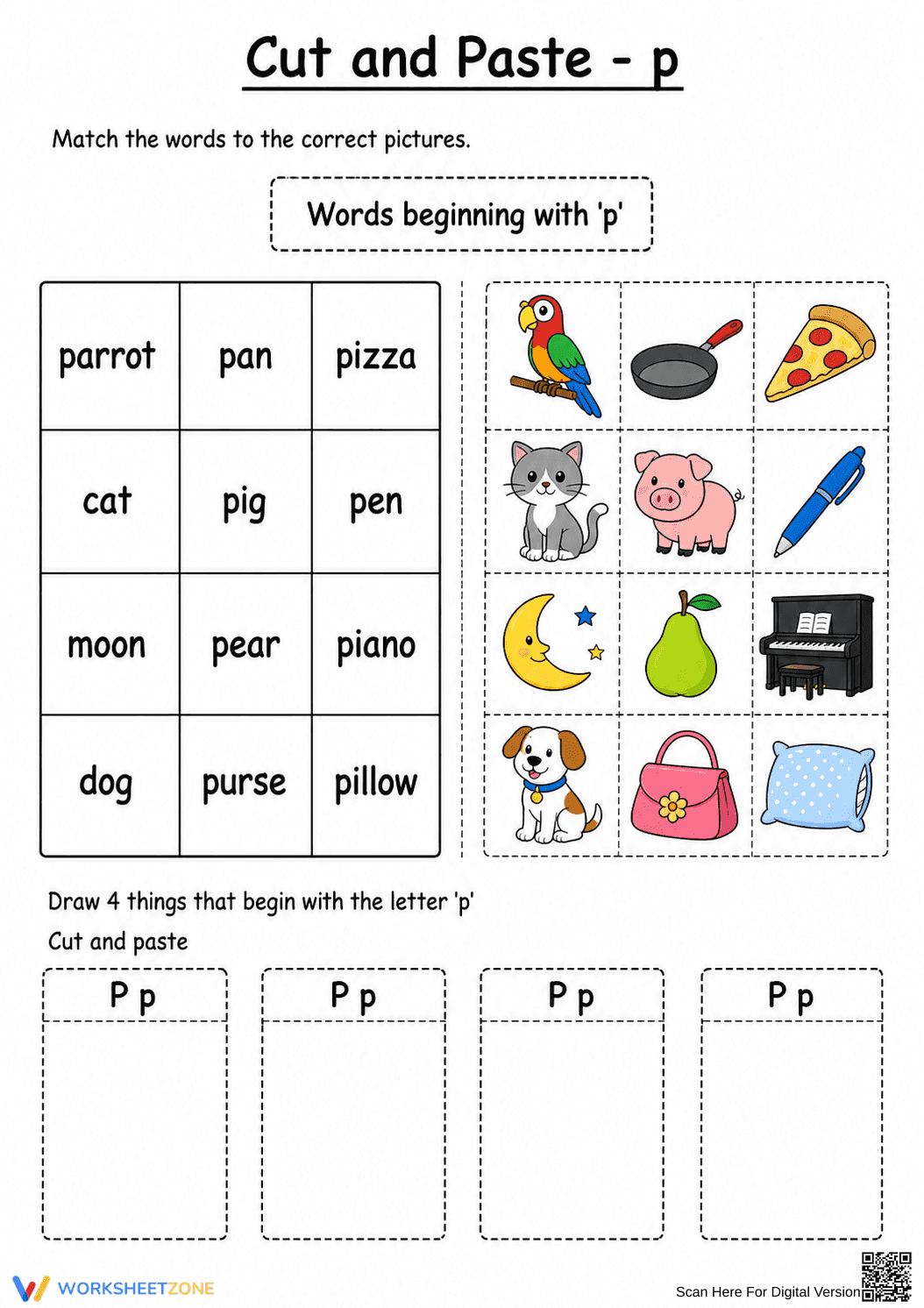
This Grade K-2 phonics worksheet helps early learners master the letter 'p' beginning sound through tactile engagement. Students identify words starting with 'p', match them to corresponding images, and illustrate their own examples. This multi-sensory approach ensures students build a strong foundation in phonemic awareness and letter-sound correspondence.
At a Glance
- Grade: K-2 · Subject: ELA Phonics
- Standard:
CCSS.ELA-LITERACY.RF.K.3.A— Demonstrate basic knowledge of one-to-one letter-sound correspondences for consonants- Skill Focus: Beginning Sound 'p' Identification
- Format: 1 page · 16 tasks · Answer key included · PDF
- Best For: Independent phonics practice and literacy centers
- Time: 15–20 minutes
The worksheet features a 12-cell grid for word-to-picture matching, focusing on the initial 'p' sound. It includes a dedicated cut-and-paste section with high-quality illustrations like a parrot, pig, and piano. Additionally, four creative drawing boxes allow students to demonstrate mastery by generating their own 'p' word examples, providing a comprehensive look at their phonological development.
Skill Progression
- Guided Practice: Students begin by identifying the letter 'p' in a word bank, providing a visual anchor for the target sound before moving to the matching phase.
- Supported Practice: The cut-and-paste activity uses 12 visual cues to help students discriminate between 'p' sounds and distractors like 'cat' or 'dog' included in the grid.
- Independent Practice: Four open-ended drawing tasks require students to recall and represent 'p' words without external prompts, solidifying the connection between the phoneme and grapheme.
This sequence follows a gradual-release model to move students from simple recognition to independent production of the target sound.
Standards Alignment
This resource aligns with `CCSS.ELA-LITERACY.RF.K.3.A`, which requires students to demonstrate basic knowledge of one-to-one letter-sound correspondences. It also supports RF.1.2.C by helping students isolate and produce initial sounds in spoken single-syllable words. Both standard codes can be copied directly into lesson plans, IEP goals, or district curriculum mapping tools.
How to Use It
Use this worksheet during a small-group literacy rotation after introducing the letter 'p' sound. It serves as an excellent formative assessment; observe if students correctly ignore the distractor images (like the moon or dog) to gauge their phonemic discrimination. Expected completion time is 15 to 20 minutes, making it a perfect fit for standard center rotations.
Who It's For
This activity is designed for Kindergarteners and first graders developing early reading skills. It is also suitable for English Language Learners (ELL) who benefit from the visual-to-word pairing. Pair this with a letter 'p' anchor chart or a shared reading of a "P" themed picture book to provide a cohesive instructional experience.
According to research by Fisher & Frey (2014), the use of visual scaffolds combined with tactile activities like cutting and pasting significantly improves retention of phonemic concepts in early childhood education. This worksheet targets CCSS.ELA-LITERACY.RF.K.3.A by requiring students to isolate the initial 'p' sound and connect it to both text and imagery. By integrating 16 distinct tasks that range from recognition to creative generation, the resource ensures that students move beyond rote memorization toward functional phonics mastery. Such structured practice is essential for building the decoding skills necessary for fluent reading. The inclusion of distractors further challenges students to apply critical thinking to their phonemic awareness, a key indicator of readiness for more complex blending tasks in later primary grades. This printable PDF provides a reliable, evidence-based tool for any early elementary classroom.


