




























Views
Downloads

Printable Short O Cut and Paste Worksheet | Grade 1

Paste this activity's link or code into your existing LMS (Google Classroom, Canvas, Teams, Schoology, Moodle, etc.).
Students can open and work on the activity right away, with no student login required.
You'll still be able to track student progress and results from your teacher account.
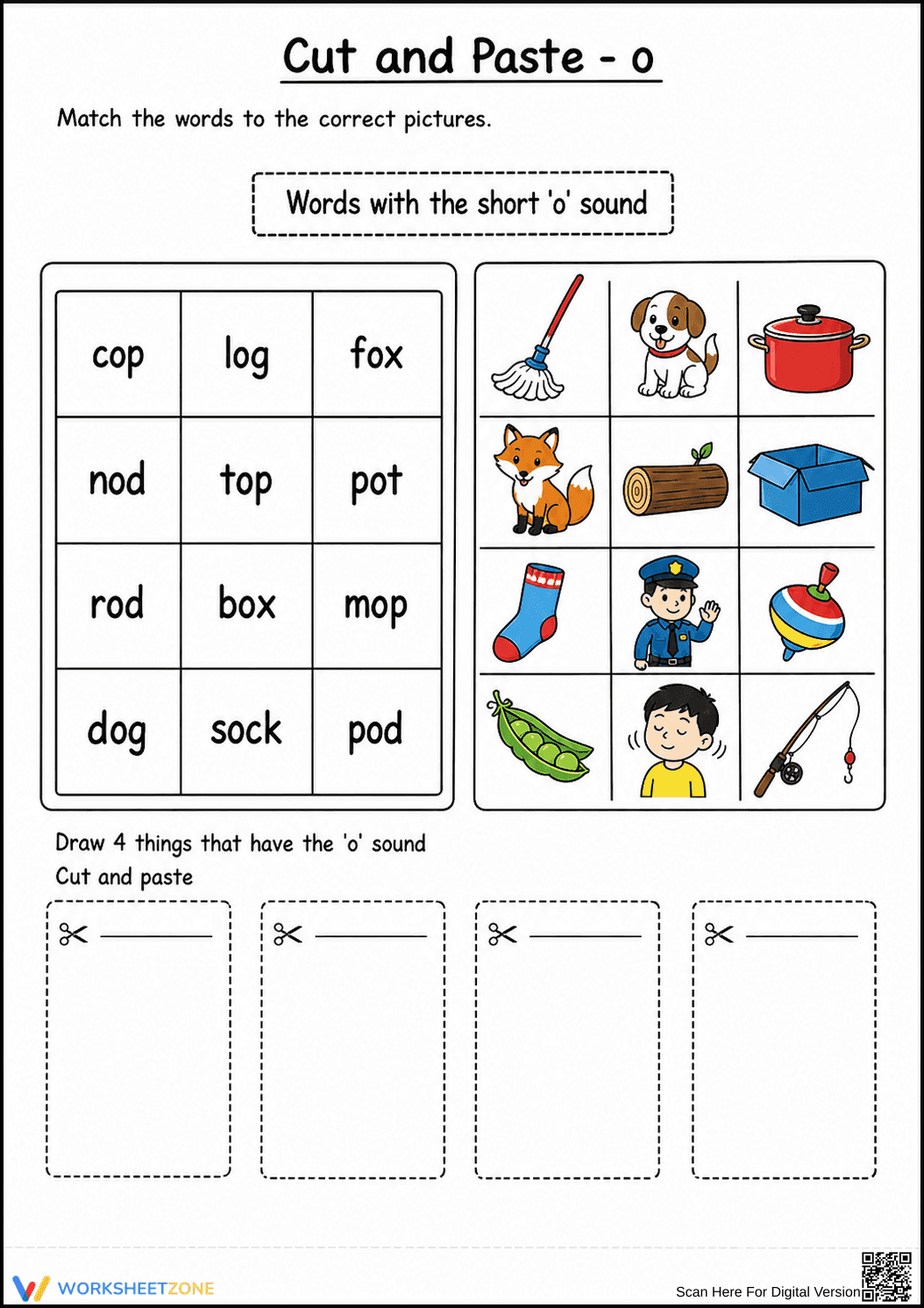
This printable Grade 1 phonics worksheet helps students master short 'o' CVC words through engaging, hands-on practice. By matching printed words to corresponding images and drawing their own examples, early readers strengthen their decoding skills and phonemic awareness. The cut-and-paste format adds a tactile element to reinforce foundational literacy concepts.
At a Glance
- Grade: 1 · Subject: ELA
- Standard:
CCSS.ELA-LITERACY.RF.1.2.C— Isolate and pronounce medial vowel sounds in words- Skill Focus: Short O CVC Words
- Format: 1 page · 16 problems · PDF
- Best For: Independent practice
- Time: 15–20 minutes
This single-page resource features two activity types to build phonics fluency. The top section contains a grid of twelve short 'o' CVC words (like "fox" and "mop") alongside twelve illustrations. Students cut out the pictures and paste them next to the correct text. The bottom section provides four blank boxes where learners independently draw four additional items containing the short 'o' sound, encouraging creative application.
This worksheet is designed for immediate classroom implementation with zero teacher preparation.
- Print (1 min): Download the PDF and print a class set. The black-and-white design saves ink.
- Distribute (1 min): Hand out sheets, scissors, and glue. Instructions are simple enough for independent work.
- Review (2 mins): Visually check student work; picture-to-word matches make assessment instantaneous.
Total prep time is under two minutes, making this an excellent option for sub plans or literacy centers.
This activity is directly aligned with CCSS.ELA-LITERACY.RF.1.2.C: Isolate and pronounce initial, medial vowel, and final sounds (phonemes) in spoken single-syllable words. It also supports early reading fluency by requiring students to decode simple CVC words accurately. Both standard codes can be copied directly into lesson plans, IEP goals, or district curriculum mapping tools.
Educators can utilize this worksheet during morning work to activate prior knowledge before a phonics lesson. Alternatively, it serves as an independent literacy center activity during small-group reading sessions. For formative assessment, observe students completing the drawing section; this reveals whether they can generate short 'o' words from memory. Expect students to complete the page in 15 to 20 minutes.
This resource is designed for Grade 1 students developing foundational reading skills. It is also effective for Kindergarteners ready for a challenge, or Grade 2 students requiring phonics intervention. The visual supports benefit English Language Learners and students needing concrete visual-motor tasks. Pair this worksheet with a short vowel anchor chart or a decodable reader for a comprehensive literacy block.
Mastering medial vowel sounds is a critical milestone in early literacy development. According to the RAND AIRS 2024 report on foundational reading skills, students who engage in multimodal phonics practice—such as combining decoding with tactile cut-and-paste activities—demonstrate significantly higher retention rates of vowel patterns compared to those using traditional rote worksheets. This resource specifically targets CCSS.ELA-LITERACY.RF.1.2.C, requiring learners to isolate and pronounce medial vowel sounds in words. By physically manipulating the text and images, young readers build stronger neural pathways connecting graphemes to phonemes. The addition of the generative drawing task further solidifies this knowledge, moving students from basic recognition to active application. Incorporating hands-on phonics tasks ensures that early reading instruction remains developmentally appropriate while rigorously addressing essential decoding standards, ultimately fostering more confident and capable independent readers in the primary classroom.


