


























Views
Downloads

Printable Cursive Handwriting Worksheet | Grade 5
Paste this activity's link or code into your existing LMS (Google Classroom, Canvas, Teams, Schoology, Moodle, etc.).
Students can open and work on the activity right away, with no student login required.
You'll still be able to track student progress and results from your teacher account.
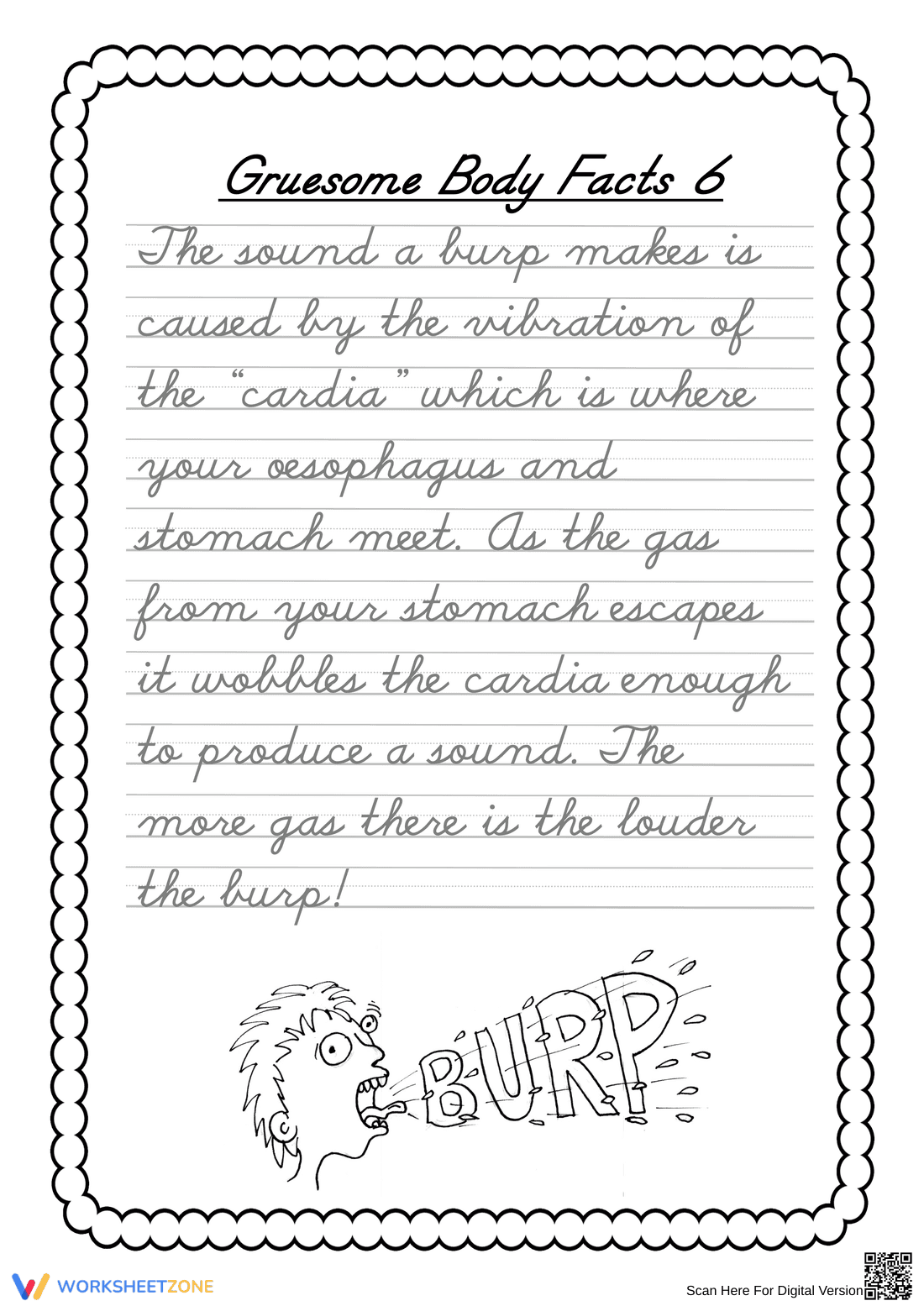
This Grade 5 cursive handwriting worksheet provides students with engaging paragraph-level practice to improve legibility and fine motor control. By tracing and writing a humorous science fact about the human body, learners refine their D'Nealian cursive skills while maintaining focus and interest in the writing process.
At a Glance
- Grade: 5 · Subject: Handwriting
- Standard:
CCSS.ELA-LITERACY.W.5.4— Produce clear and coherent writing- Skill Focus: Cursive paragraph writing
- Format: 1 page · 1 paragraph · No answer key needed · PDF
- Best For: Morning work or independent practice
- Time: 10–15 minutes
Inside this single-page resource, educators will find a high-interest paragraph titled "Gruesome Body Facts 6" formatted on standard handwriting lines. The text explains the science behind a burp, using engaging vocabulary like "esophagus" and "cardia." The worksheet features a traceable cursive model that demonstrates proper letter formation, slant, and spacing. A fun, thematic illustration at the bottom provides a visual reward and keeps the tone lighthearted for fifth graders.
Zero-Prep Workflow
- Print (1 minute): Simply download the PDF and print a class set. The black-and-white design is ink-friendly and requires no special formatting.
- Distribute (1 minute): Hand out the worksheets during morning arrival, literacy centers, or as a quick transition activity. No additional materials are needed beyond a sharpened pencil.
- Review (1 minute): Quickly scan student work for proper letter connections, consistent slant, and adherence to the baseline.
Total teacher prep time is under two minutes, making it an excellent, self-explanatory addition to any substitute plan.
Standards Alignment
This activity aligns with CCSS.ELA-LITERACY.W.5.4: Produce clear and coherent writing in which the development and organization are appropriate to task, purpose, and audience. While primarily a handwriting exercise, it reinforces the physical mechanics necessary for fluent written expression. Both standard codes can be copied directly into lesson plans, IEP goals, or district curriculum mapping tools.
How to Use It
Perfect for morning work, this worksheet provides a calm start to the day before direct instruction. It also serves as an early finisher activity during language arts. As a formative assessment observation tip, watch students as they write to ensure they form letters from the top down with a relaxed grip. Expected completion time ranges from 10 to 15 minutes.
Who It's For
Designed for fifth-grade students needing cursive reinforcement, this resource benefits learners who find traditional drills tedious. The humorous content increases motivation. For differentiation, provide a highlighted baseline for students needing spatial guidance. It pairs naturally with a direct instruction lesson on cursive connections or a human body science unit.
Developing fluent handwriting is a critical component of overall literacy and written expression in the upper elementary grades. This resource targets CCSS.ELA-LITERACY.W.5.4, helping students produce clear and coherent writing through targeted fine motor practice. According to Fisher & Frey (2014), automaticity in handwriting allows students to free up cognitive resources for higher-order tasks such as planning, drafting, and revising their compositions. When students no longer have to consciously think about how to form cursive letters, their writing volume and quality significantly improve. By integrating high-interest, humorous content into this daily practice, educators can maintain student engagement while building this essential automaticity. Consistent, brief practice sessions, such as tracing and copying a single paragraph, are highly effective for developing muscle memory and ensuring long-term retention of proper letter formation and spacing.


