


























Views
Downloads

Cursive G Practice Worksheet | Essential Grade 2 Ready
Paste this activity's link or code into your existing LMS (Google Classroom, Canvas, Teams, Schoology, Moodle, etc.).
Students can open and work on the activity right away, with no student login required.
You'll still be able to track student progress and results from your teacher account.
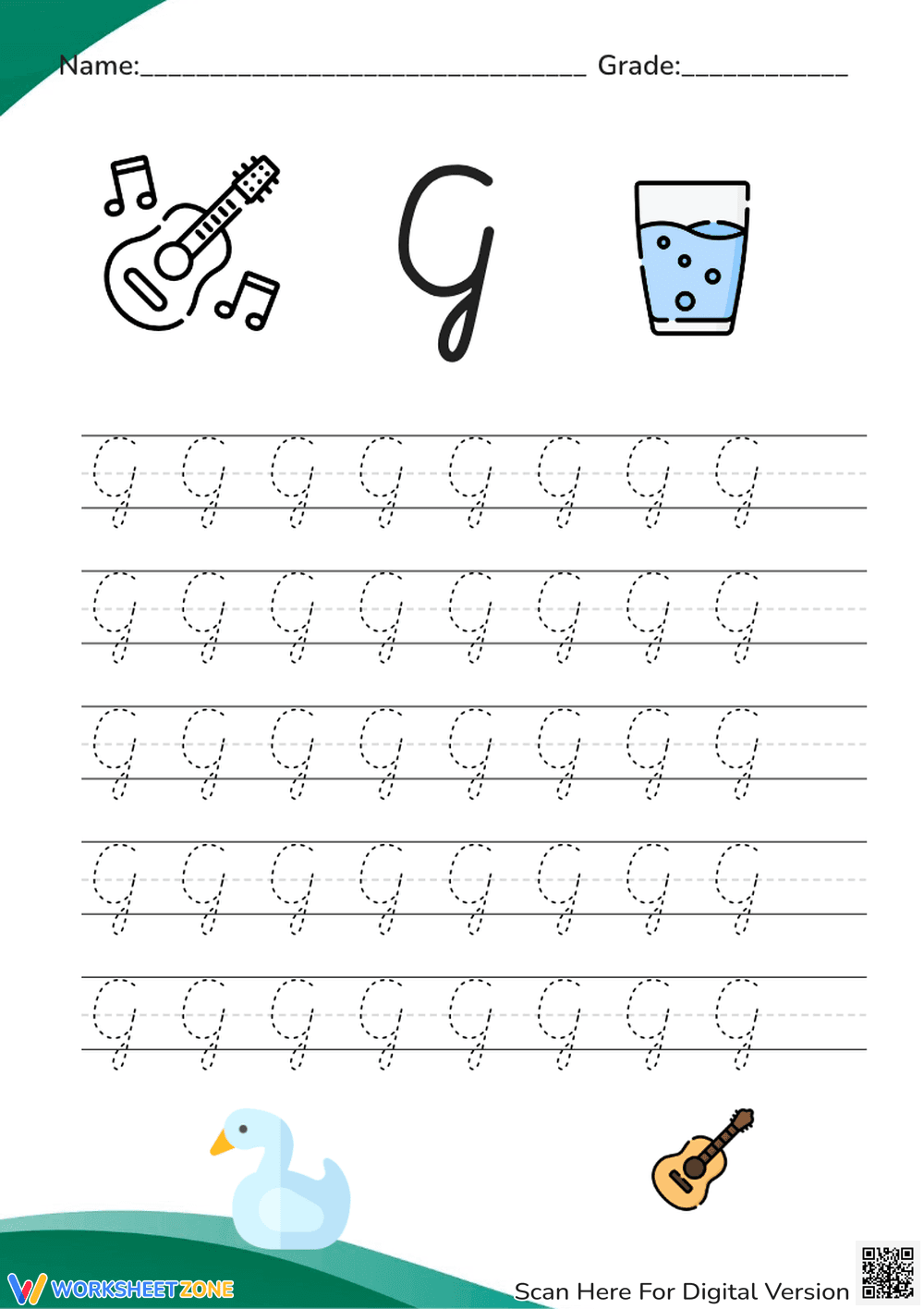
This Grade 2 cursive handwriting worksheet provides students with focused practice on forming the uppercase letter G. By tracing the letter across multiple rows, learners develop the muscle memory and fine motor control necessary for fluid penmanship. The engaging guitar and glass theme keeps young writers interested while they master this specific cursive stroke.
At a Glance
- Grade: Grade 2 · Subject: Handwriting
- Standard:
CCSS.ELA-LITERACY.L.2.1— Demonstrate command of the conventions of standard English grammar and usage when writing- Skill Focus: Cursive Uppercase G Formation
- Format: 1 page · 40 problems · Answer key not required · PDF
- Best For: Morning work or handwriting centers
- Time: 10–15 minutes
Inside this single-page PDF, you will find five rows of dotted-line tracing guides specifically for the uppercase cursive letter G. The layout includes 40 individual tracing opportunities, ensuring repetitive practice without overwhelming the student. Visual cues like a guitar, glass, and goose provide phonetic anchors for the letter sound while decorating the workspace.
The zero-prep workflow is designed for maximum efficiency. First, print the single-page PDF in about 30 seconds. Second, distribute the sheets to students during morning work or a dedicated handwriting block. Third, review student letter formation by walking the room to check for proper starting points and stroke direction. Total teacher prep time is under 2 minutes, making it an ideal sub plan addition.
This resource aligns with `CCSS.ELA-LITERACY.L.2.1`, which requires students to demonstrate command of the conventions of standard English when writing. While cursive is often a state-level requirement, this worksheet supports the broader goal of legible and conventional writing production. This standard code can be copied directly into lesson plans, IEP goals, or district curriculum mapping tools.
Use this worksheet as a formative assessment tool during your handwriting unit. It is best assigned after a brief direct instruction session where you model the swing up and loop of the uppercase G on the board. Observe students to ensure they are not drawing the letters but are using continuous fluid motions. Completion typically takes 10 to 15 minutes.
This practice sheet is ideal for second-grade students beginning their cursive journey or first graders ready for an advanced challenge. It serves as a perfect companion to an alphabet anchor chart or a cursive instructional video. The simple layout also makes it an excellent choice for occupational therapy sessions or home-school handwriting practice for improving fine motor skills.
Handwriting instruction remains a critical component of early literacy, as evidenced by research from Fisher & Frey (2014) regarding the link between motor skills and cognitive development. This worksheet targets CCSS.ELA-LITERACY.L.2.1 by providing 40 structured tracing tasks for the uppercase cursive letter G. According to the RAND AIRS 2024 report, repetitive motor practice in handwriting facilitates better letter recognition and spelling accuracy in primary grades. By focusing on a single letter, students can achieve mastery before moving to complex word connections. This resource is designed to be a print-and-go solution that fits into any 15-minute instructional block. The inclusion of thematic visual aids like a guitar and glass helps reinforce the phonemic connection to the letter G, supporting multi-sensory learning pathways. This citation-ready summary confirms the worksheet's utility in a research-backed, standards-aligned elementary classroom environment.


