


























Views
Downloads



UAE Currency Counting Worksheet | Grade 2 Essential
Paste this activity's link or code into your existing LMS (Google Classroom, Canvas, Teams, Schoology, Moodle, etc.).
Students can open and work on the activity right away, with no student login required.
You'll still be able to track student progress and results from your teacher account.
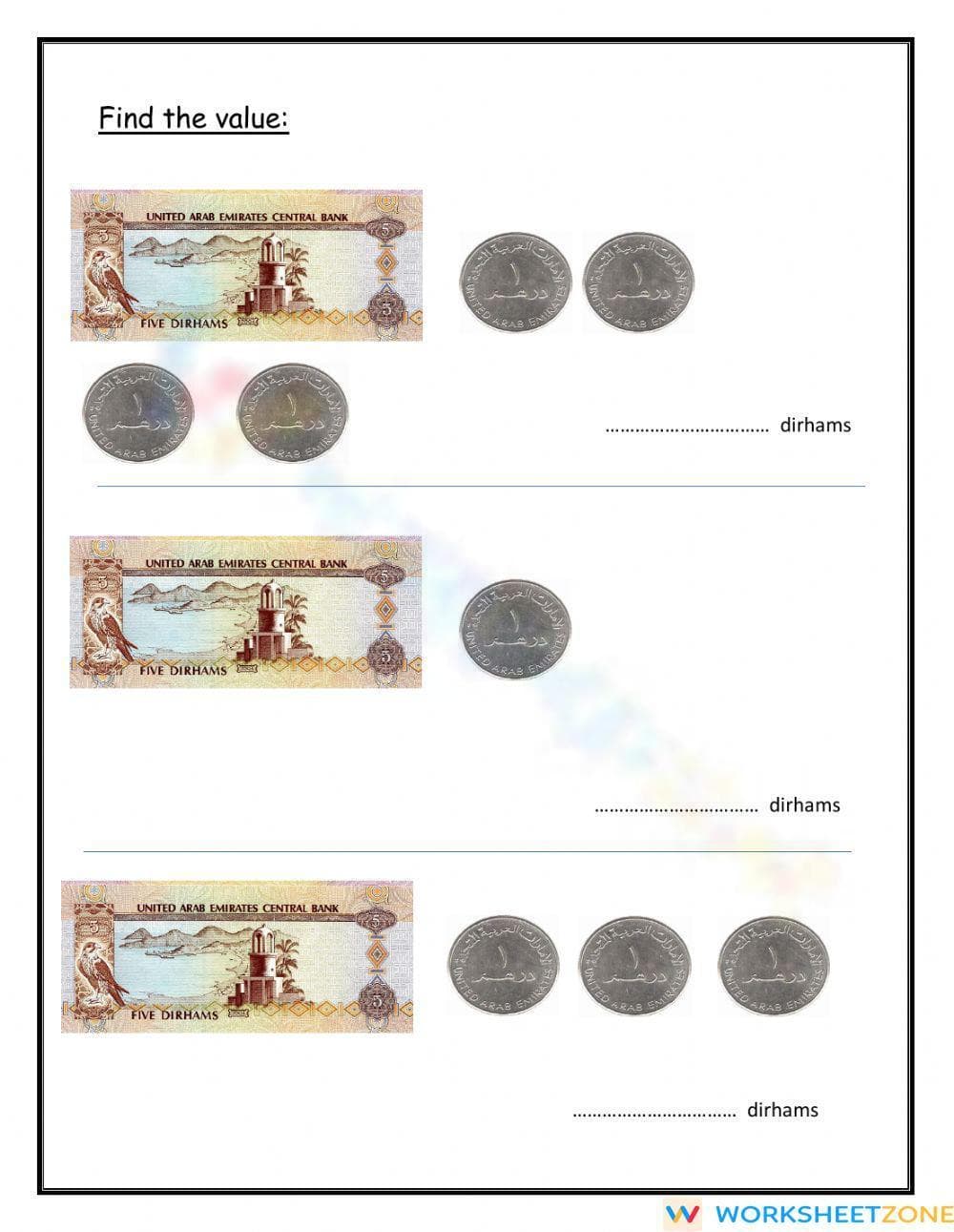
This Grade 2 math worksheet provides targeted practice in counting international currency, specifically UAE Dirhams. Students will identify the value of notes and coins to calculate totals and match them to specific prices, fostering real-world financial literacy and addition skills. This resource ensures students can accurately determine the value of a collection of currency in a practical context.
At a Glance
- Grade: 2 · Subject: Math
- Standard:
CCSS.MATH.CONTENT.2.MD.C.8— Solve problems involving the total value of a collection of currency- Skill Focus: Counting UAE Dirhams
- Format: 3 pages · 8 problems · PDF
- Best For: Independent practice or international math units
- Time: 15–20 minutes
What's Inside
This three-page resource contains eight distinct math problems designed for clarity and engagement. Students identify the value of 5-dirham notes and 1-dirham coins across six calculation tasks on the first two pages. The final page features two matching exercises where students connect toy prices to the correct currency combinations. The layout uses high-quality images of actual UAE currency to ensure visual clarity during independent work.
Zero-Prep Workflow
- Step 1: Print the three-page PDF (30 seconds).
- Step 2: Distribute to students for independent counting practice (1 minute).
- Step 3: Review the eight problems as a whole class or in small groups (10 minutes).
Total teacher prep time is under 2 minutes, making this an ideal resource for sub plans, morning work, or a quick formative assessment during a money unit.
Standards Alignment
Primary standard: CCSS.MATH.CONTENT.2.MD.C.8. This standard focuses on solving problems involving the total value of a collection of money. While this worksheet uses international currency (UAE Dirhams), the underlying mathematical operation of adding multi-unit values remains identical to US currency standards. This standard code can be copied directly into lesson plans, IEP goals, or district curriculum mapping tools.
How to Use It
Use this worksheet during a unit on international trade or as a practical application of skip-counting by fives and ones. It works well as a formative assessment after students have mastered basic addition. Educators should observe if students are counting the larger denominations first before adding the single coins. Expected completion time is 15–20 minutes.
Who It's For
This resource is designed for Grade 2 students but is appropriate for Grade 3 remediation or Grade 1 enrichment. It pairs naturally with a lesson on global currencies or a classroom market activity where students practice buying items with printed play money. It is particularly useful for students who require visual aids to master multi-step addition.
The CCSS.MATH.CONTENT.2.MD.C.8 standard requires students to solve problems involving currency values, a foundational skill for financial literacy. This worksheet focuses on the plain-English skill of identifying and adding the values of notes and coins to find a total sum. By using real-world imagery of UAE Dirhams, students engage in authentic task-based learning that bridges abstract addition with concrete application. According to Fisher & Frey (2014), the use of visual scaffolds and real-world representations in mathematics significantly improves the retention of multi-step procedural skills like currency calculation. This resource provides eight distinct opportunities for students to practice these calculations, moving from simple coin identification to matching complex totals with specific price points. Educators can utilize this tool to assess formative progress in skip-counting and base-ten addition within a practical context.


