




























Views
Downloads
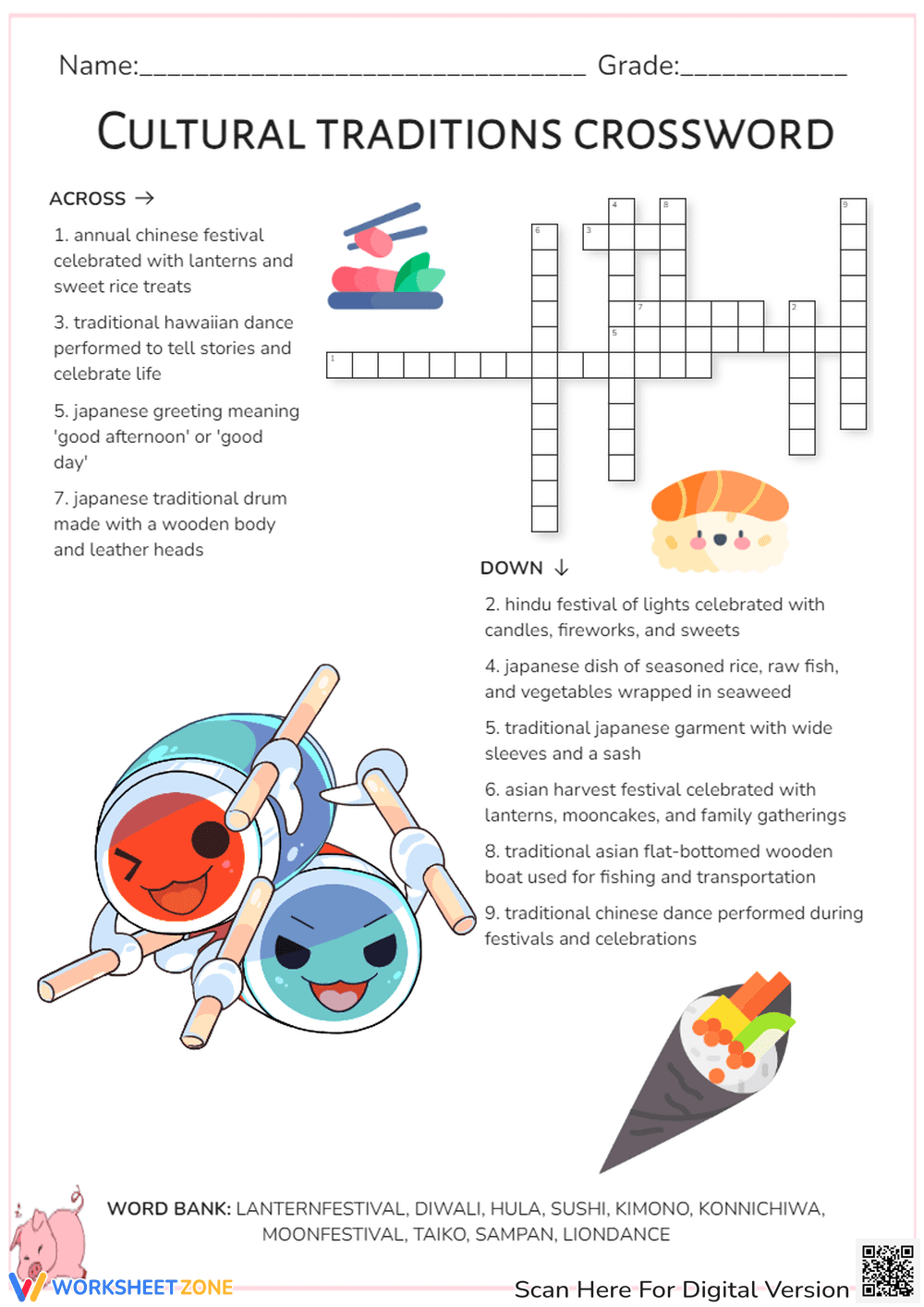

Cultural Traditions Crossword | Grade 6-8 Essential

Paste this activity's link or code into your existing LMS (Google Classroom, Canvas, Teams, Schoology, Moodle, etc.).
Students can open and work on the activity right away, with no student login required.
You'll still be able to track student progress and results from your teacher account.
This middle school crossword puzzle strengthens cultural literacy by challenging students to identify key traditions, festivals, and artifacts from Asian and Pacific Islander communities. By connecting descriptive clues to specific vocabulary terms, learners build a deeper understanding of global diversity while practicing critical reading and word-recognition skills in an engaging format.
At a Glance
- Grade: 6-8 · Subject: Social Studies
- Standard:
CCSS.ELA-LITERACY.RI.6.4— Determine the meaning of domain-specific words and phrases in a text- Skill Focus: Cultural Vocabulary & Context Clues
- Format: 1 page · 10 problems · Answer key included · PDF
- Best For: Asian Pacific American Heritage Month
- Time: 15–20 minutes
This single-page PDF features a professionally designed crossword grid accompanied by 10 specific clues. To support diverse learners, a clear word bank is provided at the bottom of the page, including terms like Lantern Festival, Diwali, and Taiko. The layout includes vibrant, culturally relevant illustrations that provide visual cues for the vocabulary words, making the content accessible.
Zero-Prep Workflow
- Print: Generate the required number of copies for your class in under 30 seconds.
- Distribute: Hand out the worksheets as a warm-up or bell-ringer activity to activate prior knowledge.
- Review: Go over the answers as a whole group to facilitate a brief discussion on the significance of each tradition.
Total teacher prep time is under 2 minutes, making this an excellent, self-contained sub plan.
Standards Alignment
The primary focus is `CCSS.ELA-LITERACY.RI.6.4`, which requires students to determine the meaning of domain-specific words and phrases. By interpreting clues about traditional garments or annual festivals, students apply context-clue strategies to identify technical vocabulary. This standard code can be copied directly into lesson plans, IEP goals, or district curriculum mapping tools to document alignment with literacy frameworks.
How to Use It
Use this worksheet as a formative assessment during Asian Pacific American Heritage Month to gauge students' familiarity with diverse cultural practices. It works best during the engage phase of a lesson or as a quiet independent activity. Teachers should observe if students are using the word bank strategically or relying on the visual illustrations to solve the clues.
Who It's For
This activity is tailored for students in grades 6 through 8, providing age-appropriate vocabulary challenges. It is particularly effective for English Language Learners who benefit from the word bank and visual supports. Pair this crossword with a short informational passage about the Pacific Islands to provide a comprehensive learning experience.
According to the RAND AIRS 2024 report on instructional materials, the integration of domain-specific vocabulary within culturally responsive contexts significantly improves long-term retention and student engagement. This worksheet addresses CCSS.ELA-LITERACY.RI.6.4 by requiring students to synthesize descriptive clues into precise cultural terminology, such as identifying the Sampan or Diwali. Research by Fisher & Frey (2014) emphasizes that word-solving tasks, like crosswords with word banks, provide the necessary scaffolding for middle schoolers to master complex social studies concepts without cognitive overload. By focusing on the rich diversity of Asian and Pacific Islander communities, this resource helps educators meet diversity and inclusion goals while maintaining rigorous academic standards. The 10-task structure ensures that students remain focused on high-leverage vocabulary that appears frequently in informational texts and global history curricula, making it a valuable tool for building comprehensive cultural literacy in modern classrooms.


