


























Views
Downloads

Grade 1-4 Compound Words — Essential No-Prep Worksheet
Paste this activity's link or code into your existing LMS (Google Classroom, Canvas, Teams, Schoology, Moodle, etc.).
Students can open and work on the activity right away, with no student login required.
You'll still be able to track student progress and results from your teacher account.
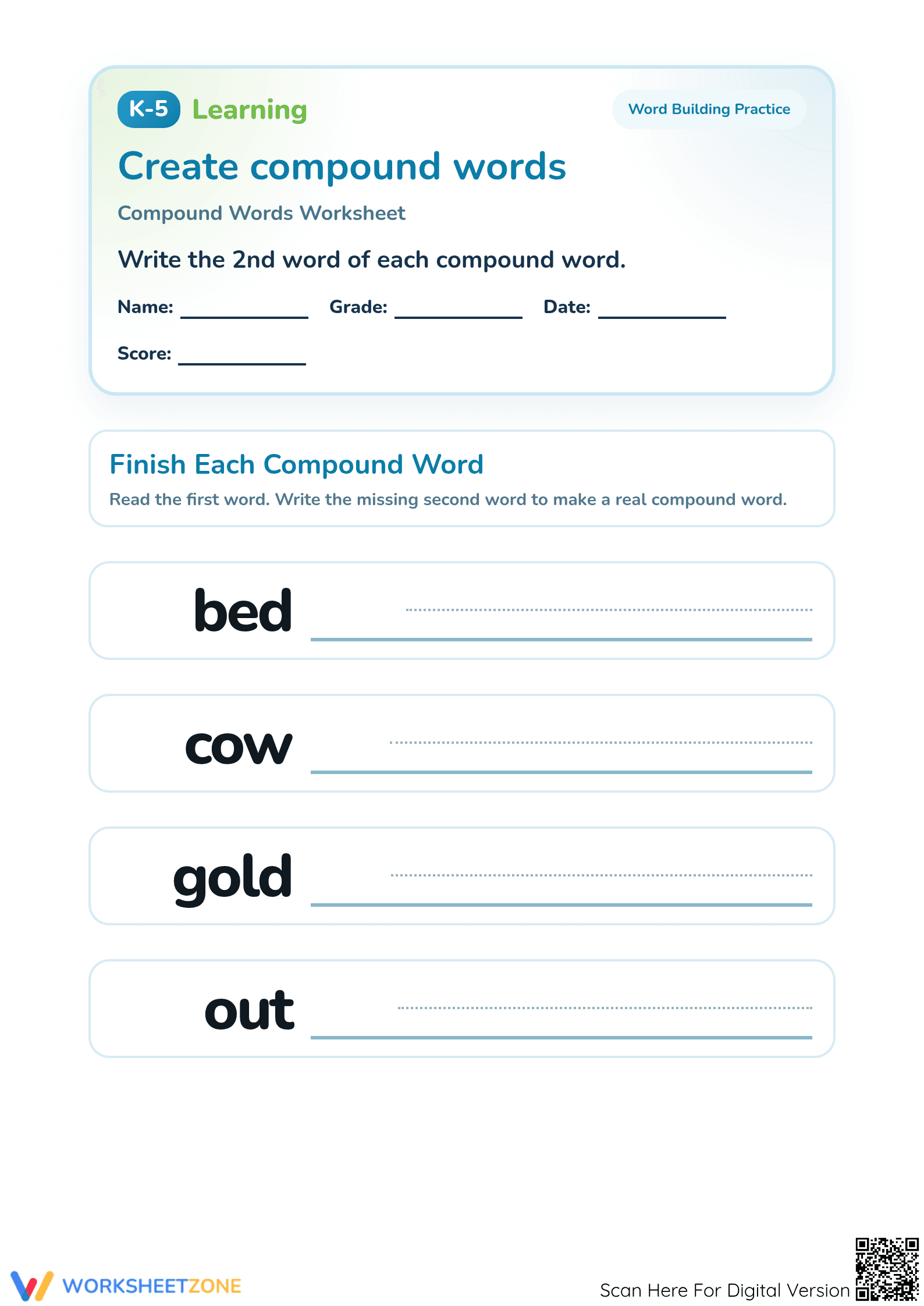
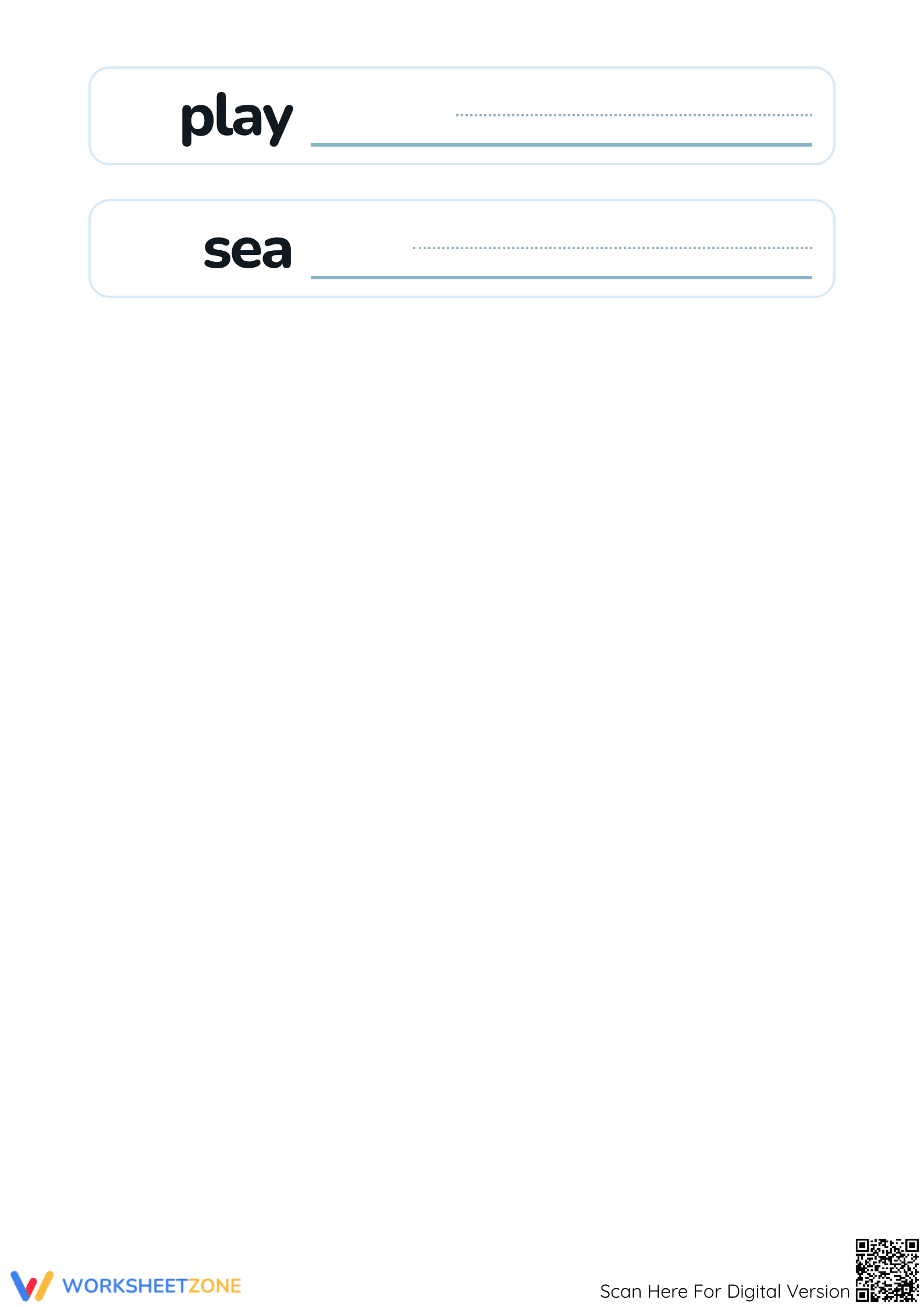
This Grade 1-4 compound words worksheet enables students to master word building by completing six interactive problems. Students learn how two distinct words join to create an entirely new meaning, enhancing their vocabulary and decoding skills. This resource provides immediate, focused practice that ensures learners can confidently identify and form common compound words independently.
At a Glance
- Grade: 1–4 · Subject: ELA
- Standard:
CCSS.ELA-LITERACY.L.2.4.D— Use knowledge of word meanings to predict the meaning of compound words- Skill Focus: Creating and completing compound words
- Format: 2 pages · 6 problems · Answer key included · PDF
- Best For: Literacy centers and independent word study practice
- Time: 10–15 minutes
This two-page PDF resource features six high-visibility tasks where students are prompted with the first half of a common compound word, such as "bed" or "cow." Learners must supply the missing second word to complete the lexical unit. The layout is clean and spacious, making it ideal for young writers. A comprehensive answer key is included for rapid teacher review or student self-correction.
Designed for the busy educator, this resource follows a three-step zero-prep workflow. First, print the two pages. Second, distribute to students for independent work. Finally, review using the provided answer key. Total preparation time is under two minutes, making this an excellent choice for sub plans or morning bell-ringers.
This resource is primarily aligned with CCSS.ELA-LITERACY.L.2.4.D, which requires students to use knowledge of the meaning of individual words to predict the meaning of compound words. It also supports Grade 1 and Grade 3 standards related to word building and morphological awareness. Both standard codes can be copied directly into lesson plans, IEP goals, or district curriculum mapping tools.
Use this worksheet during the independent practice phase of a lesson to assess individual mastery of word building. It is also highly effective as a formative assessment tool; teachers should observe if students can generate the second word without needing a word bank, which indicates strong mental orthographic representation. The expected completion time for most students is 10 to 15 minutes.
This worksheet is designed for students in Grades 1 through 4, with specific utility for English Language Learners (ELL) who are developing their foundational English vocabulary. It pairs naturally with a compound word anchor chart or a short informational text where these words frequently appear. Differentiation can be achieved by providing oral prompts for students who need additional writing support.
Compound word acquisition is a critical component of lexical development in early elementary literacy. According to the RAND AIRS 2024 report on vocabulary instruction, providing students with structured opportunities to decompose and reconstruct morphologically complex words—such as compound words—directly supports decoding fluency and semantic mapping. This worksheet targets the specific skill of identifying second-word roots within a compound structure, aligned with CCSS.ELA-LITERACY.L.2.4.D. By focusing on high-frequency root words like "bed," "cow," and "gold," learners build the cognitive bridges necessary for independent reading comprehension. Research suggests that explicit practice with word-building reinforces the research-backed instructional model, ensuring that students can transition from guided recognition to independent application. This resource provides the necessary scaffolding for Grade 1 through Grade 4 students to master word-level interactions, serving as a foundational tool for broader linguistic competence and literacy achievement in the classroom setting.


