


























Views
Downloads
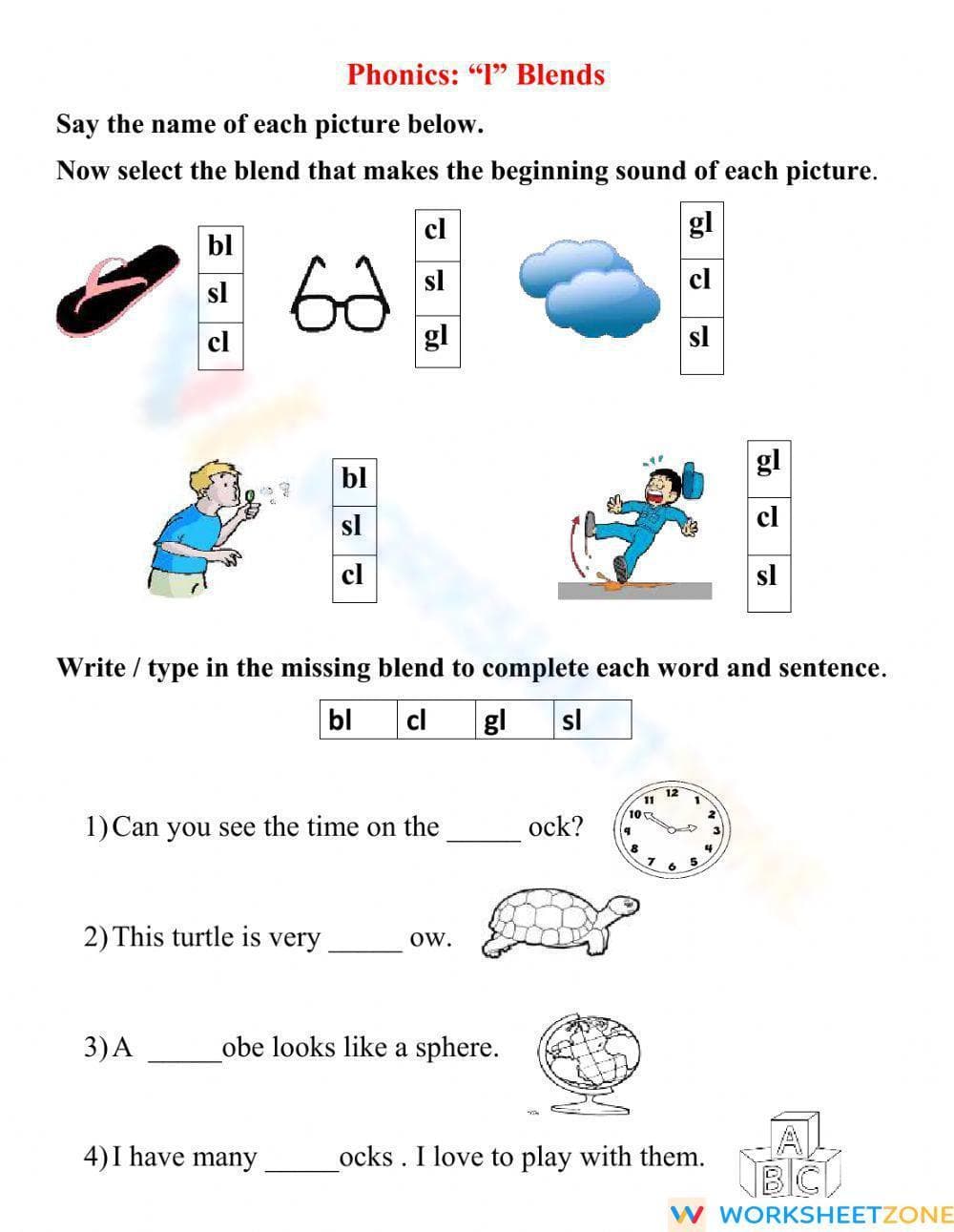

Grade 1 & 2 L-Blends — Essential Phonics Worksheet
Paste this activity's link or code into your existing LMS (Google Classroom, Canvas, Teams, Schoology, Moodle, etc.).
Students can open and work on the activity right away, with no student login required.
You'll still be able to track student progress and results from your teacher account.
This Grade 1 and 2 phonics worksheet provides focused practice on beginning "l" consonant blends, helping students decode words with bl, cl, gl, and sl. Students will strengthen their phonological awareness by identifying blends in pictures and completing sentences for improved reading fluency and spelling mastery.
At a Glance
- Grade: 1–2 · Subject: ELA – Phonics
- Standard:
CCSS.ELA-LITERACY.RF.1.2.B— Orally produce single-syllable words by blending sounds, including consonant blends- Skill Focus: Beginning "l" blends (bl, cl, gl, sl)
- Format: 1 page · 9 problems · Answer key included · PDF
- Best For: Early phonics practice and literacy centers
- Time: 10–15 minutes
What's Inside
This one-page PDF features two distinct sections designed to build phonemic confidence. The first section contains five multiple-choice items where students match images, such as slippers and clouds, to their corresponding blends. The second section provides four fill-in-the-blank sentences, requiring them to apply their knowledge of blends to complete words within a context-rich environment.
Zero-Prep Workflow
This resource is designed for immediate classroom deployment with zero teacher preparation. First, print a class set in less than a minute. Second, distribute to students who can work independently thanks to visual cues and clear instructions. Finally, review work using the structured layout which allows for a quick check. The total teacher prep time is under 2 minutes, making this an ideal solution for sub plans.
Standards Alignment
Aligned to `CCSS.ELA-LITERACY.RF.1.2.B`, this worksheet focuses on the oral production of single-syllable words by blending sounds. It also supports `CCSS.ELA-LITERACY.RF.2.3` by reinforcing grade-level phonics and word analysis skills in decoding. Both standard codes can be copied directly into lesson plans or IEP goals to ensure instructional compliance and tracking.
How to Use It
Deploy this worksheet during independent practice after a phonics lesson on consonant blends. It also serves as a high-quality formative assessment tool; teachers should observe if students are segmenting sounds correctly. Expect students to complete the tasks in approximately 12 minutes, making it a perfect fit for a literacy rotation or morning work routine.
Who It's For
Designed for students in Kindergarten through Grade 2, this worksheet is beneficial for early readers needing support with phoneme-grapheme correspondence. It pairs effectively with an anchor chart or a short decodable passage featuring these beginning sounds. The clear illustrations provide necessary scaffolding for English Language Learners and students with diverse learning needs.
The acquisition of consonant blends, specifically beginning "l" blends like bl, cl, gl, and sl, is a critical milestone in early literacy development. According to research from Fisher & Frey (2014) on the gradual release of responsibility, scaffolded phonics tasks that transition from visual identification to contextual application significantly improve a student's ability to decode complex onset-rime structures. This Grade 1 and 2 worksheet aligns with CCSS.ELA-LITERACY.RF.1.2.B, focusing on the synthesis of phonemes into single-syllable units. By engaging with nine structured problems, students reinforce the phoneme-grapheme mapping essential for reading fluency and orthographic mapping. This resource provides the necessary repetitive practice identified by NAEP reports as a key factor in closing literacy gaps. Teachers can utilize the included answer key to provide immediate corrective feedback, a practice shown by ScienceDirect analyses to accelerate the mastery of phonological awareness skills in early childhood educational settings.


