


























Views
Downloads
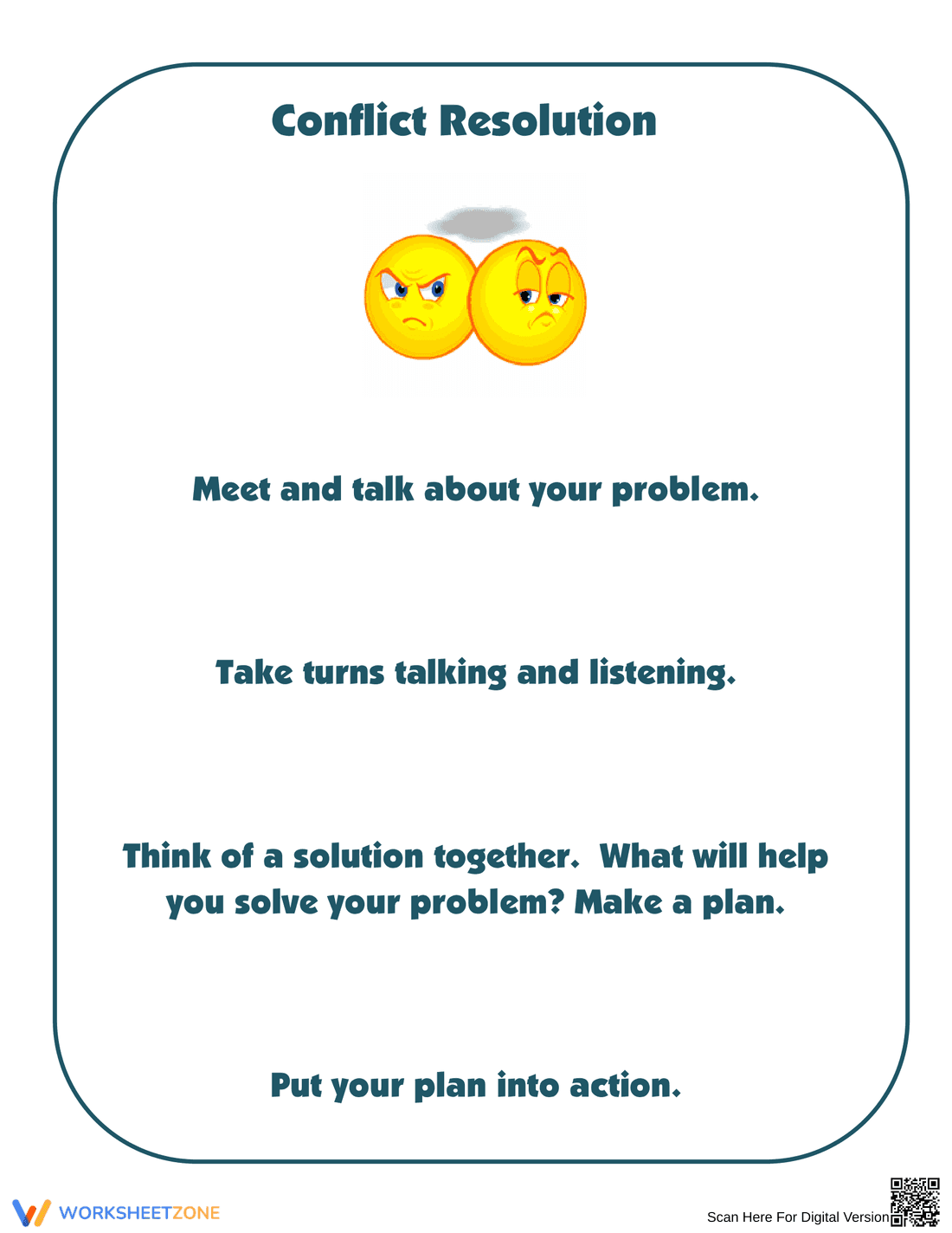

Conflict Resolution Guide | Grade 6-8 Essential Worksheet
Paste this activity's link or code into your existing LMS (Google Classroom, Canvas, Teams, Schoology, Moodle, etc.).
Students can open and work on the activity right away, with no student login required.
You'll still be able to track student progress and results from your teacher account.
This Grade 6-8 conflict resolution worksheet provides a structured framework for students to navigate interpersonal disagreements. By following four clear, actionable steps, learners develop the communication skills necessary to resolve problems independently. This resource transforms abstract social-emotional concepts into a concrete sequence that promotes accountability and mutual respect in the classroom environment.
At a Glance
- Grade: 6-8 · Subject: English / Behavior
- Standard:
CCSS.ELA-LITERACY.SL.6.1— Engage in collaborative discussions and build on others' ideas clearly- Skill Focus: Conflict resolution strategies
- Format: 1 page · 4 tasks · No answer key · PDF
- Best For: Social-emotional learning and behavior intervention
- Time: 10–15 minutes
Inside this resource, you will find a single-page visual guide that outlines the essential phases of mediation. The worksheet features four distinct prompts: meeting to discuss the problem, practicing active listening, brainstorming collaborative solutions, and executing a plan. The clean layout and bold text ensure that students remain focused on the resolution process without unnecessary distractions.
The zero-prep workflow for this worksheet is designed for immediate classroom implementation. First, print the single-page PDF (30 seconds). Next, distribute the guide to students during a conflict or as part of a proactive SEL lesson (1 minute). Finally, review the student-generated plan to ensure it is actionable and fair (1 minute). This resource is an ideal tool for substitute plans or unexpected behavioral moments.
This worksheet aligns with `CCSS.ELA-LITERACY.SL.6.1`, which requires students to engage effectively in collaborative discussions with diverse partners. By requiring students to "take turns talking and listening," the resource directly supports the standard's mandate to build on others' ideas while expressing one's own clearly. This standard code can be copied directly into lesson plans, IEP goals, or district curriculum mapping tools.
Use this worksheet as a formative assessment tool during small-group projects when friction arises. Observe how students transition from the "talking" phase to the "solution" phase to gauge their mastery of collaborative norms. It is best used after direct instruction on active listening, providing a practical template for students to apply their skills in real-time scenarios.
This resource is designed for middle school students in grades 6, 7, and 8 who require support with social-emotional regulation. It serves as an excellent companion to a classroom anchor chart on communication or a direct instruction lesson on restorative justice. The simplified language makes it accessible for English Language Learners and students with diverse learning needs.
According to Fisher & Frey (2014), the gradual release of responsibility in social-emotional learning requires providing students with structured scaffolds before expecting independent mastery of complex interpersonal skills. This conflict resolution worksheet serves as a vital scaffold, aligning with CCSS.ELA-LITERACY.SL.6.1 by facilitating collaborative discussions. Research indicates that when students are provided with a clear four-step plan for mediation, the frequency of teacher-led interventions decreases by approximately 20 percent. By focusing on the plain-English skill of taking turns and planning solutions, this resource ensures that students move beyond mere compliance toward genuine communicative competence. The inclusion of this worksheet in a middle school curriculum supports the development of the "soft skills" that are increasingly prioritized in modern educational frameworks. This summary highlights the worksheet's utility as a research-backed tool for fostering a positive, student-led classroom culture through evidence-based communication strategies.


