


























Views
Downloads

Concrete and Abstract Nouns Worksheet | Essential Grade 3-5
Paste this activity's link or code into your existing LMS (Google Classroom, Canvas, Teams, Schoology, Moodle, etc.).
Students can open and work on the activity right away, with no student login required.
You'll still be able to track student progress and results from your teacher account.
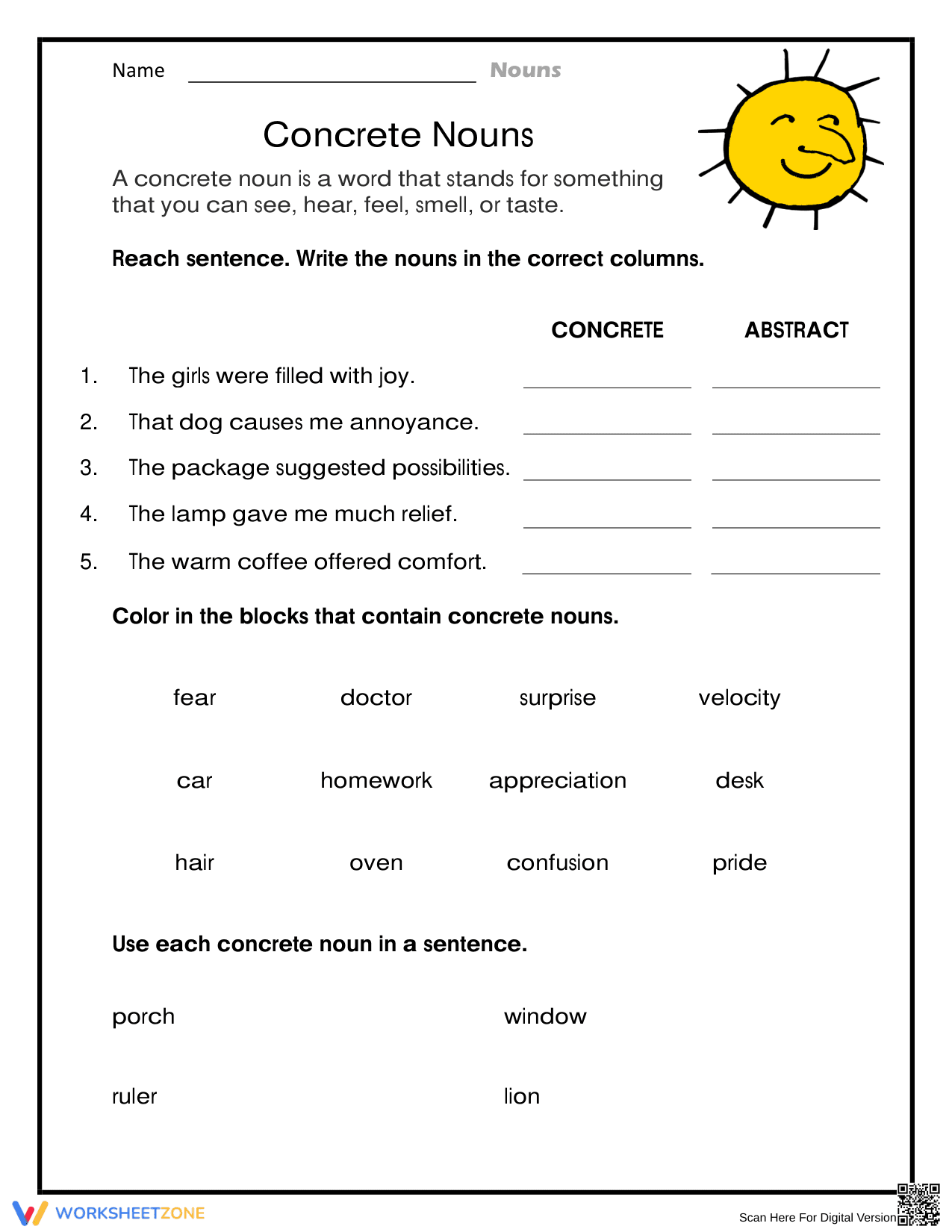
This comprehensive Grade 3–5 English Language Arts worksheet helps students master the distinction between concrete and abstract nouns. Through three distinct activity types—identification, classification, and original sentence construction—learners develop a deep understanding of how physical and conceptual nouns function in grammar.
At a Glance
- Grade: 3–5 · Subject: ELA · Grammar
- Standard:
CCSS.ELA-LITERACY.L.3.1.C— Explain the function of nouns in general and their functions in particular sentences- Skill Focus: Concrete vs. Abstract Nouns
- Format: 1 page · 21 tasks · Answer key included · PDF
- Best For: Grammar centers and independent skills practice
- Time: 20–30 minutes
What's Inside
This single-page PDF features 21 individual student tasks divided into three high-engagement sections. It begins with five sentences for noun sorting, followed by a grid of twelve nouns for visual identification and coloring. The worksheet concludes with a writing prompt requiring the use of four specific concrete nouns in original sentences. A full answer key is included to facilitate quick grading or student self-correction.
Skill Progression
- Guided Practice: Students analyze five complex sentences, identifying pairs of nouns and sorting them into concrete or abstract categories based on sensory attributes.
- Supported Practice: A collection of twelve isolated words challenges students to apply the definition of concrete nouns through a coloring activity that builds visual recognition.
- Independent Practice: Learners demonstrate mastery by generating original sentences for four concrete nouns, moving from simple identification to sophisticated application in writing.
This progression follows a gradual-release model, shifting from structured analysis to independent creative expression.
Standards Alignment
The primary alignment is CCSS.ELA-LITERACY.L.3.1.C, requiring students to explain the function of nouns in general and their specific roles in sentences. The writing portion also supports CCSS.ELA-LITERACY.L.5.1 by emphasizing standard English grammar during composition. Both standards are suitable for lesson plans, IEP goals, or curriculum mapping.
How to Use It
Use this worksheet as a summative assessment after direct instruction on the five senses and noun types. During independent work, observe students completing the coloring section; provide a sensory checklist if they struggle. Most students should finish within 25 minutes during a literacy rotation or grammar block.
Who It's For
Designed for elementary students in grades 3 through 5, this resource also serves as an excellent remedial tool for middle schoolers. It includes scaffolds like clear definitions and word banks, making it accessible for English Language Learners and students with IEPs. Pair this worksheet with a sensory scavenger hunt or a mentor text to reinforce noun identification in context.
Effective grammar instruction moves beyond rote memorization to functional application. This worksheet's "I Do, We Do, You Do" structure, aligning with Fisher & Frey (2014) on gradual release, helps students bridge abstract rules with practical communication. By identifying nouns (CCSS.ELA-LITERACY.L.3.1.C) and applying them in writing, students build robust linguistic foundations. NAEP data shows a strong grasp of parts of speech, especially concrete vs. conceptual language, improves standardized writing scores. This essential tool provides the practice needed for long-term mastery in upper-elementary academic writing.


