




























Views
Downloads

Printable Author's Claim Cards | Grade 5 ELA

Paste this activity's link or code into your existing LMS (Google Classroom, Canvas, Teams, Schoology, Moodle, etc.).
Students can open and work on the activity right away, with no student login required.
You'll still be able to track student progress and results from your teacher account.
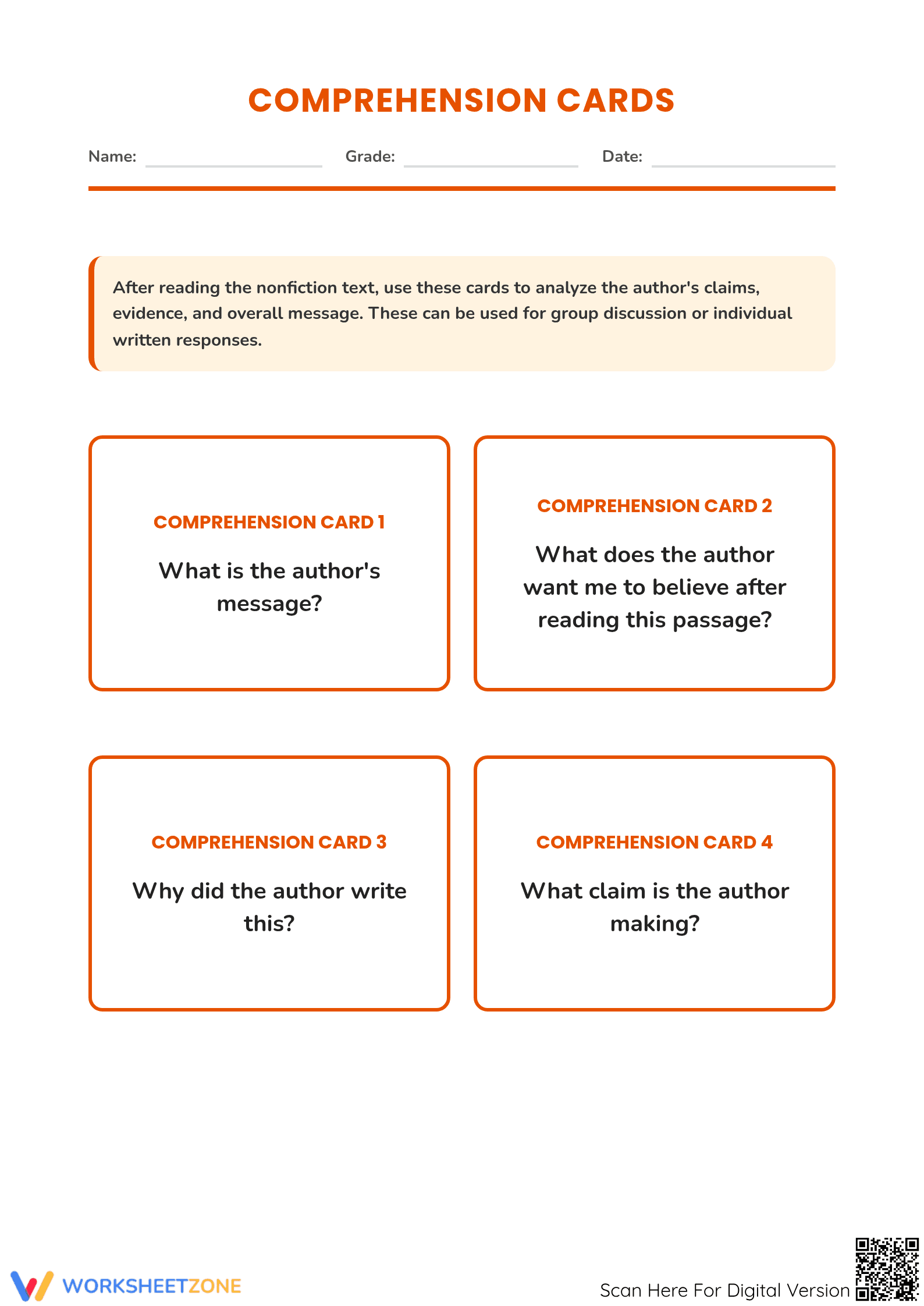
These printable comprehension cards help fifth-grade students master the critical skill of identifying an author's claims and evaluating supporting evidence in nonfiction texts. By providing targeted, open-ended prompts, this resource encourages deep analytical thinking and meaningful discussions about author's purpose and text structure.
At a Glance
- Grade: 5 · Subject: ELA
- Standard:
CCSS.ELA-LITERACY.RI.5.8— Explain how an author uses reasons and evidence to support points.- Skill Focus: Author's Claims and Evidence
- Format: 2 pages · 8 problems · No answer key · PDF
- Best For: Small group discussion
- Time: 20–30 minutes
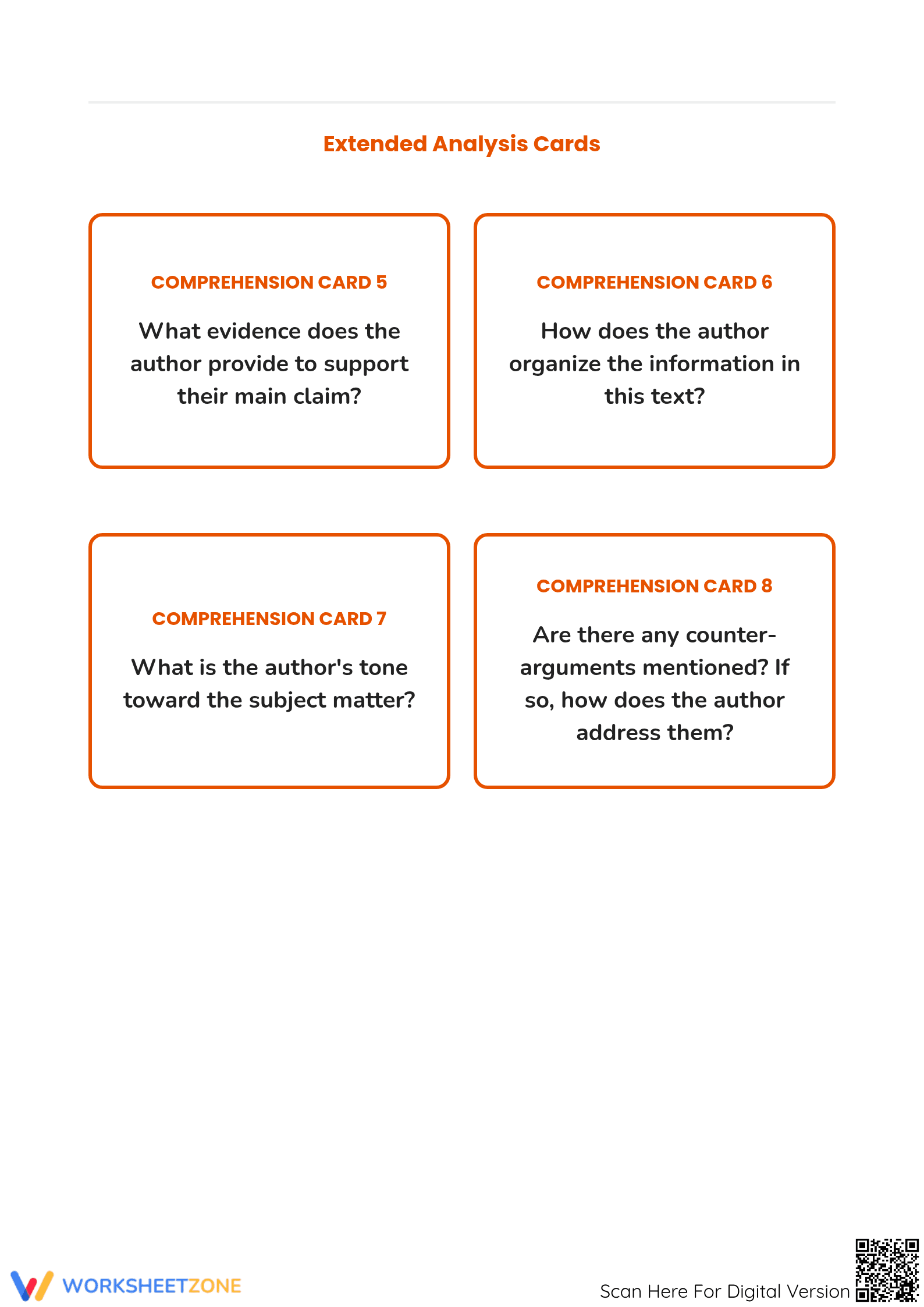
This two-page PDF includes eight comprehension cards to guide nonfiction text analysis. The first page features four foundational questions on the author's message and primary claims. The second page offers four extended analysis cards prompting students to identify supporting evidence, analyze organization, and evaluate tone. These cards are formatted for easy printing and cutting.
- Guided practice: Introduce the first four cards during whole-class instruction, modeling how to identify the author's main message and primary claims using a shared text.
- Supported practice: Transition to small groups where students use the extended analysis cards to locate specific evidence and discuss text organization collaboratively.
- Independent practice: Assign individual cards as written response prompts for independent reading or homework assignments.
This gradual-release approach ensures students build confidence analyzing nonfiction texts.
This resource is strictly aligned to CCSS.ELA-LITERACY.RI.5.8: "Explain how an author uses reasons and evidence to support particular points in a text, identifying which reasons and evidence support which point(s)." It also supports Grade 4 standards for identifying reasons and evidence. Both standard codes can be copied directly into lesson plans, IEP goals, or district curriculum mapping tools.
Use these cards during guided reading groups by assigning one prompt to each student to focus their reading of a new article. Alternatively, place them in a literacy center for independent written responses. As a formative assessment tip, listen to student discussions during small group work to gauge their ability to distinguish between a claim and evidence. Expect students to spend 20 to 30 minutes completing a thorough analysis.
This resource is ideal for fifth-grade general education students, as well as fourth graders needing enrichment or sixth graders requiring review. For differentiation, teachers can assign the foundational cards to students who need more scaffolding, while challenging advanced learners with the extended analysis cards focusing on tone and counter-arguments. These cards pair perfectly with any high-interest nonfiction passage or a direct instruction lesson on persuasive writing.
Mastering the ability to evaluate informational text is a cornerstone of modern literacy instruction. This resource directly addresses CCSS.ELA-LITERACY.RI.5.8, helping students explain how an author uses reasons and evidence to support points. According to Fisher & Frey (2014), providing students with structured, text-dependent questions significantly increases their capacity for close reading and critical analysis. By utilizing these targeted comprehension cards, educators can facilitate deeper engagement with complex nonfiction texts. The open-ended nature of the prompts encourages students to move beyond simple recall, fostering the analytical skills necessary for academic success across all subject areas. Regular practice with identifying claims and evaluating supporting evidence builds a strong foundation for both reading comprehension and persuasive writing, ensuring students are well-prepared for advanced academic challenges and rigorous assessments.


